
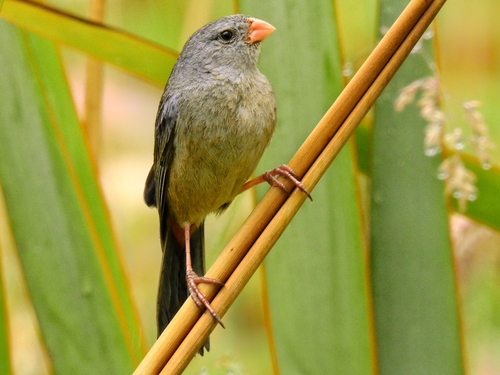
Blue-winged Mountain-Tanager

Blue-winged Mountain-Tanager

Anisognathus somptuosus

Silhouette: Sheatherius · PhyloPic

LCLeast ConcernNTVUENCR
Daily sighting probability ~10% · With luck
at Los Nevados National Natural Park

In 3 days ~20% in a week ~50%

427 Verified sightings at Los Nevados National Natural Park From 2019 to 2026
1,644 In all 5 parks
March Best month
☀️ Diurnal When it's spotted

About the Blue-winged Mountain-Tanager

The blue-winged mountain tanager (Anisognathus somptuosus) is a species of bird in the family Thraupidae, the tanagers. It is found in highland forest and woodland in the Andes of Bolivia, Colombia, Ecuador, Peru and Venezuela, as well as a disjunct population in the Venezuelan Coastal Range. It is a common species and its populations appear to be stable. It is generally bright yellow and black with blue to the wings and tail; some populations have a moss-green back. In Bolivia and southernmost Peru, the rump is blue and the voice is very different; this population is sometimes recognized as a separate species, the Bolivian mountain tanager (A. flavinucha). Wikipedia →

Sounds

Call0:29

Ecuador · 2021

© Manuel Sánchez-Nivicela · XC1143638 · CC BY-NC-ND 4.0

Song1:10

Bolivia · 2021

© Jacob Wijpkema · XC630668 · CC BY-NC-SA 4.0

Dawn song0:15

Colombia · 1996

© Paul Coopmans · XC264832 · CC BY-NC-SA 4.0

Global Distribution

Parks Where Found

# Park Country Daily sighting probability
1 Farallones de Cali National Natural Park 🇨🇴 Colombia
~30%
2 Henri Pittier National Park 🇻🇪 Venezuela
~20%
3 Los Nevados National Natural Park 🇨🇴 Colombia
~10%
4 Podocarpus National Park 🇪🇨 Ecuador
<5%
5 Chingaza National Natural Park 🇨🇴 Colombia
<5%

Cities Where Found

# City Country Daily sighting probability
1 Medellín 🇨🇴 Colombia
<5%

Zoos & Centres Where Found

# Zoo / Centre Country
1 Dallas World Aquarium 🇺🇸 United States In captivity

Before you go

What are the chances of seeing a Blue-winged Mountain-Tanager in Los Nevados National Natural Park?

With luck

About 10% of wildlife watchers report a Blue-winged Mountain-Tanager sighting in Los Nevados National Natural Park on a given day, based on 427 verified sightings from GBIF citizen-science data from 2019 to 2026. It is the 108th most-seen of the 424 birds we can rate there. Over three days the chance rises to about 20%, and over a week to about 50%, if each day is a fresh chance.

When is the best time to see a Blue-winged Mountain-Tanager in Los Nevados National Natural Park?

December to October

In those months about 10% of wildlife watchers report a Blue-winged Mountain-Tanager in Los Nevados National Natural Park on a given day, against under 5% in November, the lowest month.

What time of day is best to see a Blue-winged Mountain-Tanager?

Between 8 and 11 am

Across all the parks we cover, that three-hour window holds the most Blue-winged Mountain-Tanager sightings with a recorded time, and about 9 in 10 of them come between 6 am and 6 pm: it is a daytime animal.

Is Los Nevados National Natural Park the best place to see a Blue-winged Mountain-Tanager?

3rd of 5

Of the 5 parks where we can rate Blue-winged Mountain-Tanager sightings, Los Nevados National Natural Park ranks 3rd at about 10%. The best odds are in Farallones de Cali National Natural Park (Colombia, about 30%) and Henri Pittier National Park (Venezuela, about 20%).

Which relatives of the Blue-winged Mountain-Tanager live in Los Nevados National Natural Park?

Same genus: Anisognathus

The closest relatives of the Blue-winged Mountain-Tanager that you can see in Los Nevados National Natural Park (genus Anisognathus, Typical Mountain-Tanagers) are Lacrimose Mountain-Tanager (about 50%) and Scarlet-bellied Mountain-Tanager (about 50%), with each one's daily chance of a sighting.

Where does the Blue-winged Mountain-Tanager sighting chance come from?

GBIF citizen-science records

It is estimated from how often the Blue-winged Mountain-Tanager is recorded against all the birds logged in Los Nevados National Natural Park (427 verified sightings from 2019 to 2026), calibrated against known sighting rates. Figures are rounded to the nearest 10% because citizen-science data supports honest approximations, not decimals, and months with records from fewer than five people show "—". How it works.

← Back to Los Nevados National Natural Park