Russet-crowned Warbler

Russet-crowned Warbler

Myiothlypis coronata

Silhouette: Andy Wilson · PhyloPic

LCLeast ConcernNTVUENCR
Daily sighting probability ~10% · With luck
at Los Nevados National Natural Park

In 3 days ~30% in a week ~60%

615 Verified sightings at Los Nevados National Natural Park From 2019 to 2026
1,245 In all 4 parks
October Best month
☀️ Diurnal When it's spotted

About the Russet-crowned Warbler

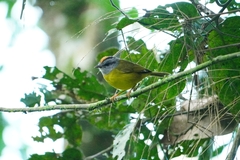
The russet-crowned warbler (Myiothlypis coronata) is a species of bird in the family Parulidae, the New World warblers. It is found in Bolivia, Colombia, Ecuador, Peru, and Venezuela. The russet-crowned warbler was formally described in 1844 with the binomial Myiodioctes coronatus. By the 1920s it had been reassigned to genus Basileuterus. By 2007 taxonomic systems had begun to resurrect genus Myiothlypis, which had been erected in 1850, for the russet-crowned warbler and many other species.

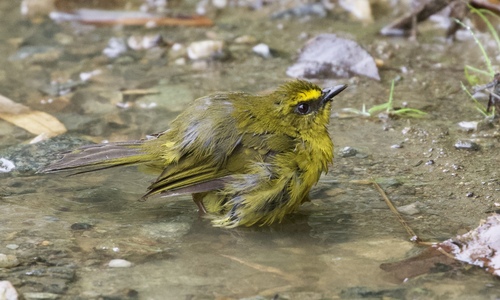
The russet-crowned warbler has these eight subspecies: The russet-crowned warbler is about 14 cm (5.5 in) long and weighs 13.5 to 19.5 g (0.48 to 0.69 oz). The sexes have the same plumage. Adults of the nominate subspecies M. c. coronata have a mostly gray head with an orange-rufous crown stripe with black borders, a long thin black stripe through the eye, and a grayish white throat. Their upperparts, wings, and tail are olive-green with a slight bronze tinge on the upperparts. Their underparts are yellow. Juveniles have an olive-brown head, upperparts, and breast. Their median and greater wing coverts have cinnamon tips that show as two faint wing... Wikipedia →

Sounds

Call0:18

Ecuador · 2025

© Scott Olmstead · XC1018372 · CC BY-NC-SA 4.0

Song0:19

Ecuador · 2025

© Marc Anderson · XC1000611 · CC BY-NC-ND 4.0

Duet0:31

Ecuador · 2016

© rudy gelis · XC827872 · CC BY-NC-SA 4.0

Global Distribution

Parks Where Found

# Park Country Daily sighting probability
1 Podocarpus National Park 🇪🇨 Ecuador
~30%
2 Los Nevados National Natural Park 🇨🇴 Colombia
~10%
3 Farallones de Cali National Natural Park 🇨🇴 Colombia
~10%
4 Chingaza National Natural Park 🇨🇴 Colombia
<5%

Cities Where Found

# City Country Daily sighting probability
1 Quito 🇪🇨 Ecuador
<5%

Before you go

What are the chances of seeing a Russet-crowned Warbler in Los Nevados National Natural Park?

With luck

About 10% of wildlife watchers report a Russet-crowned Warbler sighting in Los Nevados National Natural Park on a given day, based on 615 verified sightings from GBIF citizen-science data from 2019 to 2026. It is the 78th most-seen of the 424 birds we can rate there. Over three days the chance rises to about 30%, and over a week to about 60%, if each day is a fresh chance.

When is the best time to see a Russet-crowned Warbler in Los Nevados National Natural Park?

April, August and October–December

In those months about 20% of wildlife watchers report a Russet-crowned Warbler in Los Nevados National Natural Park on a given day, against about 10% in January–March, May–July and September, the lowest months.

What time of day is best to see a Russet-crowned Warbler?

Between 6 and 9 am

Across all the parks we cover, that three-hour window holds the most Russet-crowned Warbler sightings with a recorded time, and about 9 in 10 of them come between 6 am and 6 pm: it is a daytime animal.

Is Los Nevados National Natural Park the best place to see a Russet-crowned Warbler?

2nd of 4

Of the 4 parks where we can rate Russet-crowned Warbler sightings, Los Nevados National Natural Park ranks 2nd at about 10%. The best odds are in Podocarpus National Park (Ecuador, about 30%).

Where does the Russet-crowned Warbler sighting chance come from?

GBIF citizen-science records

It is estimated from how often the Russet-crowned Warbler is recorded against all the birds logged in Los Nevados National Natural Park (615 verified sightings from 2019 to 2026), calibrated against known sighting rates. Figures are rounded to the nearest 10% because citizen-science data supports honest approximations, not decimals, and months with records from fewer than five people show "—". How it works.

← Back to Los Nevados National Natural Park