Whooping Motmot

Whooping Motmot

Momotus subrufescens

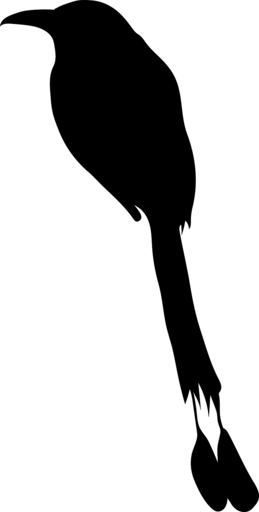
Silhouette: Sofía Terán Sánchez · PhyloPic

LCLeast ConcernNTVUENCR
Daily sighting probability ~20% · Possible
at Machalilla National Park

In 3 days ~40% in a week ~70%

161 Verified sightings at Machalilla National Park From 2019 to 2026
4,985 In all 6 parks
April Best month
☀️ Diurnal When it's spotted

About the Whooping Motmot

The whooping motmot (Momotus subrufescens) is a colorful near-passerine bird in the family Momotidae. It is found in Colombia, Ecuador, Panama, Peru, and Venezuela. The whooping motmot and the blue-capped (Momotus coeruleiceps), Trinidad (M. bahamensis), Amazonian (M. momota), Lesson's (M. lessonii), and Andean motmots (M. aequatorialis) were at one time all considered conspecific. They were split following a 2009 publication which detailed their differences.

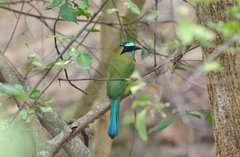
The whooping motmot's back and wings are olive-green and the underparts dull brown. It has a long, green to blue, tail that has extended feathers with racquet tips that are blue tipped with black. Its crown is black surrounded by a blue band, and it has a black eyemask bordered with turquoise. Twenty-seven specimens of the nominate whooping motmot weighed 75 to 124 g (2.6 to 4.4 oz).

The whooping motmot has two disjunct populations. The nominate subspecies is found from eastern Panama to northern and... Wikipedia →

Sounds

Call0:48

Panama · 2024

© Scott Olmstead · XC957519 · CC BY-NC-SA 4.0

Song0:30

Colombia · 2020

© Jerome Fischer · XC544556 · CC BY-NC-SA 4.0

Alarm call0:08

Ecuador · 1991

© Niels Krabbe · XC238637 · CC BY-NC-SA 3.0

Global Distribution

Parks Where Found

# Park Country Daily sighting probability
1 Soberanía National Park 🇵🇦 Panama
~30%
2 Tayrona National Natural Park 🇨🇴 Colombia
~20%
3 Machalilla National Park 🇪🇨 Ecuador
~20%
4 Darién National Park 🇵🇦 Panama
~10%
5 Parque Natural Metropolitano 🇵🇦 Panama
~10%
6 Chagres National Park 🇵🇦 Panama
<5%

Cities Where Found

# City Country Daily sighting probability
1 Guayaquil 🇪🇨 Ecuador
~10%
2 Panama City 🇵🇦 Panama
<5%

Zoos & Centres Where Found

# Zoo / Centre Country
1 Bronx Zoo 🇺🇸 United States In captivity
2 Jacksonville Zoo and Gardens 🇺🇸 United States In captivity
3 Moody Gardens 🇺🇸 United States In captivity
4 Aviario Nacional de Colombia 🇨🇴 Colombia In captivity
5 Topeka Zoo 🇺🇸 United States In captivity

Before you go

What are the chances of seeing a Whooping Motmot in Machalilla National Park?

Possible

About 20% of wildlife watchers report a Whooping Motmot sighting in Machalilla National Park on a given day, based on 161 verified sightings from GBIF citizen-science data from 2019 to 2026. It is the 56th most-seen of the 248 birds we can rate there. Over three days the chance rises to about 40%, and over a week to about 70%, if each day is a fresh chance.

When is the best time to see a Whooping Motmot in Machalilla National Park?

March–April and December

In those months about 30% of wildlife watchers report a Whooping Motmot in Machalilla National Park on a given day, against about 10% in May to November, the lowest months. Those are among Machalilla National Park's wettest months, with about 75 mm of rain a month against 5 mm in September.

What time of day is best to see a Whooping Motmot?

Between 8 and 11 am

Across all the parks we cover, that three-hour window holds the most Whooping Motmot sightings with a recorded time, and about 8 in 10 of them come between 6 am and 6 pm: it is a daytime animal.

Is Machalilla National Park the best place to see a Whooping Motmot?

3rd of 6

Of the 6 parks where we can rate Whooping Motmot sightings, Machalilla National Park ranks 3rd at about 20%. The best odds are in Soberanía National Park (Panama, about 30%) and Tayrona National Natural Park (Colombia, about 20%).

Where does the Whooping Motmot sighting chance come from?

GBIF citizen-science records

It is estimated from how often the Whooping Motmot is recorded against all the birds logged in Machalilla National Park (161 verified sightings from 2019 to 2026), calibrated against known sighting rates. Figures are rounded to the nearest 10% because citizen-science data supports honest approximations, not decimals, and months with records from fewer than five people show "—". How it works.

← Back to Machalilla National Park