Black-backed Forktail

Black-backed Forktail

Enicurus immaculatus

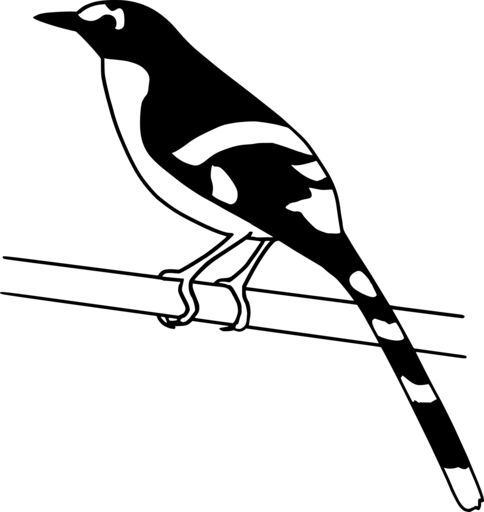
Silhouette: Andy Wilson · PhyloPic

LCLeast ConcernNTVUENCR
Daily sighting probability <5% · Rare
at Manas National Park

In 3 days ~10% in a week ~30%

62 Verified sightings at Manas National Park From 2019 to 2026
679 In all 6 parks
January Best month
☀️ Diurnal When it's spotted

About the Black-backed Forktail

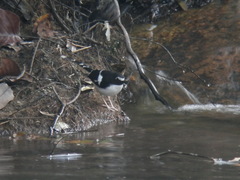
The black-backed forktail (Enicurus immaculatus), occasionally referred to as the black-throated forktail, is a forktail species in the family Muscicapidae. The species was described in 1836, from a specimen collected in Nepal. It is a medium-sized forktail, weighing between 25 and 29 grams, with a length of 20.5 to 23 centimetres (8+1⁄8 to 9 in). The species has a broad white stripe across its forehead. The crown, face, and mantle are black, while the bird's underparts are white, sharply divided from the black above. The wings are largely black with a broad white stripe across the greater coverts. The tail of the species, similar to that of other forktails, is long, graduated, and deeply forked. The tail is black with a white tip and three white bands created by shorter tail feathers. The beak of the bird is black, while the feet and legs are light pink, and the iris is brown. The species is monomorphic.

The black backed forktail is solitary, but is occasionally found in pairs or in family groups. It is described as a shy species. The bird breeds between March and June, building a nest of plant matter in holes or crevices in rocks and dead trees. Three eggs are generally laid, which are pink and spotted with red-brown. Both sexes build the nest and incubate the eggs. The species frequents fast-flowing rivers and streams in temperate forests and subtropical or tropical moist lowland forests. It is found in the Indian subcontinent and in some adjoining regions of Southeast Asia. It ranges across Bangladesh, Bhutan, India, Myanmar, Nepal and Thailand. It is generally found below 1,450 metres (4,760 ft) above sea level, but has been recorded as high as 2,600 metres (8,530 ft). Its precise range and population are unknown. It is classified as a species of Least Concern by the International Union for Conservation of Nature. Wikipedia →

Sounds

Call0:26

India · 2024

© Lars Lachmann · XC892904 · CC BY-NC-SA 4.0

Recording0:09

Bhutan · 2020

© Langur Eco Travels, bhutanbiridngtours.com · XC613155 · CC BY-NC-SA 4.0

Song0:35

India · 2012

© Mike Nelson · XC116354 · CC BY-NC-SA 3.0

Global Distribution

Parks Where Found

# Park Country Daily sighting probability
1 Namdapha National Park 🇮🇳 India
~10%
2 Doi Inthanon National Park 🇹🇭 Thailand
~10%
3 Royal Manas National Park 🇧🇹 Bhutan
~10%
4 Chitwan National Park 🇳🇵 Nepal
~10%
5 Manas National Park 🇮🇳 India
<5%
6 Kaziranga National Park 🇮🇳 India
<5%

Cities Where Found

# City Country Daily sighting probability
1 Kathmandu 🇳🇵 Nepal
<5%

Before you go

What are the chances of seeing a Black-backed Forktail in Manas National Park?

Rare

Under 5% of wildlife watchers report a Black-backed Forktail sighting in Manas National Park on a given day, based on 62 verified sightings from GBIF citizen-science data from 2019 to 2026. It is the 219th most-seen of the 377 birds we can rate there. Over three days the chance rises to about 10%, and over a week to about 30%, if each day is a fresh chance.

When is the best time to see a Black-backed Forktail in Manas National Park?

December to February

In those months about 10% of wildlife watchers report a Black-backed Forktail in Manas National Park on a given day, against under 5% in March to November, the lowest months. Those are among Manas National Park's driest months, with about 20 mm of rain a month against 1070 mm in June.

What time of day is best to see a Black-backed Forktail?

Between 2 and 5 pm

Across all the parks we cover, that three-hour window holds the most Black-backed Forktail sightings with a recorded time, and about 8 in 10 of them come between 6 am and 6 pm: it is a daytime animal.

Where does the Black-backed Forktail sighting chance come from?

GBIF citizen-science records

It is estimated from how often the Black-backed Forktail is recorded against all the birds logged in Manas National Park (62 verified sightings from 2019 to 2026), calibrated against known sighting rates. Figures are rounded to the nearest 10% because citizen-science data supports honest approximations, not decimals, and months with records from fewer than five people show "—". How it works.

← Back to Manas National Park