Chestnut-eared Bunting

Chestnut-eared Bunting

Emberiza fucata

Silhouette: L. Shyamal · PhyloPic

LCLeast ConcernNTVUENCR
Daily sighting probability <5% · Rare
at Manas National Park

In 3 days ~10%

30 Verified sightings at Manas National Park From 2019 to 2026
158 In all 3 parks
January Best month
☀️ Diurnal When it's spotted

About the Chestnut-eared Bunting

The chestnut-eared bunting (Emberiza fucata), also called grey-headed bunting or grey-hooded bunting, with the latter name also used for grey-necked bunting, is a passerine bird in the bunting family Emberizidae. The genus name Emberiza is from Old German Embritz, a bunting. The specific fucata is Latin for "painted" from fucare, "to paint red".

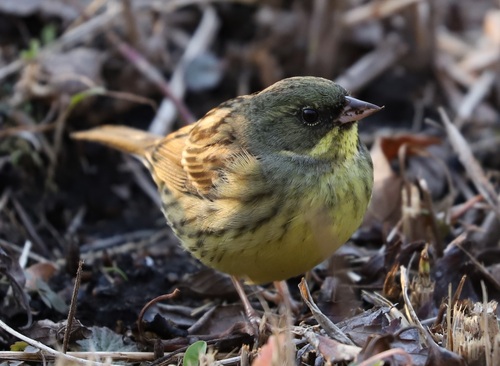
It is 15 to 16 cm in length. The plumage is mostly brown with dark streaks. The male has a grey crown and nape with dark streaks, chestnut ear-coverts and bands of black and chestnut across the breast. There is a rufous patch on the shoulders and the rump is also rufous. Females are similar to the males but duller with a less distinct head and breast pattern. First-winter birds are plainer but show warm brown ear-coverts and have an obvious ring around the eye.

Its voice is similar to the rustic bunting but quieter. The song is a rapid twittering which begins with staccato notes and then accelerates before ending with a distinctive two or three note phrase. The call is an explosive pzick.

The breeding range extends from the Himalayas locally across China to south-eastern Siberia, Korea and northern... Wikipedia →

Sounds

Song0:19

China · 2023

© Bo Shunqi 薄顺奇 · XC805186 · CC BY-NC-SA 4.0

Alarm call0:30

Russian Federation · 2016

© Tom Wulf · XC405229 · CC BY-NC-SA 4.0

Call0:23

Japan · 2015

© Peter Boesman · XC285716 · CC BY-NC-ND 4.0

Global Distribution

Parks Where Found

# Park Country Daily sighting probability
1 Nikko National Park 🇯🇵 Japan
~20%
2 Manas National Park 🇮🇳 India
<5%
3 Jim Corbett National Park 🇮🇳 India
<5%

Cities Where Found

# City Country Daily sighting probability
1 Quanzhou 🇨🇳 China
~30%
2 Kitakyushu 🇯🇵 Japan
~10%
3 Kolkata 🇮🇳 India
<5%
4 Srinagar 🇮🇳 India
<5%
5 Nanjing 🇨🇳 China
<5%
6 Beijing 🇨🇳 China
<5%
7 Shanghai 🇨🇳 China
<5%
8 Hangzhou 🇨🇳 China
<5%
9 Taipei 🇹🇼 Taiwan
<5%
10 Guangzhou 🇨🇳 China
<5%

Before you go

What are the chances of seeing a Chestnut-eared Bunting in Manas National Park?

Rare

Under 5% of wildlife watchers report a Chestnut-eared Bunting sighting in Manas National Park on a given day, based on 30 verified sightings from GBIF citizen-science data from 2019 to 2026. It is the 268th most-seen of the 377 birds we can rate there. Over three days the chance rises to about 10%, if each day is a fresh chance.

When is the best time to see a Chestnut-eared Bunting in Manas National Park?

January

In that month about 10% of wildlife watchers report a Chestnut-eared Bunting in Manas National Park on a given day, against under 5% in February to December, the lowest months. That is one of Manas National Park's driest months, with about 15 mm of rain against 1070 mm in June.

What time of day is best to see a Chestnut-eared Bunting?

Between 8 and 11 am

Across all the parks we cover, that three-hour window holds the most Chestnut-eared Bunting sightings with a recorded time, and about 9 in 10 of them come between 6 am and 6 pm: it is a daytime animal.

Is Manas National Park the best place to see a Chestnut-eared Bunting?

2nd of 3

Of the 3 parks where we can rate Chestnut-eared Bunting sightings, Manas National Park ranks 2nd at under 5%. The best odds are in Nikko National Park (Japan, about 20%).

Which relatives of the Chestnut-eared Bunting live in Manas National Park?

Same genus: Emberiza

The closest relatives of the Chestnut-eared Bunting that you can see in Manas National Park (genus Emberiza, Old World Buntings) are Crested Bunting (about 10%) and Little Bunting (about 10%), with each one's daily chance of a sighting.

Where does the Chestnut-eared Bunting sighting chance come from?

GBIF citizen-science records

It is estimated from how often the Chestnut-eared Bunting is recorded against all the birds logged in Manas National Park (30 verified sightings from 2019 to 2026), calibrated against known sighting rates. Figures are rounded to the nearest 10% because citizen-science data supports honest approximations, not decimals, and months with records from fewer than five people show "—". How it works.

← Back to Manas National Park