Crested Bunting

Crested Bunting

Emberiza lathami

Silhouette: L. Shyamal · PhyloPic

LCLeast ConcernNTVUENCR
Daily sighting probability ~10% · With luck
at Manas National Park

In 3 days ~30% in a week ~60%

169 Verified sightings at Manas National Park From 2019 to 2026
682 In all 8 parks
December Best month
🌅 Crepuscular When it's spotted

About the Crested Bunting

The crested bunting (Emberiza lathami) is a species of bird in the family Emberizidae. It is sparrow sized with males having rufous wings and tail on a black body and females being less contrastingly coloured in dull brown. Both males and females have the distinctive crest. The species was formerly placed in an monotypic genus Melophus on account of its crest, unique among the buntings. The species has a wide but scattered distribution in Asia. They are found in mostly open and dry habitats over a range of altitudes. Populations in the higher elevations of the Himalayas show seasonal altitudinal movements. They are more gregarious in winter.

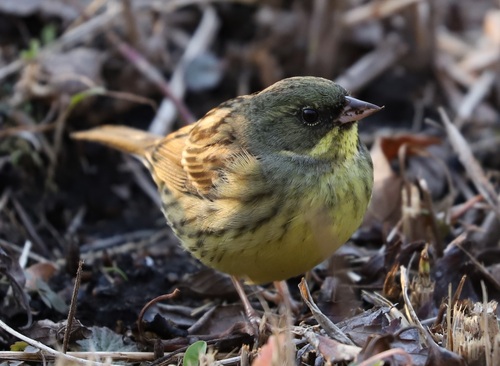
Males have a prominent crest, yellowish beak, black body plumage contrasting with the rufous flight feathers of the wing and tail. Females are shorter crested and have an overall dull-olive brown colour with dark brown streaks. The wing and tail feathers are fringed in cinnamon. Females have a grey beak. Non-breeding males are buffish grey and subadults have black tips to the rufous primary coverts.

The species was formerly placed in the monotypic genus Melophus but DNA sequence based phylogenies showed it to be nested within... Wikipedia →

Sounds

Song0:37

India · 2025

© Peter Boesman · XC1030565 · CC BY-NC-ND 4.0

Call0:36

India · 2014

© Pritam Baruah · XC177703 · CC BY-NC-SA 4.0

Song0:59

Laos · 2024

© Bram Piot · XC913421 · CC BY-NC-SA 4.0

Global Distribution

Parks Where Found

# Park Country Daily sighting probability
1 Ranthambore National Park 🇮🇳 India
~20%
2 Manas National Park 🇮🇳 India
~10%
3 Chitwan National Park 🇳🇵 Nepal
<5%
4 Jim Corbett National Park 🇮🇳 India
<5%
5 Royal Bardia National Park 🇳🇵 Nepal
<5%
6 Royal Manas National Park 🇧🇹 Bhutan
<5%
7 Satpura National Park 🇮🇳 India
<5%
8 Kanha National Park 🇮🇳 India
<5%

Cities Where Found

# City Country Daily sighting probability
1 Chhatrapati Sambhajinagar 🇮🇳 India
~10%
2 Jaipur 🇮🇳 India
<5%
3 Kota 🇮🇳 India
<5%
4 Jodhpur 🇮🇳 India
<5%
5 Nashik 🇮🇳 India
<5%
6 Bhopal 🇮🇳 India
<5%
7 Nagpur 🇮🇳 India
<5%
8 Pune 🇮🇳 India
<5%

Before you go

What are the chances of seeing a Crested Bunting in Manas National Park?

With luck

About 10% of wildlife watchers report a Crested Bunting sighting in Manas National Park on a given day, based on 169 verified sightings from GBIF citizen-science data from 2019 to 2026. It is the 135th most-seen of the 377 birds we can rate there. Over three days the chance rises to about 30%, and over a week to about 60%, if each day is a fresh chance.

When is the best time to see a Crested Bunting in Manas National Park?

December

In that month about 30% of wildlife watchers report a Crested Bunting in Manas National Park on a given day, against under 5% in April–June and September–October, the lowest months. That is one of Manas National Park's driest months, with about 10 mm of rain against 1070 mm in June.

What time of day is best to see a Crested Bunting?

Between 3 and 6 am

Across all the parks we cover, that three-hour window holds the most Crested Bunting sightings with a recorded time, and about 6 in 10 of them come between 6 am and 6 pm: it is most active around dawn and dusk.

Is Manas National Park the best place to see a Crested Bunting?

2nd of 8

Of the 8 parks where we can rate Crested Bunting sightings, Manas National Park ranks 2nd at about 10%. The best odds are in Ranthambore National Park (India, about 20%).

Where does the Crested Bunting sighting chance come from?

GBIF citizen-science records

It is estimated from how often the Crested Bunting is recorded against all the birds logged in Manas National Park (169 verified sightings from 2019 to 2026), calibrated against known sighting rates. Figures are rounded to the nearest 10% because citizen-science data supports honest approximations, not decimals, and months with records from fewer than five people show "—". How it works.

← Back to Manas National Park