Gayal

Gayal

Bos frontalis

Silhouette: Cristopher Silva · PhyloPic

Daily sighting probability ~40% · Likely
at Manas National Park

In 3 days ~70% in a week >90%

20 Verified sightings at Manas National Park From 2019 to 2026
811 In all 15 parks
December Best month
☀️ Diurnal When it's spotted

About the Gayal

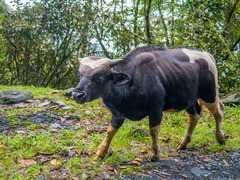
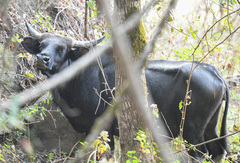
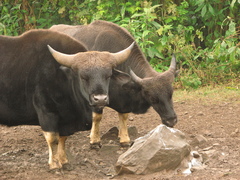
The gayal (Bos frontalis), also known as mithun or Drung ox, is a large semi-domesticated cattle in the Himalayan foothills of Indian Subcontinent and primarily in Northeast India. In his first description of 1804, Aylmer Bourke Lambert applied the binomial Bos frontalis to a domestic specimen probably from Chittagong.

In 2003, the International Commission on Zoological Nomenclature fixed the first available specific name based on a wild population that the name for this wild species is valid by virtue of its being antedated by a name based on a domestic form. Most authors have adopted the binomial Bos frontalis for the domestic species as valid for the taxon.

Phylogenetic analysis corroborates the taxonomic assessment that the gayal is an independent Bos species originating matrilineally from gaur, zebu and taurine cattle. There are two major hypotheses on the origin of the gayal:

It was domesticated from wild gaur; It is a hybrid descendant from crossing of wild gaur and domestic cattle, either Bos indicus or Bos taurus. Analysis of the genome of the gayal was published in 2017. In 2020, a phylogenetic analysis using complete mitochondrial genome sequences unambiguously... Wikipedia →

Global Distribution

Parks Where Found

# Park Country Daily sighting probability
1 Kanha National Park 🇮🇳 India
~70%
2 Nagarhole National Park 🇮🇳 India
~70%
3 Bandipur National Park 🇮🇳 India
~70%
4 Periyar National Park 🇮🇳 India
~70%
5 Bandhavgarh National Park 🇮🇳 India
~60%
6 Satpura National Park 🇮🇳 India
~60%
7 Eravikulam National Park 🇮🇳 India
~40%
8 Mudumalai National Park 🇮🇳 India
~40%
9 Khao Yai National Park 🇹🇭 Thailand
~40%
10 Manas National Park 🇮🇳 India
~40%
11 Chitwan National Park 🇳🇵 Nepal
~30%
12 Khao Sok National Park 🇹🇭 Thailand
~30%
13 Cat Tien National Park 🇻🇳 Vietnam
~30%
14 Royal Manas National Park 🇧🇹 Bhutan
~20%
15 Kaeng Krachan National Park 🇹🇭 Thailand
~20%

Zoos & Centres Where Found

# Zoo / Centre Country
1 Tierpark Berlin 🇩🇪 Germany In captivity
2 Hlawga National Park 🇲🇲 Myanmar (Burma) In captivity
3 Kyiv Zoo 🇺🇦 Ukraine In captivity
4 Thrissur Zoo 🇮🇳 India In captivity

Before you go

What are the chances of seeing a Gayal in Manas National Park?

Likely

About 40% of wildlife watchers report a Gayal sighting in Manas National Park on a given day, based on 20 verified sightings from GBIF citizen-science data from 2019 to 2026. It is the 9th most-seen of the 14 mammals we can rate there. Over three days the chance rises to about 70%, and over a week to over 90%, if each day is a fresh chance.

When is the best time to see a Gayal in Manas National Park?

December

In that month about 50% of wildlife watchers report a Gayal in Manas National Park on a given day, against about 10% in November, the lowest month. That is one of Manas National Park's driest months, with about 10 mm of rain against 1070 mm in June. July to September have too few records to rate.

What time of day is best to see a Gayal?

Between 11 am and 2 pm

Across all the parks we cover, that three-hour window holds the most Gayal sightings with a recorded time, and about 7 in 10 of them come between 6 am and 6 pm: it is a daytime animal.

Where does the Gayal sighting chance come from?

GBIF citizen-science records

It is estimated from how often the Gayal is recorded against all the mammals logged in Manas National Park (20 verified sightings from 2019 to 2026), calibrated against known sighting rates. Figures are rounded to the nearest 10% because citizen-science data supports honest approximations, not decimals, and months with records from fewer than five people show "—". How it works.

← Back to Manas National Park