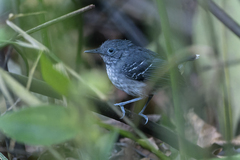
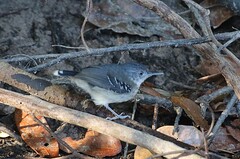

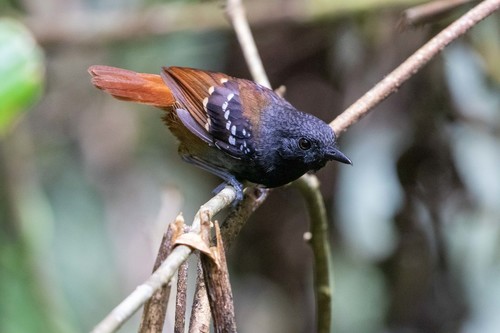
Band-tailed Antbird

Band-tailed Antbird

Hypocnemoides maculicauda

Silhouette: Sheatherius · PhyloPic

LCLeast ConcernNTVUENCR
Daily sighting probability <5% · Rare
at Manu National Park

In 3 days ~10%

73 Verified sightings at Manu National Park From 2019 to 2026
258 In all 4 parks
July Best month
☀️ Diurnal When it's spotted

About the Band-tailed Antbird

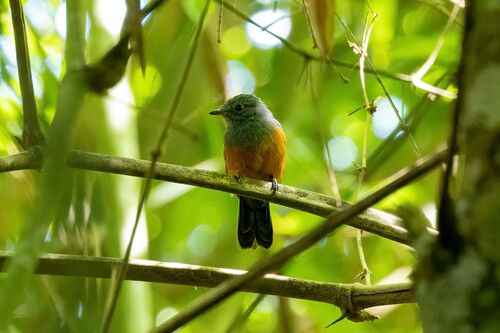
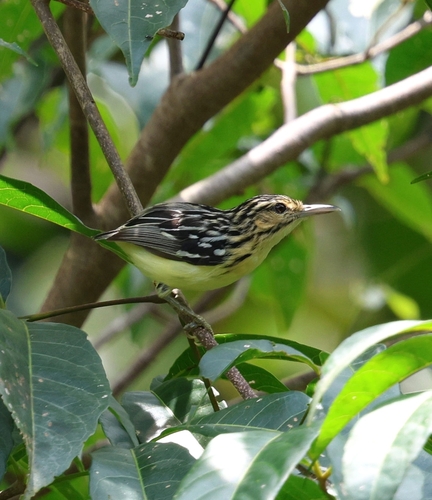
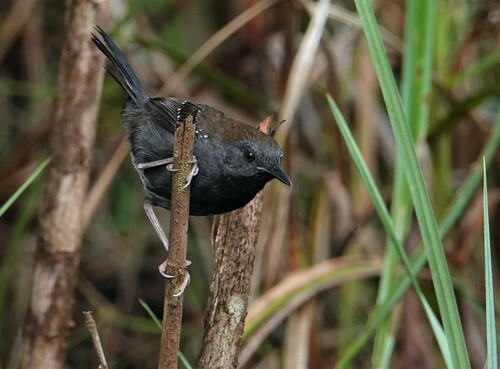
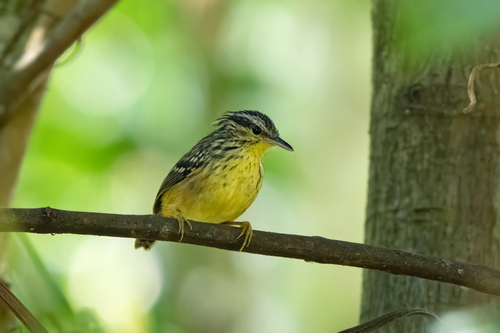
The band-tailed antbird (Hypocnemoides maculicauda) is a species of bird in subfamily Thamnophilinae of family Thamnophilidae, the "typical antbirds". It is found in Bolivia, Brazil, Colombia, and Peru. The band-tailed antbird was described by the Austrian ornithologist August von Pelzeln in 1868 and given the binomial name Hypocnemis maculicauda.; it was later transferred to genus Hypocnemoides. It shares that genus with the black-chinned antbird (H. melanopogon). However, some authors have said that the "[r]easons for treatment of Hypocnemoides maculicauda as a separate species from H. melanopogon are weak".

The band-tailed antbird is monotypic. One ornithologist proposed that the eastern population be treated as a subspecies H. m. orientalis but later work discounted that treatment. The band-tailed antbird is about 12 cm (4.7 in) long and weighs 11.5 to 14.5 g (0.41 to 0.51 oz). Adult males have leaden gray upperparts with a large but usually hidden white patch between their scapulars. Their tail is slate gray with wide white feather tips. Their flight feathers are leaden gray with lighter gray edges and their wing coverts are black... Wikipedia →

Sounds

Call0:57

Brazil · 2026

© JAYRSON ARAUJO DE OLIVEIRA · XC1162216 · CC BY-NC-SA 4.0

Subsong0:19

Bolivia · 2021

© Jacob Wijpkema · XC675039 · CC BY-NC-SA 4.0

Song0:30

Brazil · 2020

© Jerome Fischer · XC592312 · CC BY-NC-SA 4.0

Global Distribution

Parks Where Found

# Park Country Daily sighting probability
1 Parque Estadual Encontro das Águas 🇧🇷 Brazil
<5%
2 Tambopata National Reserve 🇵🇪 Peru
<5%
3 Manu National Park 🇵🇪 Peru
<5%
4 Amacayacu National Natural Park 🇨🇴 Colombia
<5%

Before you go

What are the chances of seeing a Band-tailed Antbird in Manu National Park?

Rare

Under 5% of wildlife watchers report a Band-tailed Antbird sighting in Manu National Park on a given day, based on 73 verified sightings from GBIF citizen-science data from 2019 to 2026. It is the 415th most-seen of the 641 birds we can rate there. Over three days the chance rises to about 10%, if each day is a fresh chance.

When is the best time to see a Band-tailed Antbird in Manu National Park?

Any time of year

In every month with enough records, under 5% of wildlife watchers report a Band-tailed Antbird in Manu National Park on a given day, so our monthly data shows no clear season.

What time of day is best to see a Band-tailed Antbird?

Between 7 and 10 am

Across all the parks we cover, that three-hour window holds the most Band-tailed Antbird sightings with a recorded time, and about 9 in 10 of them come between 6 am and 6 pm: it is a daytime animal.

Is Manu National Park the best place to see a Band-tailed Antbird?

Among the best

Of the 4 parks where we can rate Band-tailed Antbird sightings, Manu National Park ranks 3rd at under 5%, level with the leaders once rounded. The best odds are in Parque Estadual Encontro das Águas (Brazil, under 5%) and Tambopata National Reserve (Peru, under 5%).

Which relatives of the Band-tailed Antbird live in Manu National Park?

Same family: Thamnophilidae

The closest relatives of the Band-tailed Antbird that you can see in Manu National Park (family Thamnophilidae, Typical Antbirds) are Plain-winged Antshrike (about 20%), White-browed Antbird (about 20%) and White-lined Antbird (about 20%), with each one's daily chance of a sighting.

Where does the Band-tailed Antbird sighting chance come from?

GBIF citizen-science records

It is estimated from how often the Band-tailed Antbird is recorded against all the birds logged in Manu National Park (73 verified sightings from 2019 to 2026), calibrated against known sighting rates. Figures are rounded to the nearest 10% because citizen-science data supports honest approximations, not decimals, and months with records from fewer than five people show "—". How it works.

← Back to Manu National Park