
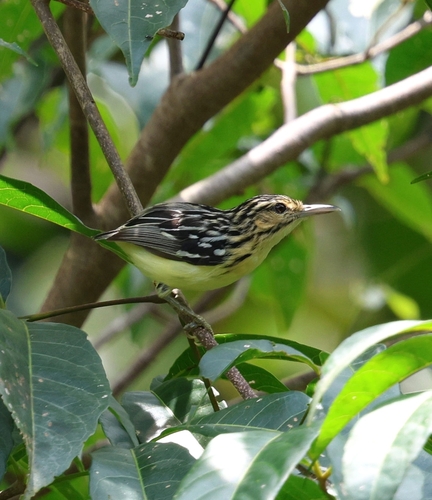
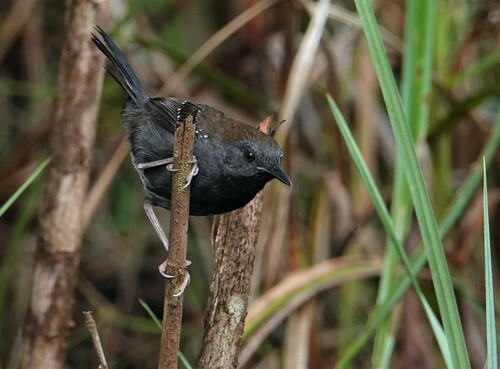
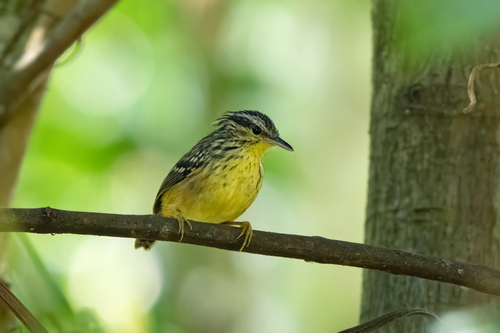
Banded Antbird

Banded Antbird

Dichrozona cincta

Silhouette: Sheatherius · PhyloPic

LCLeast ConcernNTVUENCR
Daily sighting probability <5% · Rare
at Manu National Park

In 3 days <5%

19 Verified sightings at Manu National Park From 2019 to 2026
115 In all 3 parks
January Best month
☀️ Diurnal When it's spotted

About the Banded Antbird

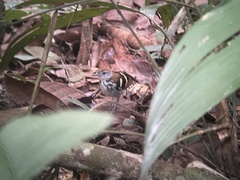
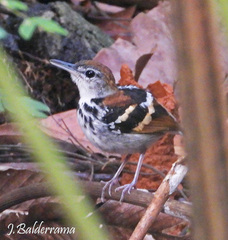
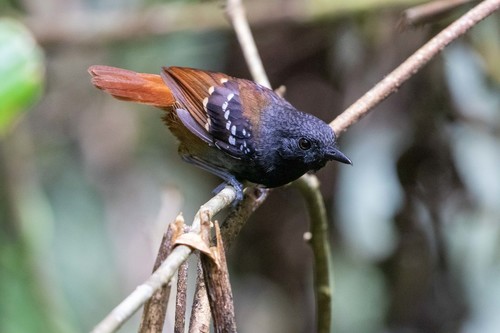
The banded antbird (Dichrozona cincta) – sometimes called banded antwren despite not being close to the true antwrens – is a species of bird in subfamily Thamnophilinae of family Thamnophilidae, the "typical antbirds". It is found in Bolivia, Brazil, Colombia, Ecuador, Peru, and Venezuela.

The banded antbird was described by the Austrian ornithologist August von Pelzeln in 1868 and given the scientific name Cyphorhinus (Microcerculus) cinctus. The present genus Dichrozona was erected by the American ornithologist Robert Ridgway in 1888.

The banded antbird has had many scientific names between its first description and the present, and its taxonomy remains unsettled. The Clements taxonomy and BirdLife International's Handbook of the Birds of the World treat it as monotypic. All agree that it is the only member of genus Dichrozona.

This article follows the three-subspecies model. The banded antbird is 9 to 10 cm (3.5 to 3.9 in) long and weighs... Wikipedia →

Sounds

Song0:45

Ecuador · 2018

© Scott Olmstead · XC417282 · CC BY-NC-SA 4.0

Call0:16

Ecuador · 1995

© Jonas Nilsson · XC275944 · CC BY-NC-SA 4.0

Alarm call0:37

Ecuador · 1994

© John V. Moore · XC258501 · CC BY-NC-SA 4.0

Global Distribution

Parks Where Found

# Park Country Daily sighting probability
1 Tambopata National Reserve 🇵🇪 Peru
<5%
2 Manu National Park 🇵🇪 Peru
<5%
3 Yasuní National Park 🇪🇨 Ecuador
<5%

Before you go

What are the chances of seeing a Banded Antbird in Manu National Park?

Rare

Under 5% of wildlife watchers report a Banded Antbird sighting in Manu National Park on a given day, based on 19 verified sightings from GBIF citizen-science data from 2019 to 2026. It is the 538th most-seen of the 641 birds we can rate there. Over three days the chance rises to under 5%, if each day is a fresh chance.

When is the best time to see a Banded Antbird in Manu National Park?

Any time of year

In every month with enough records, under 5% of wildlife watchers report a Banded Antbird in Manu National Park on a given day, so our monthly data shows no clear season.

What time of day is best to see a Banded Antbird?

Between 7 and 10 am

Across all the parks we cover, that three-hour window holds the most Banded Antbird sightings with a recorded time, and about 8 in 10 of them come between 6 am and 6 pm: it is a daytime animal.

Is Manu National Park the best place to see a Banded Antbird?

Among the best

Of the 3 parks where we can rate Banded Antbird sightings, Manu National Park ranks 2nd at under 5%, level with the leaders once rounded. The best odds are in Tambopata National Reserve (Peru, under 5%).

Where does the Banded Antbird sighting chance come from?

GBIF citizen-science records

It is estimated from how often the Banded Antbird is recorded against all the birds logged in Manu National Park (19 verified sightings from 2019 to 2026), calibrated against known sighting rates. Figures are rounded to the nearest 10% because citizen-science data supports honest approximations, not decimals, and months with records from fewer than five people show "—". How it works.

← Back to Manu National Park