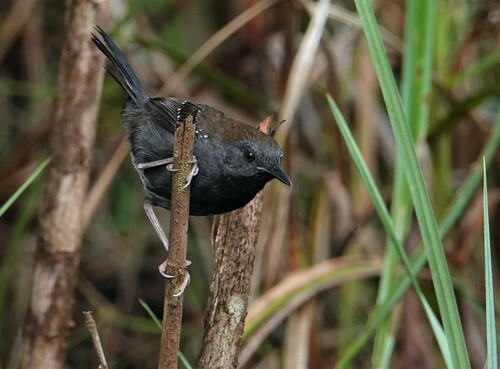
Blackish Antbird

Blackish Antbird

Cercomacra nigrescens

Silhouette: Sheatherius · PhyloPic

Daily sighting probability ~10% · With luck
at Manu National Park

In 3 days ~20% in a week ~40%

305 Verified sightings at Manu National Park From 2019 to 2026
414 In all 4 parks
May Best month

About the Blackish Antbird

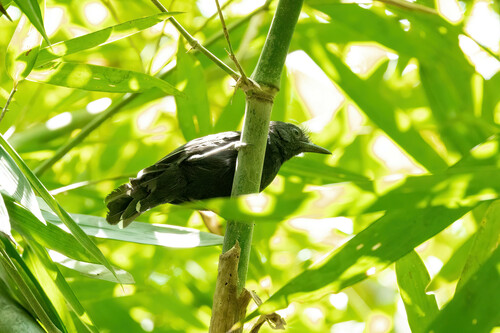
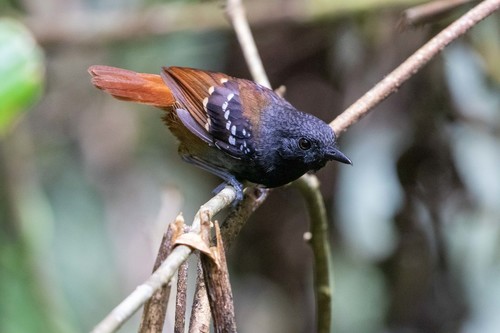
The blackish antbird (Cercomacroides nigrescens) is a species of passerine bird in subfamily Thamnophilinae of family Thamnophilidae, the "typical antbirds". It is found in Bolivia, Brazil, Colombia, Ecuador, French Guiana, Guyana, Peru, and Suriname.

The blackish antbird was described by the German ornithologists Jean Cabanis and Ferdinand Heine in 1860 and given the binomial name Percnostola nigrescens. The specific epithet is from the Latin nigrescens "blackish" (from nigrescere "to become black"). The antbird was subsequently included in the genus Cercomacra but a molecular phylogenetic study published in 2014 found that Cercomacra was polyphyletic. The genus was split to create two monophyletic genera, and six species including the blackish antbird were moved to the newly erected genus Cercomacroides.

The blackish antbird has these five subspecies: What is now the riparian antbird (C. fuscicauda) was previously treated as a sixth subspecies of the blackish antbird but... Wikipedia →


Sounds

Recording0:11

Brazil · 2026

© Paul Wolf · iNaturalist · CC BY-NC 4.0

Recording0:26

Ecuador · 2021

© Nelson Apolo · iNaturalist · CC BY-NC 4.0

Recording0:16

Peru · 2008

© dbeadle · iNaturalist · CC BY-NC 4.0

Global Distribution

Parks Where Found

# Park Country Daily sighting probability
1 Manu National Park 🇵🇪 Peru
~10%
2 Tambopata National Reserve 🇵🇪 Peru
<5%
3 Podocarpus National Park 🇪🇨 Ecuador
<5%
4 Yasuní National Park 🇪🇨 Ecuador
<5%

Before you go

What are the chances of seeing a Blackish Antbird in Manu National Park?

With luck

About 10% of wildlife watchers report a Blackish Antbird sighting in Manu National Park on a given day, based on 305 verified sightings from GBIF citizen-science data from 2019 to 2026. It is the 233rd most-seen of the 641 birds we can rate there. Over three days the chance rises to about 20%, and over a week to about 40%, if each day is a fresh chance.

When is the best time to see a Blackish Antbird in Manu National Park?

May

In that month about 20% of wildlife watchers report a Blackish Antbird in Manu National Park on a given day, against under 5% in February and November–December, the lowest months.

Is Manu National Park the best place to see a Blackish Antbird?

Yes

Of the 4 parks where we can rate Blackish Antbird sightings, Manu National Park has the highest daily chance: about 10%. Next come Tambopata National Reserve (Peru, under 5%) and Podocarpus National Park (Ecuador, under 5%).

Which relatives of the Blackish Antbird live in Manu National Park?

Same genus: Cercomacra

The closest relatives of the Blackish Antbird that you can see in Manu National Park (genus Cercomacra, Cercomacra Antbirds) are Manú Antbird (about 10%) and Gray Antbird (about 10%), with each one's daily chance of a sighting.

Where does the Blackish Antbird sighting chance come from?

GBIF citizen-science records

It is estimated from how often the Blackish Antbird is recorded against all the birds logged in Manu National Park (305 verified sightings from 2019 to 2026), calibrated against known sighting rates. Figures are rounded to the nearest 10% because citizen-science data supports honest approximations, not decimals, and months with records from fewer than five people show "—". How it works.

← Back to Manu National Park