Scarlet-shouldered Parrotlet

Scarlet-shouldered Parrotlet

Touit huetii

Silhouette: Sheatherius · PhyloPic

LCLeast ConcernNTVUENCR
Daily sighting probability <5% · Rare
at Manu National Park

In 3 days <5%

15 Verified sightings at Manu National Park From 2019 to 2026
215 In all 5 parks
January Best month
☀️ Diurnal When it's spotted

About the Scarlet-shouldered Parrotlet

The scarlet-shouldered parrotlet (Touit huetii), also known as the red-winged parrotlet or Huet's parrotlet, is a species of bird in subfamily Arinae of the family Psittacidae, the African and New World parrots. It is found in Bolivia, Brazil, Colombia, Ecuador, Guyana, Peru, and Venezuela, possibly in Suriname, and as a vagrant to Trinidad and Tobago.

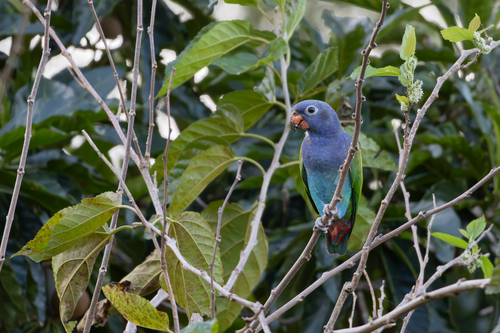
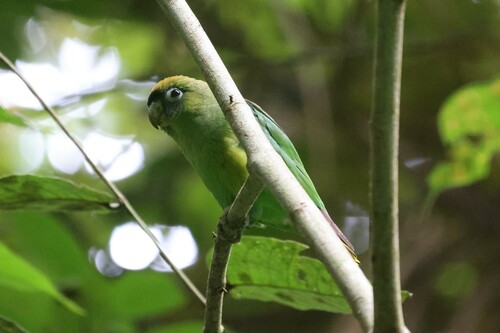
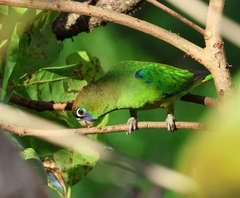
The scarlet-shouldered parrotlet is monotypic. The scarlet-shouldered parrotlet is 15 to 16 cm (5.9 to 6.3 in) long and weighs 58 to 62 g (2.0 to 2.2 oz). Its body is mostly green, darker above than below. The front of its face is dark with a white eye ring and its crown and nape olive-brown. Its upper wing coverts are dark blue, its primaries black, and its carpal bar, underwing coverts, and axillaries red. The male's tail has green central feathers and red outer ones with black tips; females' tails are all greenish yellow with black tips. Both sexes' under tail coverts are yellow. Immature birds are like adult females but with a green face.

The scarlet-shouldered parrotlet has a disjunct distribution. It is found in northeastern Venezuela and adjacent Guyana... Wikipedia →
Sounds

Flight call0:36

Brazil · 2006

© Paul Coopmans · XC264419 · CC BY-NC-SA 4.0

Song0:09

Brazil · 2016

© Felipe Arantes · XC388377 · CC BY-NC-SA 4.0

Call0:22

Brazil · 2013

© Sidnei Dantas · XC147342 · CC BY-NC-SA 3.0

Global Distribution

Parks Where Found

# Park Country Daily sighting probability
1 Yasuní National Park 🇪🇨 Ecuador
<5%
2 Anavilhanas National Park 🇧🇷 Brazil
<5%
3 Sierra de la Macarena National Park 🇨🇴 Colombia
<5%
4 Tambopata National Reserve 🇵🇪 Peru
<5%
5 Manu National Park 🇵🇪 Peru
<5%

Before you go

What are the chances of seeing a Scarlet-shouldered Parrotlet in Manu National Park?

Rare

Under 5% of wildlife watchers report a Scarlet-shouldered Parrotlet sighting in Manu National Park on a given day, based on 15 verified sightings from GBIF citizen-science data from 2019 to 2026. It is the 554th most-seen of the 641 birds we can rate there. Over three days the chance rises to under 5%, if each day is a fresh chance.

When is the best time to see a Scarlet-shouldered Parrotlet in Manu National Park?

Any time of year

In every month with enough records, under 5% of wildlife watchers report a Scarlet-shouldered Parrotlet in Manu National Park on a given day, so our monthly data shows no clear season.

What time of day is best to see a Scarlet-shouldered Parrotlet?

Between 8 and 11 am

Across all the parks we cover, that three-hour window holds the most Scarlet-shouldered Parrotlet sightings with a recorded time, and nearly all of them come between 6 am and 6 pm: it is a daytime animal.

Is Manu National Park the best place to see a Scarlet-shouldered Parrotlet?

Among the best

Of the 5 parks where we can rate Scarlet-shouldered Parrotlet sightings, Manu National Park ranks 5th at under 5%, level with the leaders once rounded. The best odds are in Yasuní National Park (Ecuador, under 5%), Anavilhanas National Park (Brazil, under 5%) and Sierra de la Macarena National Park (Colombia, under 5%).

Which relatives of the Scarlet-shouldered Parrotlet live in Manu National Park?

Same family: Psittacidae

The closest relatives of the Scarlet-shouldered Parrotlet that you can see in Manu National Park (family Psittacidae, New World and African Parrots) are Chestnut-fronted Macaw (about 50%), Blue-headed Parrot (about 40%) and Blue-and-yellow Macaw (about 30%), with each one's daily chance of a sighting.

Where does the Scarlet-shouldered Parrotlet sighting chance come from?

GBIF citizen-science records

It is estimated from how often the Scarlet-shouldered Parrotlet is recorded against all the birds logged in Manu National Park (15 verified sightings from 2019 to 2026), calibrated against known sighting rates. Figures are rounded to the nearest 10% because citizen-science data supports honest approximations, not decimals, and months with records from fewer than five people show "—". How it works.

← Back to Manu National Park