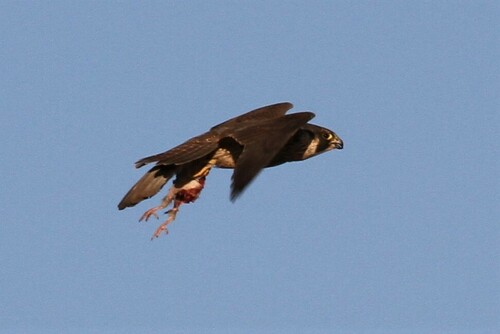
Slaty-backed Forest Falcon

Slaty-backed Forest Falcon

Micrastur mirandollei

Silhouette: Unknown (photo), John E. McCormack, Michael G. Harvey, Brant C. Faircloth, Nicholas G. Crawford, Travis C. Glenn, Robb T. Brumfield & T. Michael Keesey · PhyloPic

LCLeast ConcernNTVUENCR
Daily sighting probability <5% · Rare
at Manu National Park

In 3 days <5%

22 Verified sightings at Manu National Park From 2019 to 2026
556 In all 7 parks
May Best month
☀️ Diurnal When it's spotted

About the Slaty-backed Forest Falcon

The slaty-backed forest falcon (Micrastur mirandollei) is a species of bird of prey in subfamily Herpetotherinae of family Falconidae, the falcons, and caracaras. It is found in Costa Rica, Panama, and every mainland South American country except Argentina, Chile, Paraguay, and Uruguay.

The slaty-backed, collared, and Buckley's forest falcons are sister species. The slaty-backed forest falcon is monotypic. The population in Central America and western Colombia and Ecuador, has at times been treated as the subspecies M. m. extimus, but this separation has not been widely recognized.

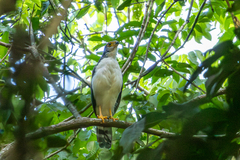
The slaty-backed forest falcon is 40 to 45 cm (16 to 18 in) long. Males weigh about 420 g (15 oz) and females about 500 to 556 g (18 to 20 oz). Its wingspan is 65 to 71 cm (26 to 28 in). Adults have slate gray upperparts, and are darker on the crown and lighter on the cheeks. Their throats and underparts are white to cream, and plain but for a few dark feather shafts making streaks. Their tail is dark slate gray with a white tip and three narrow white bars that often are indistinct. Their iris is yellowish brown to dark brown, its cere greenish yellow, and... Wikipedia →

Sounds

Dawn song1:00

Brazil · 2022

© Flávio Kulaif Ubaid · XC931743 · CC BY-NC-SA 4.0

Song1:08

Panama · 2021

© Remco Hofland · XC884258 · CC BY-NC-SA 4.0

Duet1:01

Brazil · 2020

© Beatriz Souza Cirino · XC711634 · CC BY-NC-SA 4.0

Global Distribution

Parks Where Found

# Park Country Daily sighting probability
1 Soberanía National Park 🇵🇦 Panama
<5%
2 Gandoca-Manzanillo Wildlife Refuge 🇨🇷 Costa Rica
<5%
3 Cahuita National Park 🇨🇷 Costa Rica
<5%
4 Yasuní National Park 🇪🇨 Ecuador
<5%
5 Tambopata National Reserve 🇵🇪 Peru
<5%
6 Manu National Park 🇵🇪 Peru
<5%
7 Tenorio Volcano National Park 🇨🇷 Costa Rica
<5%

Before you go

What are the chances of seeing a Slaty-backed Forest Falcon in Manu National Park?

Rare

Under 5% of wildlife watchers report a Slaty-backed Forest Falcon sighting in Manu National Park on a given day, based on 22 verified sightings from GBIF citizen-science data from 2019 to 2026. It is the 535th most-seen of the 641 birds we can rate there. Over three days the chance rises to under 5%, if each day is a fresh chance.

When is the best time to see a Slaty-backed Forest Falcon in Manu National Park?

Any time of year

In every month with enough records, under 5% of wildlife watchers report a Slaty-backed Forest Falcon in Manu National Park on a given day, so our monthly data shows no clear season.

What time of day is best to see a Slaty-backed Forest Falcon?

Between 8 and 11 am

Across all the parks we cover, that three-hour window holds the most Slaty-backed Forest Falcon sightings with a recorded time, and about 8 in 10 of them come between 6 am and 6 pm: it is a daytime animal.

Is Manu National Park the best place to see a Slaty-backed Forest Falcon?

Among the best

Of the 7 parks where we can rate Slaty-backed Forest Falcon sightings, Manu National Park ranks 6th at under 5%, level with the leaders once rounded. The best odds are in Soberanía National Park (Panama, under 5%), Gandoca-Manzanillo Wildlife Refuge (Costa Rica, under 5%) and Cahuita National Park (Costa Rica, under 5%).

Where does the Slaty-backed Forest Falcon sighting chance come from?

GBIF citizen-science records

It is estimated from how often the Slaty-backed Forest Falcon is recorded against all the birds logged in Manu National Park (22 verified sightings from 2019 to 2026), calibrated against known sighting rates. Figures are rounded to the nearest 10% because citizen-science data supports honest approximations, not decimals, and months with records from fewer than five people show "—". How it works.

← Back to Manu National Park