Black-hooded Antshrike

Black-hooded Antshrike

Thamnophilus bridgesi

Silhouette: Sheatherius · PhyloPic

LCLeast ConcernNTVUENCR
Daily sighting probability ~40% · Likely
at Manuel Antonio National Park

In 3 days ~80% in a week >90%

1,159 Verified sightings at Manuel Antonio National Park From 2019 to 2026
7,855 In all 8 parks
November Best month
☀️ Diurnal When it's spotted

About the Black-hooded Antshrike

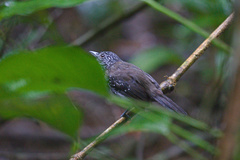
The black-hooded antshrike (Thamnophilus bridgesi) is a species of bird in subfamily Thamnophilinae of family Thamnophilidae, the "typical antbirds". It is found in Costa Rica and Panama. The black-hooded antshrike was described by the English zoologist Philip Sclater in 1856 and given its current binomial name Thamnophilus bridgesi. The specific epithet honors a Mr. Bridges who collected the holotype. (Sclater did not publish Bridges' given name.)

The black-hooded antshrike is monotypic. The black-hooded antshrike is 15 to 17 cm (5.9 to 6.7 in) long and weighs 26 to 27 g (0.92 to 0.95 oz). Members of genus Thamnophilus are largish members of the antbird family; all have stout bills with a hook like those of true shrikes. This species exhibits some sexual dimorphism. Adult males are mostly black. They have a white patch between their scapulars, small white dots on their wing coverts, and dark gray belly and undertail coverts. Adult females have blackish gray forehead, crown, and face with narrow white streaks. Their upperparts and wings are very dark grayish brown with white-edged scapulars and white-spotted wing coverts. Their tail is... Wikipedia →

Sounds

Song1:09

Costa Rica · 2024

© Alain Verneau · XC865982 · CC BY-NC-SA 4.0

Call0:41

Costa Rica · 2020

© Steve Hampton · XC544056 · CC BY-NC-SA 4.0

Song0:18

Costa Rica · 2015

© Garry Bakker · XC575596 · CC BY-NC-SA 4.0

Global Distribution

Parks Where Found

# Park Country Daily sighting probability
1 Corcovado National Park 🇨🇷 Costa Rica
~60%
2 Carara National Park 🇨🇷 Costa Rica
~40%
3 Manuel Antonio National Park 🇨🇷 Costa Rica
~40%
4 Piedras Blancas National Park 🇨🇷 Costa Rica
~30%
5 Marino Ballena National Park 🇨🇷 Costa Rica
~30%
6 Chirripó National Park 🇨🇷 Costa Rica
<5%
7 La Amistad International Park (Panama) 🇵🇦 Panama
<5%
8 Tenorio Volcano National Park 🇨🇷 Costa Rica
<5%

Before you go

What are the chances of seeing a Black-hooded Antshrike in Manuel Antonio National Park?

Likely

About 40% of wildlife watchers report a Black-hooded Antshrike sighting in Manuel Antonio National Park on a given day, based on 1,159 verified sightings from GBIF citizen-science data from 2019 to 2026. It is the 12th most-seen of the 325 birds we can rate there. Over three days the chance rises to about 80%, and over a week to over 90%, if each day is a fresh chance.

When is the best time to see a Black-hooded Antshrike in Manuel Antonio National Park?

June and November

In those months about 50% of wildlife watchers report a Black-hooded Antshrike in Manuel Antonio National Park on a given day, against about 30% in April and September, the lowest months. Those are among Manuel Antonio National Park's wettest months, with about 640 mm of rain a month against 35 mm in February.

What time of day is best to see a Black-hooded Antshrike?

Between 9 am and noon

Across all the parks we cover, that three-hour window holds the most Black-hooded Antshrike sightings with a recorded time, and about 9 in 10 of them come between 6 am and 6 pm: it is a daytime animal.

Is Manuel Antonio National Park the best place to see a Black-hooded Antshrike?

3rd of 8

Of the 8 parks where we can rate Black-hooded Antshrike sightings, Manuel Antonio National Park ranks 3rd at about 40%. The best odds are in Corcovado National Park (Costa Rica, about 60%) and Carara National Park (Costa Rica, about 40%). All parks ranked.

Where does the Black-hooded Antshrike sighting chance come from?

GBIF citizen-science records

It is estimated from how often the Black-hooded Antshrike is recorded against all the birds logged in Manuel Antonio National Park (1,159 verified sightings from 2019 to 2026), calibrated against known sighting rates. Figures are rounded to the nearest 10% because citizen-science data supports honest approximations, not decimals, and months with records from fewer than five people show "—". How it works.

← Back to Manuel Antonio National Park

