


Completed

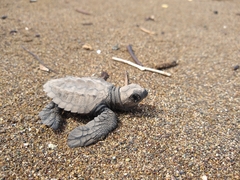
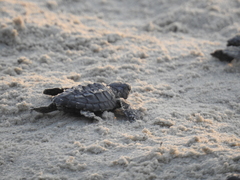

Pacific Ridley
Lepidochelys olivacea
Silhouette: (after Spotila 2004) · PhyloPic
- KingdomAnimalia (Animals)
- PhylumChordata (Chordates)
- ClassTestudines
- FamilyCheloniidae (Typical Sea Turtles)
- GenusLepidochelys (Ridley Sea Turtles)
- SpeciesLepidochelys olivacea (Pacific Ridley)
In 3 days ~20% in a week ~40%
10 Verified sightings at Manuel Antonio National Park From 2019 to 2026
360 In all 7 parks
October Best month
🌅 Crepuscular When it's spotted


Completed
About the Pacific Ridley
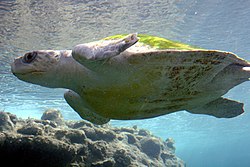
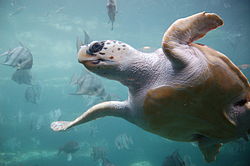
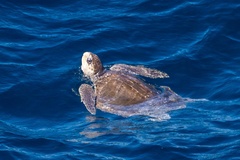
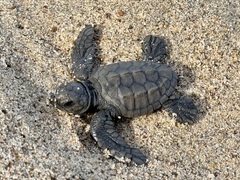
The olive ridley sea turtle (Lepidochelys olivacea), also known commonly as the Pacific ridley sea turtle, is a species of turtle in the family Cheloniidae. The species is the second-smallest and most abundant of all sea turtles found in the world. L. olivacea is found in warm and tropical waters, primarily in the Pacific and Indian Oceans, but also in the warm waters of the Atlantic Ocean.
This turtle and the related Kemp's ridley sea turtle are best known for their unique synchronised mass nestings called arribadas, where thousands of females come together on the same beach to lay eggs. The olive ridley sea turtle may have been first described as Testudo mydas minor by Georg Adolf Suckow in 1798. It was later described and named Chelonia multiscutata by Heinrich Kuhl in 1820. Still later, it was described and named Chelonia olivacea by Johann Friedrich von Eschscholtz in 1829. The species was placed in the subgenus Lepidochelys by Leopold Fitzinger in 1843. After Lepidochelys was elevated to full genus status, the species was called Lepidochelys olivacea by Charles Frédéric Girard in 1858. Because Eschscholtz was the first to propose the specific epithet olivacea, he... Wikipedia →
Recent sightings of Pacific Ridley in Manuel Antonio National Park
LIVEiNaturalistGlobal Distribution
Parks Where Found
| # | Park | Country | Daily sighting probability |
|---|---|---|---|
| 1 | Ostional Wildlife Refuge | 🇨🇷 Costa Rica | |
| 2 | Cabo Blanco Absolute Nature Reserve | 🇨🇷 Costa Rica | |
| 3 | Coiba National Park | 🇵🇦 Panama | |
| 4 | Corcovado National Park | 🇨🇷 Costa Rica | |
| 5 | Las Baulas Marine National Park | 🇨🇷 Costa Rica | |
| 6 | Marino Ballena National Park | 🇨🇷 Costa Rica | |
| 7 | Manuel Antonio National Park | 🇨🇷 Costa Rica |
Zoos & Centres Where Found
| # | Zoo / Centre | Country | |
|---|---|---|---|
| 1 | SeaWorld San Diego | 🇺🇸 United States | |
| 2 | Pairi Daiza | 🇧🇪 Belgium | |
| 3 | Kélonia | 🇫🇷 France | |
| 4 | Parque Municipal Summit | 🇵🇦 Panama | |
| 5 | Aquarium of the Pacific | 🇺🇸 United States | |
| 6 | Farm in the City | 🇲🇾 Malaysia | |
| 7 | Gran Acuario de Mazatlán "Mar de Cortés" | 🇲🇽 Mexico | |
| 8 | Virginia Aquarium | 🇺🇸 United States | |
| 9 | Phuket Aquarium | 🇹🇭 Thailand | |
| 10 | Projeto TAMAR | 🇧🇷 Brazil | |
| 11 | Hatfield Visitors Center | 🇺🇸 United States | |
| 12 | Bangsaen Aquarium | 🇹🇭 Thailand | |
| 13 | Cairns Turtle Rehabilitation Centre | 🇫🇯 Fiji | |
| 14 | Free Rein Foundation | 🇺🇸 United States | |
| 15 | National Museum of Marine Biology and Aquarium | 🇹🇼 Taiwan | |
| 16 | Vogelpark Bali | 🇮🇩 Indonesia | |
| 17 | Wiwa Quito | 🇪🇨 Ecuador |
Closest Relatives at Manuel Antonio National Park
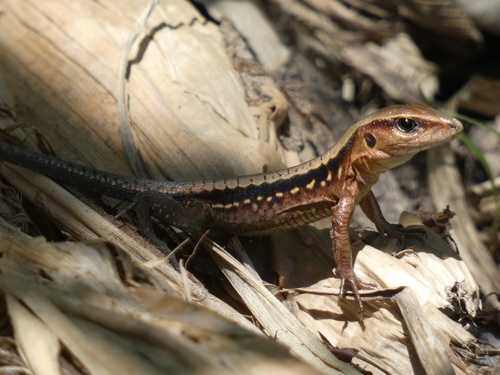
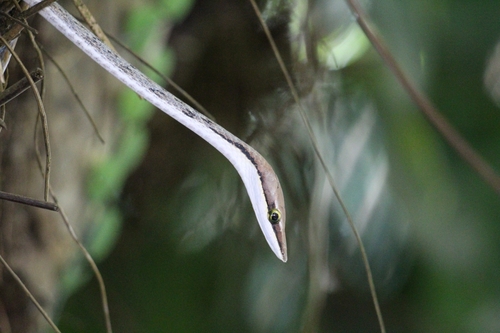
No species of the same family or order lives in Manuel Antonio National Park, so these are its closest relatives here: other reptiles.






Before you go
What are the chances of seeing a Pacific Ridley in Manuel Antonio National Park?
With luck
About 10% of wildlife watchers report a Pacific Ridley sighting in Manuel Antonio National Park on a given day, based on 10 verified sightings from GBIF citizen-science data from 2019 to 2026. It is the 39th most-seen of the 39 reptiles we can rate there. Over three days the chance rises to about 20%, and over a week to about 40%, if each day is a fresh chance.
When is the best time to see a Pacific Ridley in Manuel Antonio National Park?
June–August and October–January
In those months about 10% of wildlife watchers report a Pacific Ridley in Manuel Antonio National Park on a given day, against under 5% in February–May and September, the lowest months.
What time of day is best to see a Pacific Ridley?
Between 4 and 7 pm
Across all the parks we cover, that three-hour window holds the most Pacific Ridley sightings with a recorded time, and about 7 in 10 of them come between 6 am and 6 pm: it is most active around dawn and dusk.
Is Manuel Antonio National Park the best place to see a Pacific Ridley?
7th of 7
Of the 7 parks where we can rate Pacific Ridley sightings, Manuel Antonio National Park ranks 7th at about 10%. The best odds are in Ostional Wildlife Refuge (Costa Rica, about 40%), Cabo Blanco Absolute Nature Reserve (Costa Rica, about 30%) and Coiba National Park (Panama, about 20%). All parks ranked.
Where does the Pacific Ridley sighting chance come from?
GBIF citizen-science records
It is estimated from how often the Pacific Ridley is recorded against all the reptiles logged in Manuel Antonio National Park (10 verified sightings from 2019 to 2026), calibrated against known sighting rates. Figures are rounded to the nearest 10% because citizen-science data supports honest approximations, not decimals, and months with records from fewer than five people show "—". How it works.
