Sabine's Gull

Sabine's Gull

Xema sabini

Silhouette: Sheatherius · PhyloPic

LCLeast ConcernNTVUENCR
Daily sighting probability <5% · Rare
at Manuel Antonio National Park

In 3 days <5%

14 Verified sightings at Manuel Antonio National Park From 2019 to 2026
405 In all 14 parks
September Best month
☀️ Diurnal When it's spotted

About the Sabine's Gull

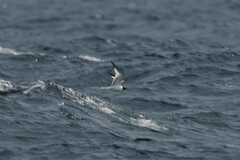
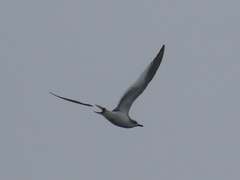
Sabine's gull ( SAY-bin; Xema sabini) is a small gull. It is usually treated as the only species placed in the genus Xema, though some authors include it with other gulls in a wide view of the genus Larus. It has also been known historically as fork-tailed gull or xeme (from the genus name). It breeds in colonies on Arctic coasts and tundra, laying two or three spotted olive-brown eggs in a ground nest lined with grass. Sabine's gull is pelagic outside the breeding season. It takes a wide variety of mainly animal food, and will eat any suitable small prey.

Sabine's gull was formally described in 1819 by the naturalist Joseph Sabine under the binomial name Larus sabini. Sabine based his description on specimens that had been collected by his brother Captain Edward Sabine, who had accompanied Captain John Ross on a voyage to look for the Northwest Passage. The birds were found breeding on low-lying islands off the west coast of Greenland in July 1818. Sabine's gull is now the only species placed in the genus Xema; the genus was described in 1819 by the zoologist William Leach in an appendix to Ross's account of the voyage. The genus name Xema appears to be an invented name... Wikipedia →

Sounds

Call0:39

United States · 2017

© Patrik Åberg · XC406448 · CC BY-NC-SA 4.0

Flight call0:25

Norway · 2007

© Fernand DEROUSSEN · XC135855 · CC BY-NC-ND 3.0

Call0:12

United States · 2014

© Andrew Spencer · XC185604 · CC BY-NC-SA 4.0

Global Distribution

Parks Where Found

# Park Country Daily sighting probability
1 Kenai Fjords National Park 🇺🇸 United States
~10%
2 Svalbard 🇳🇴 Norway
<5%
3 Nahuel Huapi National Park 🇦🇷 Argentina
<5%
4 Cabo Blanco Absolute Nature Reserve 🇨🇷 Costa Rica
<5%
5 Machalilla National Park 🇪🇨 Ecuador
<5%
6 Death Valley National Park 🇺🇸 United States
<5%
7 Great Bear Rainforest 🇨🇦 Canada
<5%
8 Padre Island National Seashore 🇺🇸 United States
<5%
9 Table Mountain National Park 🇿🇦 South Africa
<5%
10 Manuel Antonio National Park 🇨🇷 Costa Rica
<5%
11 Merritt Island National Wildlife Refuge 🇺🇸 United States
<5%
12 Redwood National Park 🇺🇸 United States
<5%
13 Wadden Sea National Park 🇩🇪 Germany
<5%
14 Point Pelee National Park 🇨🇦 Canada
<5%

Cities Where Found

# City Country Daily sighting probability
1 Dakar 🇸🇳 Senegal
~20%
2 Las Vegas 🇺🇸 United States
~10%
3 Cape Town 🇿🇦 South Africa
<5%
4 Anchorage 🇺🇸 United States
<5%
5 Calgary 🇨🇦 Canada
<5%
6 Denver 🇺🇸 United States
<5%
7 Los Angeles 🇺🇸 United States
<5%
8 Miami 🇺🇸 United States
<5%
9 Salt Lake City 🇺🇸 United States
<5%
10 Mesa 🇺🇸 United States
<5%

Before you go

What are the chances of seeing a Sabine's Gull in Manuel Antonio National Park?

Rare

Under 5% of wildlife watchers report a Sabine's Gull sighting in Manuel Antonio National Park on a given day, based on 14 verified sightings from GBIF citizen-science data from 2019 to 2026. It is the 284th most-seen of the 325 birds we can rate there. Over three days the chance rises to under 5%, if each day is a fresh chance.

When is the best time to see a Sabine's Gull in Manuel Antonio National Park?

September

In that month about 10% of wildlife watchers report a Sabine's Gull in Manuel Antonio National Park on a given day, against under 5% in October to August, the lowest months. That is one of Manuel Antonio National Park's wettest months, with about 660 mm of rain against 35 mm in February.

What time of day is best to see a Sabine's Gull?

Between 11 am and 2 pm

Across all the parks we cover, that three-hour window holds the most Sabine's Gull sightings with a recorded time, and about 9 in 10 of them come between 6 am and 6 pm: it is a daytime animal.

Is Manuel Antonio National Park the best place to see a Sabine's Gull?

10th of 14

Of the 14 parks where we can rate Sabine's Gull sightings, Manuel Antonio National Park ranks 10th at under 5%. The best odds are in Kenai Fjords National Park (United States, about 10%), Svalbard (Norway, under 5%) and Nahuel Huapi National Park (Argentina, under 5%).

Where does the Sabine's Gull sighting chance come from?

GBIF citizen-science records

It is estimated from how often the Sabine's Gull is recorded against all the birds logged in Manuel Antonio National Park (14 verified sightings from 2019 to 2026), calibrated against known sighting rates. Figures are rounded to the nearest 10% because citizen-science data supports honest approximations, not decimals, and months with records from fewer than five people show "—". How it works.

← Back to Manuel Antonio National Park