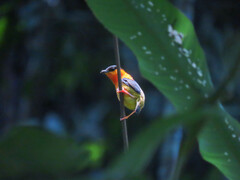
Orange-collared Manakin

Orange-collared Manakin

Manacus aurantiacus

Silhouette: Edwin Price · PhyloPic

LCLeast ConcernNTVUENCR
Daily sighting probability <5% · Rare
at Marino Ballena National Park

In 3 days ~10%

33 Verified sightings at Marino Ballena National Park From 2019 to 2026
3,448 In all 7 parks
May Best month
☀️ Diurnal When it's spotted

About the Orange-collared Manakin

The orange-collared manakin (Manacus aurantiacus) is a passerine bird in the manakin family. It is an endemic resident breeder in Costa Rica and western Panama, where it is found in forests, secondary growth and plantations. It is a small, plump bird about 10 centimetres (4 in) long. Males have a black crown, mid back, wings and tail and an olive-green rump. The rest of the head, neck, breast and upper back are orange, and the belly is yellow. Females are olive-green with yellow underparts and resemble female white-collared manakins. At breeding time, males are involved in lekking behaviour on the forest floor. This is a fairly common species with a somewhat restricted range, and the International Union for Conservation of Nature has rated its conservation status as being of "least concern".

The orange-collared manakin is, like its relatives, a compact short-tailed bird with a heavy hooked bill, orange legs and brightly coloured male plumage. It is typically 10 cm long and weighs 15.5 g. The adult male has a black crown, wings and tail, and a black band across the midback. The rest of the head, neck, breast and upper back are orange, the rump is olive-green, and... Wikipedia →

Sounds

Song0:05

Costa Rica · 2022

© Asociación Ambiental Finca Cántaros · XC723136 · CC BY-NC-SA 4.0

Call0:39

Costa Rica · 2019

© Okamoto Keita Sin · XC575989 · CC BY-NC-SA 4.0

Wing snaps0:36

Costa Rica · 2020

© Steve Hampton · XC544049 · CC BY-NC-SA 4.0

Global Distribution

Parks Where Found

# Park Country Daily sighting probability
1 Piedras Blancas National Park 🇨🇷 Costa Rica
~30%
2 Corcovado National Park 🇨🇷 Costa Rica
~30%
3 Carara National Park 🇨🇷 Costa Rica
~20%
4 Chirripó National Park 🇨🇷 Costa Rica
<5%
5 Marino Ballena National Park 🇨🇷 Costa Rica
<5%
6 La Amistad International Park (Panama) 🇵🇦 Panama
<5%
7 Manuel Antonio National Park 🇨🇷 Costa Rica
<5%

Before you go

What are the chances of seeing an Orange-collared Manakin in Marino Ballena National Park?

Rare

Under 5% of wildlife watchers report an Orange-collared Manakin sighting in Marino Ballena National Park on a given day, based on 33 verified sightings from GBIF citizen-science data from 2019 to 2026. It is the 192nd most-seen of the 303 birds we can rate there. Over three days the chance rises to about 10%, if each day is a fresh chance.

When is the best time to see an Orange-collared Manakin in Marino Ballena National Park?

May and November

In those months about 10% of wildlife watchers report an Orange-collared Manakin in Marino Ballena National Park on a given day, against under 5% in June–October and December–April, the lowest months.

What time of day is best to see an Orange-collared Manakin?

Between 9 am and noon

Across all the parks we cover, that three-hour window holds the most Orange-collared Manakin sightings with a recorded time, and about 9 in 10 of them come between 6 am and 6 pm: it is a daytime animal.

Is Marino Ballena National Park the best place to see an Orange-collared Manakin?

5th of 7

Of the 7 parks where we can rate Orange-collared Manakin sightings, Marino Ballena National Park ranks 5th at under 5%. The best odds are in Piedras Blancas National Park (Costa Rica, about 30%), Corcovado National Park (Costa Rica, about 30%) and Carara National Park (Costa Rica, about 20%).

Where does the Orange-collared Manakin sighting chance come from?

GBIF citizen-science records

It is estimated from how often the Orange-collared Manakin is recorded against all the birds logged in Marino Ballena National Park (33 verified sightings from 2019 to 2026), calibrated against known sighting rates. Figures are rounded to the nearest 10% because citizen-science data supports honest approximations, not decimals, and months with records from fewer than five people show "—". How it works.

← Back to Marino Ballena National Park