White-bellied Bustard

White-bellied Bustard

Eupodotis senegalensis

Silhouette: Kai Caspar · PhyloPic

LCLeast ConcernNTVUENCR
Daily sighting probability ~30% · Possible
at Masai Mara National Reserve

In 3 days ~60% in a week ~90%

782 Verified sightings at Masai Mara National Reserve From 2019 to 2026
3,948 In all 15 parks
October Best month
☀️ Diurnal When it's spotted

About the White-bellied Bustard

The white-bellied bustard or white-bellied korhaan (Eupodotis senegalensis) is an African species of bustard. It is widespread in sub-Saharan Africa in grassland and open woodland habitats. Despite its wide distribution and easily identifiable characteristics, very few studies have been conducted on this species and little is known about its life history and behavior.

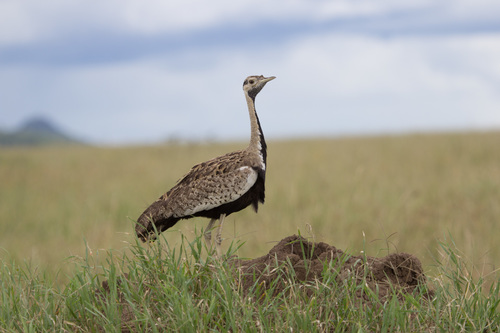
It is one of the smaller bustards, 48 to 61 centimetres (19 to 24 in) long. All are tawny brown above and on the breast and white on the belly, with cream-coloured legs; juveniles have light brown necks and heads, and adults have blue-grey necks. The adult female has a grey crown, a brown and buff line below the eye, and black speckling on the throat. The adult male has a black crown, black lines on the white cheeks, a black throat patch, and a pinkish-red bill. This species exhibits sexual dimorphism; the males are larger than the females. The call, often given in the early morning and late evening, has been described as "a very loud, guttural k'whuka WHUKa, k'wuka WHUKa..., or k'warrak, k'warrak..."

This species is usually seen in pairs or family groups, as young stay with their parents much longer... Wikipedia →

Sounds

Song0:10

Tanzania · 2026

© isaac kilusu · XC1095733 · CC BY-NC-SA 4.0

Flight call0:10

South Africa · 2017

© W.J. Rossouw · XC365845 · CC BY-NC-SA 4.0

Call0:25

Ethiopia · 2015

© Peter Boesman · XC300292 · CC BY-NC-ND 4.0

Global Distribution

Parks Where Found

# Park Country Daily sighting probability
1 Awash National Park 🇪🇹 Ethiopia
~40%
2 Tsavo East National Park 🇰🇪 Kenya
~40%
3 Amboseli National Park 🇰🇪 Kenya
~30%
4 Tarangire National Park 🇹🇿 Tanzania
~30%
5 Serengeti National Park 🇹🇿 Tanzania
~30%
6 Masai Mara National Reserve 🇰🇪 Kenya
~30%
7 Nairobi National Park 🇰🇪 Kenya
~20%
8 Samburu National Reserve 🇰🇪 Kenya
~20%
9 Ruaha National Park 🇹🇿 Tanzania
~20%
10 Kidepo Valley National Park 🇺🇬 Uganda
~20%
11 Tsavo West National Park 🇰🇪 Kenya
~10%
12 Meru National Park 🇰🇪 Kenya
~10%
13 Mkomazi National Park 🇹🇿 Tanzania
~10%
14 Ngorongoro Conservation Area 🇹🇿 Tanzania
~10%
15 Lake Manyara National Park 🇹🇿 Tanzania
<5%

Cities Where Found

# City Country Daily sighting probability
1 Maiduguri 🇳🇬 Nigeria
~10%

Zoos & Centres Where Found

# Zoo / Centre Country
1 Al Ain Zoo 🇦🇪 United Arab Emirates In captivity
2 Jacksonville Zoo and Gardens 🇺🇸 United States In captivity

Before you go

What are the chances of seeing a White-bellied Bustard in Masai Mara National Reserve?

Possible

About 30% of wildlife watchers report a White-bellied Bustard sighting in Masai Mara National Reserve on a given day, based on 782 verified sightings from GBIF citizen-science data from 2019 to 2026. It is the 50th most-seen of the 398 birds we can rate there. Over three days the chance rises to about 60%, and over a week to about 90%, if each day is a fresh chance.

When is the best time to see a White-bellied Bustard in Masai Mara National Reserve?

January, April and October–November

In those months about 30% of wildlife watchers report a White-bellied Bustard in Masai Mara National Reserve on a given day, against about 20% in February–March, May–September and December, the lowest months. Those are among Masai Mara National Reserve's wettest months, with about 95 mm of rain a month against 15 mm in July.

What time of day is best to see a White-bellied Bustard?

Between 3 and 6 pm

Across all the parks we cover, that three-hour window holds the most White-bellied Bustard sightings with a recorded time, and about 8 in 10 of them come between 6 am and 6 pm: it is a daytime animal.

Which relatives of the White-bellied Bustard live in Masai Mara National Reserve?

Same family: Otididae

The closest relatives of the White-bellied Bustard that you can see in Masai Mara National Reserve (family Otididae, Bustards) are Black-bellied Bustard (about 30%) and Kori Bustard (about 10%), with each one's daily chance of a sighting.

Where does the White-bellied Bustard sighting chance come from?

GBIF citizen-science records

It is estimated from how often the White-bellied Bustard is recorded against all the birds logged in Masai Mara National Reserve (782 verified sightings from 2019 to 2026), calibrated against known sighting rates. Figures are rounded to the nearest 10% because citizen-science data supports honest approximations, not decimals, and months with records from fewer than five people show "—". How it works.

← Back to Masai Mara National Reserve