White-headed Barbet

White-headed Barbet

Lybius leucocephalus

Silhouette: PhyloPic

LCLeast ConcernNTVUENCR
Daily sighting probability ~10% · With luck
at Masai Mara National Reserve

In 3 days ~20% in a week ~40%

173 Verified sightings at Masai Mara National Reserve From 2019 to 2026
1,401 In all 16 parks
February Best month
☀️ Diurnal When it's spotted

About the White-headed Barbet

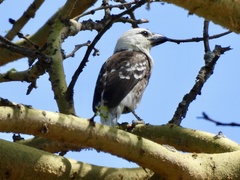
The white-headed barbet (Lybius leucocephalus) is a species of bird in the family Lybiidae. It is found in Angola, Cameroon, Central African Republic, Chad, Democratic Republic of the Congo, Kenya, Nigeria, South Sudan, Tanzania, and Uganda.

This species of African barbet comprises several races distinguished by different duetting song patters but all have a raucous greeting ceremony. It is the only barbet species to use simultaneous singing during a duet. This species is one of the largest in this genus at 18–19.5 cm (7.1–7.7 in) in length. It is a black and white type of barbet that has a stubby neck and a heavy-toothed bill. It is found in open woodland areas that are close to water and cultivation. It utilizes fig and jacaranda trees to find food and to excavate nests. These birds are also very social and live in small groups. Wikipedia →

Sounds

Call0:15

Kenya · 2023

© Brendan Sloan · XC818903 · CC BY-NC-ND 4.0

Call0:20

Kenya · 2021

© isaac kilusu · XC614369 · CC BY-NC-SA 4.0

Call0:06

Uganda · 2020

© Magnus Wadstein · XC610934 · CC BY-NC-SA 4.0

Global Distribution

Parks Where Found

# Park Country Daily sighting probability
1 Nairobi National Park 🇰🇪 Kenya
~30%
2 Kidepo Valley National Park 🇺🇬 Uganda
~20%
3 Lake Mburo National Park 🇺🇬 Uganda
~10%
4 Meru National Park 🇰🇪 Kenya
~10%
5 Queen Elizabeth National Park 🇺🇬 Uganda
~10%
6 Lake Nakuru National Park 🇰🇪 Kenya
~10%
7 Lake Manyara National Park 🇹🇿 Tanzania
~10%
8 Masai Mara National Reserve 🇰🇪 Kenya
~10%
9 Akagera National Park 🇷🇼 Rwanda
<5%
10 Serengeti National Park 🇹🇿 Tanzania
<5%
11 Virunga National Park 🇨🇩 Democratic Republic of the Congo
<5%
12 Ngorongoro Conservation Area 🇹🇿 Tanzania
<5%
13 Tarangire National Park 🇹🇿 Tanzania
<5%
14 Murchison Falls National Park 🇺🇬 Uganda
<5%
15 Arusha National Park 🇹🇿 Tanzania
<5%
16 Kibale National Park 🇺🇬 Uganda
<5%

Cities Where Found

# City Country Daily sighting probability
1 Nairobi 🇰🇪 Kenya
~10%

Before you go

What are the chances of seeing a White-headed Barbet in Masai Mara National Reserve?

With luck

About 10% of wildlife watchers report a White-headed Barbet sighting in Masai Mara National Reserve on a given day, based on 173 verified sightings from GBIF citizen-science data from 2019 to 2026. It is the 179th most-seen of the 398 birds we can rate there. Over three days the chance rises to about 20%, and over a week to about 40%, if each day is a fresh chance.

When is the best time to see a White-headed Barbet in Masai Mara National Reserve?

January–February, April–May, August and October–November

In those months about 10% of wildlife watchers report a White-headed Barbet in Masai Mara National Reserve on a given day, against under 5% in March, June–July, September and December, the lowest months.

What time of day is best to see a White-headed Barbet?

Between 8 and 11 am

Across all the parks we cover, that three-hour window holds the most White-headed Barbet sightings with a recorded time, and about 8 in 10 of them come between 6 am and 6 pm: it is a daytime animal.

Is Masai Mara National Reserve the best place to see a White-headed Barbet?

8th of 16

Of the 16 parks where we can rate White-headed Barbet sightings, Masai Mara National Reserve ranks 8th at about 10%. The best odds are in Nairobi National Park (Kenya, about 30%), Kidepo Valley National Park (Uganda, about 20%) and Lake Mburo National Park (Uganda, about 10%).

Where does the White-headed Barbet sighting chance come from?

GBIF citizen-science records

It is estimated from how often the White-headed Barbet is recorded against all the birds logged in Masai Mara National Reserve (173 verified sightings from 2019 to 2026), calibrated against known sighting rates. Figures are rounded to the nearest 10% because citizen-science data supports honest approximations, not decimals, and months with records from fewer than five people show "—". How it works.

← Back to Masai Mara National Reserve