Brown-Belted Bumble Bee

Brown-Belted Bumble Bee

Bombus griseocollis

Daily sighting probability <5% · Rare
at Merritt Island National Wildlife Refuge

In 3 days ~10% in a week ~30%

5 Verified sightings at Merritt Island National Wildlife Refuge From 2019 to 2026
233 In all 6 parks
March Best month
☀️ Diurnal When it's spotted

About the Brown-Belted Bumble Bee

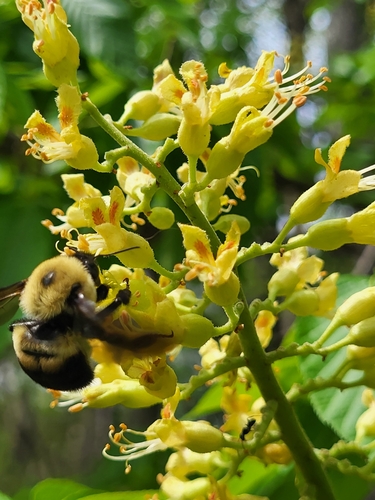
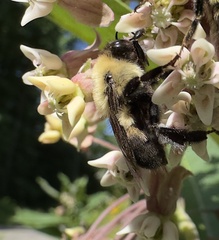
Bombus griseocollis is a species of bumblebee known commonly as the brown-belted bumblebee. It is native to much of the United States except for the Southwest, and to the southernmost regions of several of the provinces of Canada.

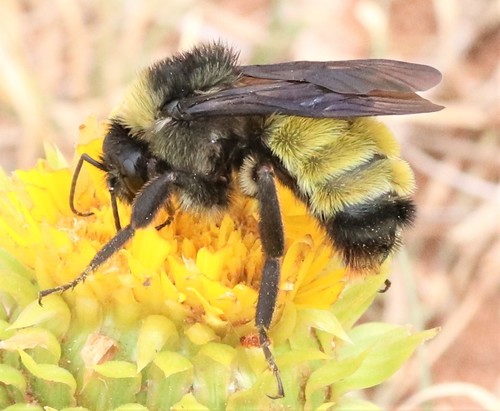
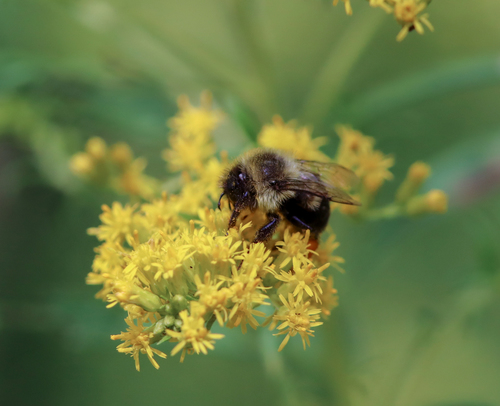
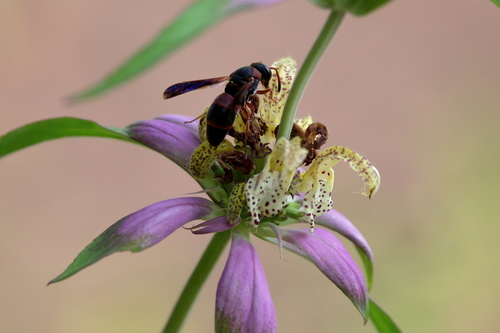
The queen is 2.1 to 2.3 centimeters long and about a centimeter wide at the abdomen. Its head and face are black with scattered yellow hairs. The thorax is coated in yellow hairs. The abdomen is yellow banded with black, with a black posterior and black ventral surface. The legs are black.

Workers are smaller than the queen, sometimes less than a centimeter long. They are similar in color pattern, but may have a brown-yellow band around the abdomen. Males are about 1.5 to 1.9 centimeters long and about 0.7 centimeters wide at the abdomen. They have very large eyes that span about two thirds the width of the head. The face and thorax have yellow hairs and the abdomen is banded with yellow, yellow-brown, and black.

Eggs are white, robust, and slightly curved. The average length is 2.91 mm with a range of 2.8–3.1 mm and the diameter range is 0.8–1.00 mm. This bumblebee can occupy many kinds of habitat, including meadows, wetlands... Wikipedia →
Global Distribution

Parks Where Found

# Park Country Daily sighting probability
1 Badlands National Park 🇺🇸 United States
~30%
2 Riding Mountain National Park 🇨🇦 Canada
~20%
3 Shenandoah National Park 🇺🇸 United States
~20%
4 Great Smoky Mountains National Park 🇺🇸 United States
~10%
5 Point Pelee National Park 🇨🇦 Canada
~10%
6 Merritt Island National Wildlife Refuge 🇺🇸 United States
<5%

Cities Where Found

# City Country Daily sighting probability
1 Minneapolis [Saint Paul] 🇺🇸 United States
~40%
2 Boston 🇺🇸 United States
~30%
3 Salt Lake City 🇺🇸 United States
~20%
4 Montreal 🇨🇦 Canada
~20%
5 Philadelphia 🇺🇸 United States
~20%
6 New York City 🇺🇸 United States
~20%
7 Toronto 🇨🇦 Canada
~20%
8 Chicago 🇺🇸 United States
~20%
9 Denver 🇺🇸 United States
~20%
10 Washington 🇺🇸 United States
~20%

Before you go

What are the chances of seeing a Brown-Belted Bumble Bee in Merritt Island National Wildlife Refuge?

Rare

Under 5% of wildlife watchers report a Brown-Belted Bumble Bee sighting in Merritt Island National Wildlife Refuge on a given day, based on 5 verified sightings from GBIF citizen-science data from 2019 to 2026. It is the 165th most-seen of the 189 insects we can rate there. Over three days the chance rises to about 10%, and over a week to about 30%, if each day is a fresh chance.

When is the best time to see a Brown-Belted Bumble Bee in Merritt Island National Wildlife Refuge?

March and May

In those months about 10% of wildlife watchers report a Brown-Belted Bumble Bee in Merritt Island National Wildlife Refuge on a given day, against under 5% in April and June–February, the lowest months.

What time of day is best to see a Brown-Belted Bumble Bee?

Between 10 am and 1 pm

Across all the parks we cover, that three-hour window holds the most Brown-Belted Bumble Bee sightings with a recorded time, and about 9 in 10 of them come between 6 am and 6 pm: it is a daytime animal.

Is Merritt Island National Wildlife Refuge the best place to see a Brown-Belted Bumble Bee?

6th of 6

Of the 6 parks where we can rate Brown-Belted Bumble Bee sightings, Merritt Island National Wildlife Refuge ranks 6th at under 5%. The best odds are in Badlands National Park (United States, about 30%), Riding Mountain National Park (Canada, about 20%) and Shenandoah National Park (United States, about 20%).

Which relatives of the Brown-Belted Bumble Bee live in Merritt Island National Wildlife Refuge?

Same genus: Bombus

The closest relatives of the Brown-Belted Bumble Bee that you can see in Merritt Island National Wildlife Refuge (genus Bombus, Bumble Bees) are American Bumble Bee (about 20%) and Common Eastern Bumble Bee (about 10%), with each one's daily chance of a sighting.

Where does the Brown-Belted Bumble Bee sighting chance come from?

GBIF citizen-science records

It is estimated from how often the Brown-Belted Bumble Bee is recorded against all the insects logged in Merritt Island National Wildlife Refuge (5 verified sightings from 2019 to 2026), calibrated against known sighting rates. Figures are rounded to the nearest 10% because citizen-science data supports honest approximations, not decimals, and months with records from fewer than five people show "—". How it works.

← Back to Merritt Island National Wildlife Refuge