
Abyssinian Scimitarbill

Abyssinian Scimitarbill

Rhinopomastus minor

Silhouette: Sheatherius · PhyloPic

LCLeast ConcernNTVUENCR
Daily sighting probability ~20% · Possible
at Meru National Park

In 3 days ~40% in a week ~70%

21 Verified sightings at Meru National Park From 2019 to 2026
1,439 In all 15 parks
April Best month
☀️ Diurnal When it's spotted

About the Abyssinian Scimitarbill

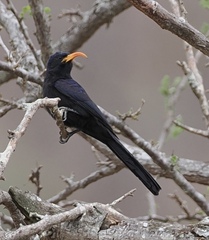
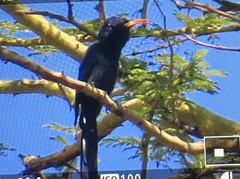
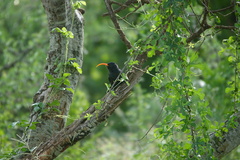
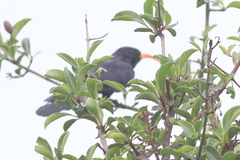
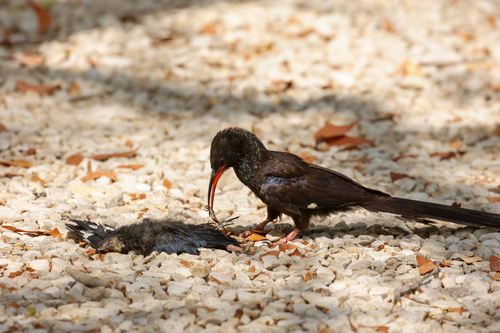
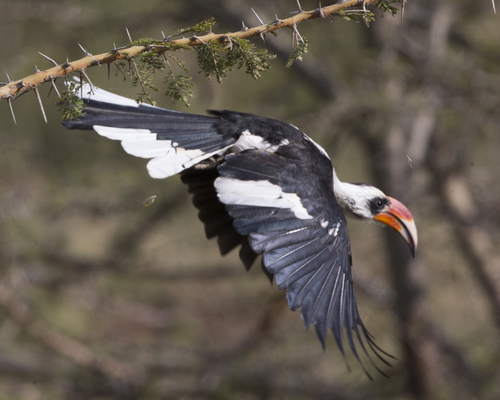
The Abyssinian scimitarbill (Rhinopomastus minor) is a species of bird in the family Phoeniculidae. The term Abyssinia, is an old name for the region of Ethiopia, and scimitar refers to a curved sword, which its bill resembles. It is found in Djibouti, Ethiopia, Kenya, Somalia, South Sudan, Tanzania, and Uganda. The bird is non migratory, diurnal, and terrestrial. Their nests are sometimes parasitized by the greater honeyguide (Indicator indicator) which are favored by some because they can guide to beehives.

The bird is all black with a blue-purple iridescence which covers their whole body and especially the back of the head. The bird's beak is bright orange to red and is characteristically curved and pointed. It is slightly longer than the length of its head and is built to probe into cracks and crevices for insects. It can be differentiated from other wood hoopoes by its all black legs and shorter tail, which is about the length of the bird's body excluding its head.

The males coloring tends to be more blue, whereas the females have more brown tones especially in the head. Males also tend to be slightly larger than females. Their bill length... Wikipedia →

Sounds

Call0:53

Kenya · 2024

© Peter Boesman · XC948458 · CC BY-NC-ND 4.0

Song0:47

Tanzania · 2020

© isaac kilusu · XC609486 · CC BY-NC-SA 4.0

Call0:36

Kenya · 2018

© Frank Lambert · XC451472 · CC BY-NC-ND 4.0

Global Distribution

Parks Where Found

# Park Country Daily sighting probability
1 Samburu National Reserve 🇰🇪 Kenya
~30%
2 Awash National Park 🇪🇹 Ethiopia
~30%
3 Mkomazi National Park 🇹🇿 Tanzania
~20%
4 Tsavo West National Park 🇰🇪 Kenya
~20%
5 Kidepo Valley National Park 🇺🇬 Uganda
~20%
6 Meru National Park 🇰🇪 Kenya
~20%
7 Ruaha National Park 🇹🇿 Tanzania
~10%
8 Tsavo East National Park 🇰🇪 Kenya
~10%
9 Serengeti National Park 🇹🇿 Tanzania
~10%
10 Ngorongoro Conservation Area 🇹🇿 Tanzania
~10%
11 Tarangire National Park 🇹🇿 Tanzania
<5%
12 Amboseli National Park 🇰🇪 Kenya
<5%
13 Nairobi National Park 🇰🇪 Kenya
<5%
14 Arusha National Park 🇹🇿 Tanzania
<5%
15 Masai Mara National Reserve 🇰🇪 Kenya
<5%

Before you go

What are the chances of seeing an Abyssinian Scimitarbill in Meru National Park?

Possible

About 20% of wildlife watchers report an Abyssinian Scimitarbill sighting in Meru National Park on a given day, based on 21 verified sightings from GBIF citizen-science data from 2019 to 2026. It is the 126th most-seen of the 243 birds we can rate there. Over three days the chance rises to about 40%, and over a week to about 70%, if each day is a fresh chance.

When is the best time to see an Abyssinian Scimitarbill in Meru National Park?

April and November

In those months about 30% of wildlife watchers report an Abyssinian Scimitarbill in Meru National Park on a given day, against about 10% in September and December–March, the lowest months. Those are among Meru National Park's wettest months, with about 190 mm of rain a month against almost none in July. May and July–August have too few records to rate.

What time of day is best to see an Abyssinian Scimitarbill?

Between 8 and 11 am

Across all the parks we cover, that three-hour window holds the most Abyssinian Scimitarbill sightings with a recorded time, and about 8 in 10 of them come between 6 am and 6 pm: it is a daytime animal.

Is Meru National Park the best place to see an Abyssinian Scimitarbill?

6th of 15

Of the 15 parks where we can rate Abyssinian Scimitarbill sightings, Meru National Park ranks 6th at about 20%. The best odds are in Samburu National Reserve (Kenya, about 30%), Awash National Park (Ethiopia, about 30%) and Mkomazi National Park (Tanzania, about 20%).

Where does the Abyssinian Scimitarbill sighting chance come from?

GBIF citizen-science records

It is estimated from how often the Abyssinian Scimitarbill is recorded against all the birds logged in Meru National Park (21 verified sightings from 2019 to 2026), calibrated against known sighting rates. Figures are rounded to the nearest 10% because citizen-science data supports honest approximations, not decimals, and months with records from fewer than five people show "—". How it works.

← Back to Meru National Park