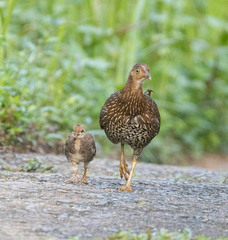
Sri Lanka Junglefowl

Sri Lanka Junglefowl

Gallus lafayettii

Silhouette: Caleb M. Gordon · PhyloPic

LCLeast ConcernNTVUENCR Endemic
Daily sighting probability ~30% · Possible
at Minneriya National Park

In 3 days ~70% in a week ~90%

221 Verified sightings at Minneriya National Park From 2019 to 2026
3,214 In all 6 parks
February Best month
🌅 Crepuscular When it's spotted

About the Sri Lanka Junglefowl

The Sri Lankan junglefowl (Gallus lafayettii), also known as the Ceylon junglefowl or Lafayette's junglefowl, is a member of the Galliformes bird order. It is a common endemic bird in Sri Lanka, where it is the national bird. It is closely related to the red junglefowl (G. gallus), the wild junglefowl from which the chicken was domesticated. However, it is even more closely related to the gray junglefowl. Sri Lankan junglefowl and red junglefowl diverged about 2.8 million years ago, whereas time of divergence between the Sri Lankan junglefowl and grey junglefowl was 1.8 million years ago.

Evidence of introgressive hybridization from Sri Lanka junglefowl has also been established in domestic chicken. The specific name of the Sri Lankan junglefowl commemorates the French aristocrat Gilbert du Motier, marquis de La Fayette (1757–1834).

As with other junglefowl, the Sri Lankan junglefowl is strongly sexually dimorphic; the male is much larger than the female, with more vivid plumage and a highly exaggerated wattle and comb. The male Sri Lankan junglefowl ranges from 66–72 cm (26–28 in) in length and 790–1,140 g (1.74–2.51 lb) in weight, essentially resembling a large... Wikipedia →

Sounds

Call0:36

Sri Lanka · 2026

© Uku Paal · XC1097205 · CC BY-NC-SA 4.0

Song0:37

Sri Lanka · 2007

© Jelle Scharringa · XC724572 · CC BY-NC-SA 4.0

Call0:28

Sri Lanka · 2021

© THILANKA EDIRISINGHE · XC635300 · CC BY-NC-SA 4.0

Global Distribution

Parks Where Found

# Park Country Daily sighting probability
1 Wilpattu National Park 🇱🇰 Sri Lanka
~80%
2 Yala National Park 🇱🇰 Sri Lanka
~70%
3 Horton Plains National Park 🇱🇰 Sri Lanka
~60%
4 Sinharaja Forest Reserve 🇱🇰 Sri Lanka
~60%
5 Udawalawe National Park 🇱🇰 Sri Lanka
~40%
6 Minneriya National Park 🇱🇰 Sri Lanka
~30%

Cities Where Found

# City Country Daily sighting probability
1 Colombo [Sri Jayawardenepura Kotte] 🇱🇰 Sri Lanka
<5%

Zoos & Centres Where Found

# Zoo / Centre Country
1 Parc des oiseaux 🇫🇷 France In captivity
2 Kyiv Zoo 🇺🇦 Ukraine In captivity
3 Bird Paradise 🇸🇬 Singapore In captivity
4 Rainforest Wild Asia 🇸🇬 Singapore In captivity
5 National Zoological Gardens of Sri Lanka 🇱🇰 Sri Lanka In captivity
6 Avifauna 🇪🇸 Spain In captivity

Before you go

What are the chances of seeing a Sri Lanka Junglefowl in Minneriya National Park?

Possible

About 30% of wildlife watchers report a Sri Lanka Junglefowl sighting in Minneriya National Park on a given day, based on 221 verified sightings from GBIF citizen-science data from 2019 to 2026. It is the 30th most-seen of the 155 birds we can rate there. Over three days the chance rises to about 70%, and over a week to about 90%, if each day is a fresh chance.

When is the best time to see a Sri Lanka Junglefowl in Minneriya National Park?

February

In that month about 50% of wildlife watchers report a Sri Lanka Junglefowl in Minneriya National Park on a given day, against about 20% in July, the lowest month.

What time of day is best to see a Sri Lanka Junglefowl?

Between 2 and 5 am

Across all the parks we cover, that three-hour window holds the most Sri Lanka Junglefowl sightings with a recorded time, and about half of them come between 6 pm and 6 am: it is most active around dawn and dusk.

Where does the Sri Lanka Junglefowl sighting chance come from?

GBIF citizen-science records

It is estimated from how often the Sri Lanka Junglefowl is recorded against all the birds logged in Minneriya National Park (221 verified sightings from 2019 to 2026), calibrated against known sighting rates. Figures are rounded to the nearest 10% because citizen-science data supports honest approximations, not decimals, and months with records from fewer than five people show "—". How it works.

← Back to Minneriya National Park