Mediterranean Turtle

Mediterranean Turtle

Mauremys leprosa

Silhouette: Beth Reinke · PhyloPic

Daily sighting probability ~40% · Likely
at Monfragüe National Park

In 3 days ~80% in a week >90%

128 Verified sightings at Monfragüe National Park From 2019 to 2026
410 In all 4 parks
May Best month
🌅 Crepuscular When it's spotted

About the Mediterranean Turtle

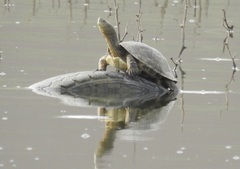
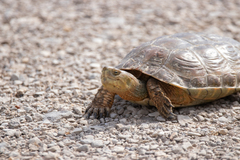
The Iberian pond turtle (Mauremys leprosa), also known as the Mediterranean pond turtle or Mediterranean turtle, is a species of turtle in the family Geoemydidae. The species is endemic to southwestern Europe and northwestern Africa.

Including the nominotypical subspecies, there are two sub-species which are accepted: M. leprosa leprosa (Schweigger, 1812) – Iberian pond turtle M. leprosa saharica Schleich, 1996 – Saharan pond turtle Mauremys leprosa is native to the western mainland Mediterranean Basin, stretching from the tip of southern France to the northwestern Maghreb (in Morocco, Algeria, Tunisia and Libya). It is most frequent in the southern half of the Iberian Peninsula (Portugal and Spain).

Archived from the original (PDF) on 2011-07-17. Retrieved 2010-12-15. Wikipedia →

Global Distribution

Parks Where Found

# Park Country Daily sighting probability
1 Monfragüe National Park 🇪🇸 Spain
~40%
2 Doñana National Park 🇪🇸 Spain
~20%
3 Sierra Nevada National Park 🇪🇸 Spain
~20%
4 Sierra de Guadarrama National Park 🇪🇸 Spain
~10%

Cities Where Found

# City Country Daily sighting probability
1 Marrakesh 🇲🇦 Morocco
~50%
2 Lisbon 🇵🇹 Portugal
~10%
3 Porto 🇵🇹 Portugal
<5%

Zoos & Centres Where Found

# Zoo / Centre Country
1 Paris Zoological Park 🇫🇷 France In captivity
2 Aquarium du palais de la Porte Dorée 🇫🇷 France In captivity
3 Parc du Belvédère 🇹🇳 Tunisia In captivity
4 Wilhelma 🇩🇪 Germany In captivity
5 Seville Zoo 🇪🇸 Spain In captivity
6 L'Oceanogràfic 🇪🇸 Spain In captivity
7 Zoo de Córdoba 🇪🇸 Spain In captivity
8 Zoo Koki (Parque zoológico y botánico) 🇪🇸 Spain In captivity
9 Zoo Lagos 🇵🇹 Portugal In captivity
10 Aquarium Barcelona 🇪🇸 Spain In captivity
11 Acuario de Sevilla 🇪🇸 Spain In captivity
12 Aquarium of Gijón 🇪🇸 Spain In captivity
13 Aquarium River of Zaragoza 🇪🇸 Spain In captivity
14 Alameda Wildlife Conservation Park 🇬🇧 United Kingdom In captivity
15 Fluviário de Mora 🇵🇹 Portugal In captivity
16 Atlantis Aquarium Madrid 🇪🇸 Spain In captivity

Before you go

What are the chances of seeing a Mediterranean Turtle in Monfragüe National Park?

Likely

About 40% of wildlife watchers report a Mediterranean Turtle sighting in Monfragüe National Park on a given day, based on 128 verified sightings from GBIF citizen-science data from 2019 to 2026. It is the 2nd most-seen of the 11 reptiles we can rate there. Over three days the chance rises to about 80%, and over a week to over 90%, if each day is a fresh chance.

When is the best time to see a Mediterranean Turtle in Monfragüe National Park?

April and May

In those months about 50% of wildlife watchers report a Mediterranean Turtle in Monfragüe National Park on a given day, against under 5% in February, the lowest month.

What time of day is best to see a Mediterranean Turtle?

Between 10 am and 1 pm

Across all the parks we cover, that three-hour window holds the most Mediterranean Turtle sightings with a recorded time, and about 7 in 10 of them come between 6 am and 6 pm: it is most active around dawn and dusk.

Is Monfragüe National Park the best place to see a Mediterranean Turtle?

Yes

Of the 4 parks where we can rate Mediterranean Turtle sightings, Monfragüe National Park has the highest daily chance: about 40%. Next come Doñana National Park (Spain, about 20%) and Sierra Nevada National Park (Spain, about 20%).

Where does the Mediterranean Turtle sighting chance come from?

GBIF citizen-science records

It is estimated from how often the Mediterranean Turtle is recorded against all the reptiles logged in Monfragüe National Park (128 verified sightings from 2019 to 2026), calibrated against known sighting rates. Figures are rounded to the nearest 10% because citizen-science data supports honest approximations, not decimals, and months with records from fewer than five people show "—". How it works.

← Back to Monfragüe National Park