Central American Pygmy-Owl

Central American Pygmy-Owl

Glaucidium griseiceps

Silhouette: Edwin Price · PhyloPic

LCLeast ConcernNTVUENCR
Daily sighting probability ~10% · With luck
at Montes Azules Biosphere Reserve

In 3 days ~20% in a week ~40%

19 Verified sightings at Montes Azules Biosphere Reserve From 2019 to 2026
300 In all 10 parks
February Best month
☀️ Diurnal When it's spotted

About the Central American Pygmy-Owl

The Central American pygmy owl (Glaucidium griseiceps) is a species of owl in the family Strigidae. It is found in Belize, Colombia, Costa Rica, Ecuador, Guatemala, Honduras, Mexico, Nicaragua, and Panama. The International Ornithological Committee (IOC) treats the Central American pygmy owl as monotypic.

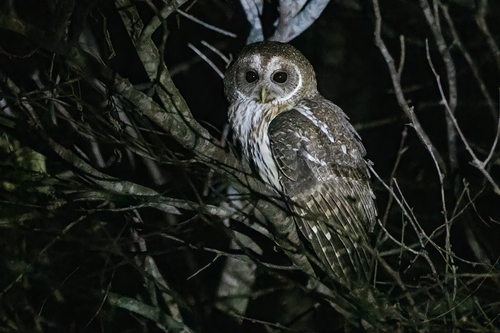
The Central American pygmy owl is 13 to 18 cm (5.1 to 7.1 in) long. Males weigh 50.6 to 58.8 g (1.78 to 2.07 oz) and females about 56 g (2.0 oz). Adults' crown and nape are grayish brown; the crown has buff to whitish spots and the nape dark "false eyes". Their upperparts and tail are rich brown and the tail has pale bars across it. Their underparts are whitish with reddish brown streaks. The juvenile's crown and nape are gray; the crown is unspotted and the nape's false eyes are sooty.

The Central American pygmy owl is found from Veracruz, Oaxaca, and Chiapas in southern Mexico through Guatemala, Belize, Honduras, Costa Rica, and Panama into... Wikipedia →

Sounds

Song0:24

Colombia · 2021

© Iván Lau · XC666242 · CC BY-NC-SA 4.0

Call0:17

Costa Rica · 2017

© Jorge Gabriel Campos · XC360797 · CC BY-NC-SA 4.0

Song0:30

Costa Rica · 2019

© GABRIEL LEITE · XC489599 · CC BY-NC-SA 4.0

Global Distribution

Parks Where Found

# Park Country Daily sighting probability
1 Darién National Park 🇵🇦 Panama
~20%
2 Montes Azules Biosphere Reserve 🇲🇽 Mexico
~10%
3 Gandoca-Manzanillo Wildlife Refuge 🇨🇷 Costa Rica
<5%
4 Pico Bonito National Park 🇭🇳 Honduras
<5%
5 Braulio Carrillo National Park 🇨🇷 Costa Rica
<5%
6 Cahuita National Park 🇨🇷 Costa Rica
<5%
7 Rincón de la Vieja National Park 🇨🇷 Costa Rica
<5%
8 Tenorio Volcano National Park 🇨🇷 Costa Rica
<5%
9 Tortuguero National Park 🇨🇷 Costa Rica
<5%
10 La Amistad International Park (Panama) 🇵🇦 Panama
<5%

Before you go

What are the chances of seeing a Central American Pygmy-Owl in Montes Azules Biosphere Reserve?

With luck

About 10% of wildlife watchers report a Central American Pygmy-Owl sighting in Montes Azules Biosphere Reserve on a given day, based on 19 verified sightings from GBIF citizen-science data from 2019 to 2026. It is the 172nd most-seen of the 240 birds we can rate there. Over three days the chance rises to about 20%, and over a week to about 40%, if each day is a fresh chance.

When is the best time to see a Central American Pygmy-Owl in Montes Azules Biosphere Reserve?

February and May

In those months about 20% of wildlife watchers report a Central American Pygmy-Owl in Montes Azules Biosphere Reserve on a given day, against under 5% in April, June–July and September–January, the lowest months. Those are among Montes Azules Biosphere Reserve's driest months, with about 110 mm of rain a month against 370 mm in June.

What time of day is best to see a Central American Pygmy-Owl?

Between 9 am and noon

Across all the parks we cover, that three-hour window holds the most Central American Pygmy-Owl sightings with a recorded time, and about 9 in 10 of them come between 6 am and 6 pm: it is a daytime animal.

Is Montes Azules Biosphere Reserve the best place to see a Central American Pygmy-Owl?

2nd of 10

Of the 10 parks where we can rate Central American Pygmy-Owl sightings, Montes Azules Biosphere Reserve ranks 2nd at about 10%. The best odds are in Darién National Park (Panama, about 20%).

Where does the Central American Pygmy-Owl sighting chance come from?

GBIF citizen-science records

It is estimated from how often the Central American Pygmy-Owl is recorded against all the birds logged in Montes Azules Biosphere Reserve (19 verified sightings from 2019 to 2026), calibrated against known sighting rates. Figures are rounded to the nearest 10% because citizen-science data supports honest approximations, not decimals, and months with records from fewer than five people show "—". How it works.

← Back to Montes Azules Biosphere Reserve