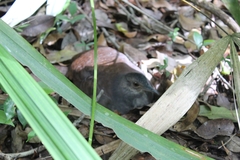
Slaty-breasted Tinamou

Slaty-breasted Tinamou

Crypturellus boucardi

Silhouette: J. N. Wiegers · PhyloPic

LCNTVUVulnerableENCR
Daily sighting probability ~10% · With luck
at Montes Azules Biosphere Reserve

In 3 days ~20% in a week ~40%

22 Verified sightings at Montes Azules Biosphere Reserve From 2019 to 2026
526 In all 8 parks
May Best month
☀️ Diurnal When it's spotted

About the Slaty-breasted Tinamou

The slaty-breasted tinamou or Boucard's tinamou (Crypturellus boucardi) is a type of tinamou commonly found in lowland moist forests of Mexico and Central America. All tinamou are from the family Tinamidae, and in the larger scheme are also ratites. Unlike other ratites, tinamous can fly, although in general, they are not strong fliers. All ratites evolved from prehistoric flying birds, and tinamous are the closest living relative of these birds.

The slaty-breasted tinamou has two sub-species: C. b. boucardi (the nominate subspecies) ranges along the lowlands of the Gulf of Mexico and Caribbean coast in southeastern Mexico, Belize, Guatemala, and northwestern Honduras

C. b. costaricensis ranges on the Caribbean slope in Honduras, Nicaragua, and northern Costa Rica Philip Sclater identified the slaty-breasted tinamou from a specimen from Oaxaca, Mexico, in 1859. Crypturellus can be broken down into the following: kruptos meaning covered or hidden, oura meaning the tail and ellus meaning diminutive. Therefore, Crypturellus means the small covered tail. Finally, boucardi is the Latin form of Boucard to commemorate Adolphe Boucard. Wikipedia →

Sounds

Song1:03

Guatemala · 2024

© Peter Boesman · XC880048 · CC BY-NC-ND 4.0

Call0:26

Mexico · 2003

© David Bradley · XC3319 · CC BY-NC-ND 2.5

Song0:11

Costa Rica · 2016

© Patrick ODonnell · XC314754 · CC BY-NC-SA 4.0

Global Distribution

Parks Where Found

# Park Country Daily sighting probability
1 Cockscomb Basin Wildlife Sanctuary 🇧🇿 Belize
~10%
2 Montes Azules Biosphere Reserve 🇲🇽 Mexico
~10%
3 Pico Bonito National Park 🇭🇳 Honduras
~10%
4 Braulio Carrillo National Park 🇨🇷 Costa Rica
<5%
5 Tikal National Park 🇬🇹 Guatemala
<5%
6 Tenorio Volcano National Park 🇨🇷 Costa Rica
<5%
7 Rincón de la Vieja National Park 🇨🇷 Costa Rica
<5%
8 Tortuguero National Park 🇨🇷 Costa Rica
<5%

Before you go

What are the chances of seeing a Slaty-breasted Tinamou in Montes Azules Biosphere Reserve?

With luck

About 10% of wildlife watchers report a Slaty-breasted Tinamou sighting in Montes Azules Biosphere Reserve on a given day, based on 22 verified sightings from GBIF citizen-science data from 2019 to 2026. It is the 156th most-seen of the 240 birds we can rate there. Over three days the chance rises to about 20%, and over a week to about 40%, if each day is a fresh chance.

When is the best time to see a Slaty-breasted Tinamou in Montes Azules Biosphere Reserve?

May–June and September

In those months about 20% of wildlife watchers report a Slaty-breasted Tinamou in Montes Azules Biosphere Reserve on a given day, against under 5% in January, March–April, July–August and November, the lowest months. Those are among Montes Azules Biosphere Reserve's wettest months, with about 270 mm of rain a month against 55 mm in March.

What time of day is best to see a Slaty-breasted Tinamou?

Between 9 am and noon

Across all the parks we cover, that three-hour window holds the most Slaty-breasted Tinamou sightings with a recorded time, and about 9 in 10 of them come between 6 am and 6 pm: it is a daytime animal.

Is Montes Azules Biosphere Reserve the best place to see a Slaty-breasted Tinamou?

Among the best

Of the 8 parks where we can rate Slaty-breasted Tinamou sightings, Montes Azules Biosphere Reserve ranks 2nd at about 10%, level with the leaders once rounded. The best odds are in Cockscomb Basin Wildlife Sanctuary (Belize, about 10%).

Where does the Slaty-breasted Tinamou sighting chance come from?

GBIF citizen-science records

It is estimated from how often the Slaty-breasted Tinamou is recorded against all the birds logged in Montes Azules Biosphere Reserve (22 verified sightings from 2019 to 2026), calibrated against known sighting rates. Figures are rounded to the nearest 10% because citizen-science data supports honest approximations, not decimals, and months with records from fewer than five people show "—". How it works.

← Back to Montes Azules Biosphere Reserve