Central American Coral Snake

Central American Coral Snake

Micrurus nigrocinctus

Silhouette: Edwin Price · PhyloPic

LCLeast ConcernNTVUENCR
Daily sighting probability ~10% · With luck
at Monteverde Cloud Forest Reserve

In 3 days ~20% in a week ~50%

15 Verified sightings at Monteverde Cloud Forest Reserve From 2019 to 2026
107 In all 10 parks
December Best month
☀️🌙 Day & Night When it's spotted

About the Central American Coral Snake

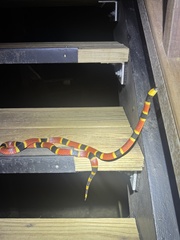
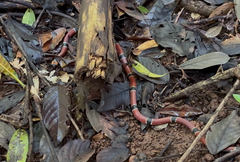
Micrurus nigrocinctus, commonly known as the Central American coral snake, is a species of a highly venomous snake in the family Elapidae. The species is endemic to Latin America from southern Mexico, Central America, to north Colombia. There are five recognized subspecies, including the nominate subspecies described here.

Common names for Micrurus nigrocinctus include Central American coral snake, and in Spanish: serpiente-coralillo centroamericana, coral centroamericana, coralillo, gargantilla, salviara, limlim, babaspul, and coral macho.

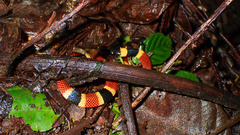
The Central American coral snake is capable of growing to a total length (tail included) of 115 cm (45 in), but most are closer to 65 cm (26 in). It has smooth dorsal scales, a rounded head, and the pupil of the eye is round. Its color pattern can vary from two-colored to three-colored, with black, yellow and red rings. The snout is black. On the head, there is usually a yellow parietal band (in three-colored specimens) or a red parietal band (in bi-colored specimens). The color pattern on the body consists of often fairly broad red rings separated by much narrower sets of yellow-black-yellow rings. The number... Wikipedia →

Global Distribution

Parks Where Found

# Park Country Daily sighting probability
1 Pico Bonito National Park 🇭🇳 Honduras
~50%
2 Santa Rosa National Park 🇨🇷 Costa Rica
~30%
3 Celaque National Park 🇭🇳 Honduras
~30%
4 Chagres National Park 🇵🇦 Panama
~30%
5 Rincón de la Vieja National Park 🇨🇷 Costa Rica
~20%
6 Palo Verde National Park 🇨🇷 Costa Rica
~20%
7 Soberanía National Park 🇵🇦 Panama
~10%
8 Monteverde Cloud Forest Reserve 🇨🇷 Costa Rica
~10%
9 Parque Natural Metropolitano 🇵🇦 Panama
~10%
10 La Amistad International Park (Panama) 🇵🇦 Panama
~10%

Cities Where Found

# City Country Daily sighting probability
1 San José 🇨🇷 Costa Rica
~10%
2 Panama City 🇵🇦 Panama
~10%

Zoos & Centres Where Found

# Zoo / Centre Country
1 El Nispero Zoo 🇵🇦 Panama In captivity

Closest Relatives at Monteverde Cloud Forest Reserve

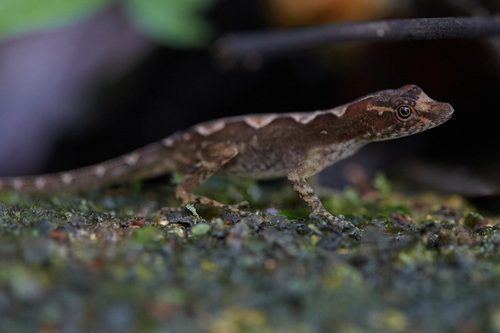
No species of the same family or order lives in Monteverde Cloud Forest Reserve, so these are its closest relatives here: other reptiles.

Before you go

What are the chances of seeing a Central American Coral Snake in Monteverde Cloud Forest Reserve?

With luck

About 10% of wildlife watchers report a Central American Coral Snake sighting in Monteverde Cloud Forest Reserve on a given day, based on 15 verified sightings from GBIF citizen-science data from 2019 to 2026. It is the 15th most-seen of the 43 reptiles we can rate there. Over three days the chance rises to about 20%, and over a week to about 50%, if each day is a fresh chance.

When is the best time to see a Central American Coral Snake in Monteverde Cloud Forest Reserve?

March, May–August and November–January

In those months about 10% of wildlife watchers report a Central American Coral Snake in Monteverde Cloud Forest Reserve on a given day, against under 5% in February, April and September–October, the lowest months.

What time of day is best to see a Central American Coral Snake?

Between 9 am and noon

Across all the parks we cover, that three-hour window holds the most Central American Coral Snake sightings with a recorded time, and about 7 in 10 of them come between 6 am and 6 pm: it is seen both by day and at night.

Where does the Central American Coral Snake sighting chance come from?

GBIF citizen-science records

It is estimated from how often the Central American Coral Snake is recorded against all the reptiles logged in Monteverde Cloud Forest Reserve (15 verified sightings from 2019 to 2026), calibrated against known sighting rates. Figures are rounded to the nearest 10% because citizen-science data supports honest approximations, not decimals, and months with records from fewer than five people show "—". How it works.

← Back to Monteverde Cloud Forest Reserve