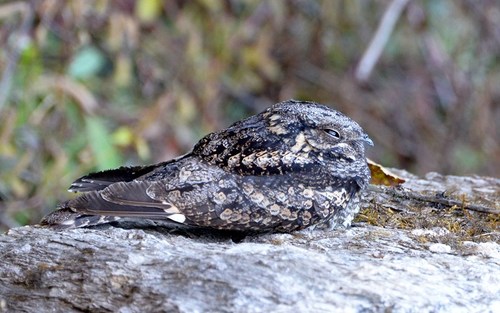
Jerdon's Nightjar

Jerdon's Nightjar

Caprimulgus atripennis

Silhouette: Ferran Sayol · PhyloPic

LCLeast ConcernNTVUENCR
Daily sighting probability <5% · Rare
at Nagarhole National Park

In 3 days ~10% in a week ~20%

67 Verified sightings at Nagarhole National Park From 2019 to 2026
676 In all 8 parks
February Best month
🌅 Crepuscular When it's spotted

About the Jerdon's Nightjar

Jerdon's nightjar (Caprimulgus atripennis) is a medium-sized nightjar species native to southern India and Sri Lanka. Formerly considered as a subspecies of the long-tailed nightjar, it is best recognized by its distinctive call which sounds like a wooden plank being beaten periodically with each note ending in a quaver. The common name commemorates Thomas C. Jerdon who described the species.

Thomas C. Jerdon first described this species in an annotation to his 1845 treatment of the jungle nightjar (C. indicus) in the Illustrations of Indian ornithology. Subsequently, it was sometimes lumped again with C. macrurus, but the co-occurrence of this form and large-tailed nightjar C. macrurus without interbreeding in the northeast of the Indian peninsula was noted in 1987 suggesting their distinctness. It has since been reaffirmed as a full species based on studies of their vocalizations. Jerdon's type locality mentioned as Ghauts has been considered to be the Eastern Ghats west of Nellore.

Like other nightjars, it has a wide gape, long wings, soft downy plumage and nocturnal habits. At 26 cm in overall length... Wikipedia →

Sounds

Duet0:51

India · 2026

© JAIRAM VIJAYAN · XC1104611 · CC BY-SA 4.0

Song0:05

India · 2023

© Sandeep Chakraborty · XC777399 · CC BY-NC-SA 4.0

Call0:28

Sri Lanka · 2021

© THILANKA EDIRISINGHE · XC647304 · CC BY-NC-SA 4.0

Global Distribution

Parks Where Found

# Park Country Daily sighting probability
1 Yala National Park 🇱🇰 Sri Lanka
~10%
2 Wilpattu National Park 🇱🇰 Sri Lanka
~10%
3 Minneriya National Park 🇱🇰 Sri Lanka
~10%
4 Mudumalai National Park 🇮🇳 India
~10%
5 Udawalawe National Park 🇱🇰 Sri Lanka
~10%
6 Periyar National Park 🇮🇳 India
~10%
7 Nagarhole National Park 🇮🇳 India
<5%
8 Bandipur National Park 🇮🇳 India
<5%

Cities Where Found

# City Country Daily sighting probability
1 Thrissur 🇮🇳 India
~20%
2 Bengaluru 🇮🇳 India
<5%

Before you go

What are the chances of seeing a Jerdon's Nightjar in Nagarhole National Park?

Rare

Under 5% of wildlife watchers report a Jerdon's Nightjar sighting in Nagarhole National Park on a given day, based on 67 verified sightings from GBIF citizen-science data from 2019 to 2026. It is the 174th most-seen of the 272 birds we can rate there. Over three days the chance rises to about 10%, and over a week to about 20%, if each day is a fresh chance.

When is the best time to see a Jerdon's Nightjar in Nagarhole National Park?

February, September and December

In those months about 10% of wildlife watchers report a Jerdon's Nightjar in Nagarhole National Park on a given day, against under 5% in January, March–August and October–November, the lowest months. Those are among Nagarhole National Park's driest months, with about 70 mm of rain a month against 270 mm in July.

What time of day is best to see a Jerdon's Nightjar?

Between 2 and 5 pm

Across all the parks we cover, that three-hour window holds the most Jerdon's Nightjar sightings with a recorded time, and about 7 in 10 of them come between 6 am and 6 pm: it is most active around dawn and dusk.

Is Nagarhole National Park the best place to see a Jerdon's Nightjar?

7th of 8

Of the 8 parks where we can rate Jerdon's Nightjar sightings, Nagarhole National Park ranks 7th at under 5%. The best odds are in Yala National Park (Sri Lanka, about 10%), Wilpattu National Park (Sri Lanka, about 10%) and Minneriya National Park (Sri Lanka, about 10%).

Where does the Jerdon's Nightjar sighting chance come from?

GBIF citizen-science records

It is estimated from how often the Jerdon's Nightjar is recorded against all the birds logged in Nagarhole National Park (67 verified sightings from 2019 to 2026), calibrated against known sighting rates. Figures are rounded to the nearest 10% because citizen-science data supports honest approximations, not decimals, and months with records from fewer than five people show "—". How it works.

← Back to Nagarhole National Park