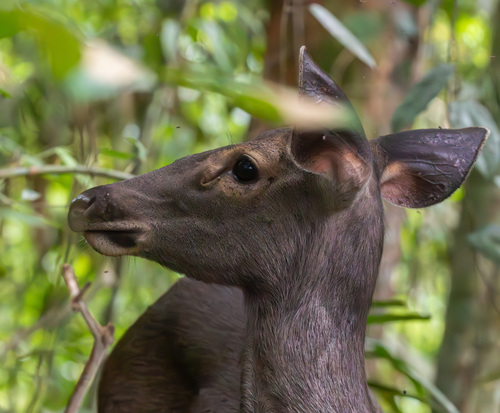
Ruddy Mongoose

Ruddy Mongoose

Herpestes smithii

Silhouette: Margot Michaud · PhyloPic

Daily sighting probability ~30% · Possible
at Nagarhole National Park

In 3 days ~70% in a week ~90%

8 Verified sightings at Nagarhole National Park From 2019 to 2026
453 In all 10 parks
January Best month
🌅 Crepuscular When it's spotted

About the Ruddy Mongoose

The ruddy mongoose (Urva smithii) is a species of mongoose native to the forests of India and Sri Lanka. It is classified as least concern in the IUCN Red List. In 1837, British zoologist John Edward Gray proposed the scientific name Herpestes smithii for a zoological specimen in the collection of the British Natural History Museum. Different species names were proposed by various biologists over the years for the ruddy mongooses. In 2009, the Asian mongooses were classified under a new genus, Urva. Three different sub-species have been recognized: smithii, thysanurus, and zeylanius.

The ruddy mongoose is found in forests and shrub lands in India and Sri Lanka. It is mainly a forest dweller and prefers more secluded areas. It has also been recorded to forage in secluded paddy fields in the region. It is classified as least concern in the IUCN Red List.

The ruddy mongoose is a large mongoose with a greyish-brown fur. It has an average head to body length of 40–45 cm (16–18 in) and a 36 cm (14 in) long tail. The long tail features a darker tasseled tip, which is usually curved upward, and is visible from a distance.

��2... Wikipedia →

Global Distribution

Parks Where Found

# Park Country Daily sighting probability
1 Yala National Park 🇱🇰 Sri Lanka
~80%
2 Wilpattu National Park 🇱🇰 Sri Lanka
~80%
3 Ranthambore National Park 🇮🇳 India
~60%
4 Udawalawe National Park 🇱🇰 Sri Lanka
~60%
5 Bandhavgarh National Park 🇮🇳 India
~40%
6 Kanha National Park 🇮🇳 India
~30%
7 Sinharaja Forest Reserve 🇱🇰 Sri Lanka
~30%
8 Nagarhole National Park 🇮🇳 India
~30%
9 Bandipur National Park 🇮🇳 India
~20%
10 Minneriya National Park 🇱🇰 Sri Lanka
~20%

Before you go

What are the chances of seeing a Ruddy Mongoose in Nagarhole National Park?

Possible

About 30% of wildlife watchers report a Ruddy Mongoose sighting in Nagarhole National Park on a given day, based on 8 verified sightings from GBIF citizen-science data from 2019 to 2026. It is the 14th most-seen of the 15 mammals we can rate there. Over three days the chance rises to about 70%, and over a week to about 90%, if each day is a fresh chance.

When is the best time to see a Ruddy Mongoose in Nagarhole National Park?

January

In that month about 60% of wildlife watchers report a Ruddy Mongoose in Nagarhole National Park on a given day, against under 5% in February, May, July and October–November, the lowest months. That is one of Nagarhole National Park's driest months, with about 15 mm of rain against 270 mm in July.

What time of day is best to see a Ruddy Mongoose?

Between 2 and 5 am

Across all the parks we cover, that three-hour window holds the most Ruddy Mongoose sightings with a recorded time, and about 6 in 10 of them come between 6 am and 6 pm: it is most active around dawn and dusk.

Where does the Ruddy Mongoose sighting chance come from?

GBIF citizen-science records

It is estimated from how often the Ruddy Mongoose is recorded against all the mammals logged in Nagarhole National Park (8 verified sightings from 2019 to 2026), calibrated against known sighting rates. Figures are rounded to the nearest 10% because citizen-science data supports honest approximations, not decimals, and months with records from fewer than five people show "—". How it works.

← Back to Nagarhole National Park