Pririt Batis

Pririt Batis

Batis pririt

Silhouette: Mathieu Pélissié · PhyloPic

LCLeast ConcernNTVUENCR
Daily sighting probability ~20% · Possible
at Namib-Naukluft National Park

In 3 days ~40% in a week ~70%

88 Verified sightings at Namib-Naukluft National Park From 2019 to 2026
347 In all 4 parks
April Best month
☀️ Diurnal When it's spotted

About the Pririt Batis

The pririt batis (Batis pririt) also known as the pririt puff-back flycatcher or pririt puffback, is a small passerine bird in the wattle-eye family. It is resident in Southern Africa and southwestern Angola. It is a small stout insect-eating bird, found in dry broadleaf woodland and thorn scrub. The nest is a small neat cup low in a tree or bush.

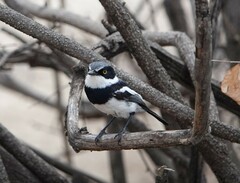
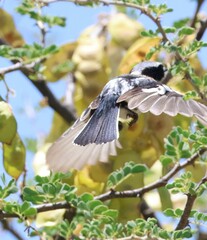
The pririt batis is strikingly patterned. The adult male has a dark grey crown and back, black eye mask and white throat. It has a black rump and tail, and its wing are black with white edging to the flight feathers and a long white shoulder patch. The underparts are white with a broad black breast band and black speckles on the flanks. The female and juvenile plumages differ in that there is no black breast band, but the throat and breast are a warm buff colour.

The pririt batis hunts by flycatching, or by taking prey from the ground like a shrike. The song is typically a slow descending series of whistled notes: teuu, teuu, teuu, teuu. Ian Sinclair, Phil Hockey and Warwick Tarboton, SASOL Birds of Southern Africa (Struik 2002) ISBN 1-86872-721-1 Pririt batis - Species text in The Atlas of Southern... Wikipedia →

Sounds

Duet0:26

Botswana · 2026

© Ehren Eksteen · XC1185162 · CC BY-NC-SA 4.0

Song0:12

South Africa · 2022

© Lynette Rudman · XC741518 · CC BY-NC-SA 4.0

Call0:06

South Africa · 2022

© Tony Archer · XC709661 · CC BY-NC-SA 4.0

Global Distribution

Parks Where Found

# Park Country Daily sighting probability
1 Waterberg Plateau Park 🇳🇦 Namibia
~60%
2 Namib-Naukluft National Park 🇳🇦 Namibia
~20%
3 Kgalagadi Transfrontier Park 🇿🇦 South Africa
~10%
4 Etosha National Park 🇳🇦 Namibia
~10%

Before you go

What are the chances of seeing a Pririt Batis in Namib-Naukluft National Park?

Possible

About 20% of wildlife watchers report a Pririt Batis sighting in Namib-Naukluft National Park on a given day, based on 88 verified sightings from GBIF citizen-science data from 2019 to 2026. It is the 31st most-seen of the 108 birds we can rate there. Over three days the chance rises to about 40%, and over a week to about 70%, if each day is a fresh chance.

When is the best time to see a Pririt Batis in Namib-Naukluft National Park?

April

In that month about 50% of wildlife watchers report a Pririt Batis in Namib-Naukluft National Park on a given day, against under 5% in November, the lowest month.

What time of day is best to see a Pririt Batis?

Between 7 and 10 am

Across all the parks we cover, that three-hour window holds the most Pririt Batis sightings with a recorded time, and about 9 in 10 of them come between 6 am and 6 pm: it is a daytime animal.

Is Namib-Naukluft National Park the best place to see a Pririt Batis?

2nd of 4

Of the 4 parks where we can rate Pririt Batis sightings, Namib-Naukluft National Park ranks 2nd at about 20%. The best odds are in Waterberg Plateau Park (Namibia, about 60%).

Which relatives of the Pririt Batis live in Namib-Naukluft National Park?

Same order: Passeriformes

The closest relatives of the Pririt Batis that you can see in Namib-Naukluft National Park (order Passeriformes, Perching Birds) are Cape Sparrow (about 80%), Familiar Chat (about 60%) and Pied Crow (about 60%), with each one's daily chance of a sighting.

Where does the Pririt Batis sighting chance come from?

GBIF citizen-science records

It is estimated from how often the Pririt Batis is recorded against all the birds logged in Namib-Naukluft National Park (88 verified sightings from 2019 to 2026), calibrated against known sighting rates. Figures are rounded to the nearest 10% because citizen-science data supports honest approximations, not decimals, and months with records from fewer than five people show "—". How it works.

← Back to Namib-Naukluft National Park