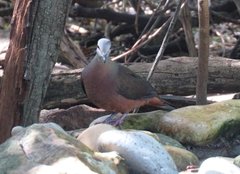
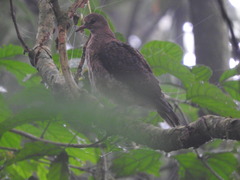

African Lemon Dove

African Lemon Dove

Columba larvata

Silhouette: Steven Traver · PhyloPic

Daily sighting probability <5% · Rare
at Ngorongoro Conservation Area

In 3 days <5% in a week ~10%

31 Verified sightings at Ngorongoro Conservation Area From 2019 to 2026
809 In all 12 parks
November Best month
☀️ Diurnal When it's spotted

About the African Lemon Dove

The lemon dove or cinnamon dove (Aplopelia larvata) is a species of bird in the pigeon family Columbidae found in montane forests of sub-Saharan Africa. The lemon dove has a generally brownish-grey plumage with a cinnamon brown breast. Adults have a greenish-glossed neck and white markings on the head, and juveniles are rather more brown with pale feather fringe barring and have greyer facial markings. This dove is a common species, and the International Union for Conservation of Nature has rated its conservation status as being of "least concern".

The lemon dove was previously placed in the genus Columba, but it differs from the African pigeons of the genus Columba both genetically, in which it is closer to the genus Streptopelia, and by its more strongly terrestrial habits. The population on the island of São Tomé in the Gulf of Guinea, usually considered a subspecies, has been treated as a separate species A. simplex (São Tomé lemon dove; syn. C. simplex) by some authors.

Seven subspecies are recognised: Wikipedia →

Sounds

Call1:23

Tanzania · 2019

© Louis A. Hansen · XC514559 · CC BY-NC-SA 4.0

Song0:57

Zambia · 2019

© Peter Boesman · XC508861 · CC BY-NC-ND 4.0

Call0:38

South Africa · 2019

© Lynette Rudman · XC497031 · CC BY-NC-SA 4.0

Global Distribution

Parks Where Found

# Park Country Daily sighting probability
1 Garden Route National Park 🇿🇦 South Africa
~10%
2 Table Mountain National Park 🇿🇦 South Africa
~10%
3 Liwonde National Park 🇲🇼 Malawi
<5%
4 Arusha National Park 🇹🇿 Tanzania
<5%
5 iSimangaliso Wetland Park 🇿🇦 South Africa
<5%
6 Ngorongoro Conservation Area 🇹🇿 Tanzania
<5%
7 Kidepo Valley National Park 🇺🇬 Uganda
<5%
8 Aberdare National Park 🇰🇪 Kenya
<5%
9 Nyungwe National Park 🇷🇼 Rwanda
<5%
10 Nairobi National Park 🇰🇪 Kenya
<5%
11 Bwindi Impenetrable National Park 🇺🇬 Uganda
<5%
12 Kruger National Park 🇿🇦 South Africa
<5%

Cities Where Found

# City Country Daily sighting probability
1 Nairobi 🇰🇪 Kenya
<5%
2 Durban 🇿🇦 South Africa
<5%

Before you go

What are the chances of seeing an African Lemon Dove in Ngorongoro Conservation Area?

Rare

Under 5% of wildlife watchers report an African Lemon Dove sighting in Ngorongoro Conservation Area on a given day, based on 31 verified sightings from GBIF citizen-science data from 2019 to 2026. It is the 373rd most-seen of the 519 birds we can rate there. Over three days the chance rises to under 5%, and over a week to about 10%, if each day is a fresh chance.

When is the best time to see an African Lemon Dove in Ngorongoro Conservation Area?

November

In that month about 10% of wildlife watchers report an African Lemon Dove in Ngorongoro Conservation Area on a given day, against under 5% in December to October, the lowest months. That is one of Ngorongoro Conservation Area's wettest months, with about 180 mm of rain against almost none in July.

What time of day is best to see an African Lemon Dove?

Between 9 am and noon

Across all the parks we cover, that three-hour window holds the most African Lemon Dove sightings with a recorded time, and about 9 in 10 of them come between 6 am and 6 pm: it is a daytime animal.

Is Ngorongoro Conservation Area the best place to see an African Lemon Dove?

6th of 12

Of the 12 parks where we can rate African Lemon Dove sightings, Ngorongoro Conservation Area ranks 6th at under 5%. The best odds are in Garden Route National Park (South Africa, about 10%), Table Mountain National Park (South Africa, about 10%) and Liwonde National Park (Malawi, under 5%).

Which relatives of the African Lemon Dove live in Ngorongoro Conservation Area?

Same genus: Columba

The closest relatives of the African Lemon Dove that you can see in Ngorongoro Conservation Area (genus Columba, Typical Old World Pigeons) are Speckled Pigeon (about 20%) and Rameron Pigeon (about 10%), with each one's daily chance of a sighting.

Where does the African Lemon Dove sighting chance come from?

GBIF citizen-science records

It is estimated from how often the African Lemon Dove is recorded against all the birds logged in Ngorongoro Conservation Area (31 verified sightings from 2019 to 2026), calibrated against known sighting rates. Figures are rounded to the nearest 10% because citizen-science data supports honest approximations, not decimals, and months with records from fewer than five people show "—". How it works.

← Back to Ngorongoro Conservation Area