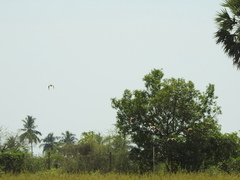
Chestnut-bellied Sandgrouse

Chestnut-bellied Sandgrouse

Pterocles exustus

Silhouette: Tarique Sani (photo), John E. McCormack, Michael G. Harvey, Brant C. Faircloth, Nicholas G. Crawford, Travis C. Glenn, Robb T. Brumfield & T. Michael Keesey · PhyloPic

LCLeast ConcernNTVUENCR
Daily sighting probability ~10% · With luck
at Ngorongoro Conservation Area

In 3 days ~30% in a week ~60%

258 Verified sightings at Ngorongoro Conservation Area From 2019 to 2026
1,853 In all 10 parks
March Best month
☀️ Diurnal When it's spotted

About the Chestnut-bellied Sandgrouse

The chestnut-bellied sandgrouse or common sandgrouse (Pterocles exustus) is a species of sandgrouse. It is a sedentary and nomadic species that ranges from northern and central Africa and further east towards western and southern Asia. There are six recognized subspecies.

The chestnut-bellied sandgrouse is sexually dimorphic in plumage colouration and varies in overall plumage colouration between the six subspecies. The chestnut-bellied sandgrouse is a bird of barren, semi-deserts. It is heavily reliant on water, despite living in hot, arid climates and is known to travel up to 50 miles (80 kilometres) in a day to search for water.

Chestnut-bellied sandgrouse are selective feeders which primarily subsist on seeds, often preferring to consume small seeds in large amounts. The chestnut-bellied sandgrouse is a species of sandgrouse placed in the genus Pterocles. Sandgrouse belong to the family Pteroclididae, which belongs to the order Pteroclidiformes. This means they are more closely related to pigeons and doves and are not a type of grouse.

There are six recognised subspecies of chestnut-bellied sandgrouse: P. ex. exustus: Senegal, Gambia, Mauritania and Sudan. P. e... Wikipedia →

Sounds

Flight call0:24

Oman · 2023

© Peter Boesman · XC781403 · CC BY-NC-ND 4.0

Call0:46

Ethiopia · 2019

© Aladdin · XC504015 · CC BY-NC-SA 4.0

Call0:09

Oman · 2018

© AUDEVARD Aurélien · XC444470 · CC BY-NC-SA 4.0

Global Distribution

Parks Where Found

# Park Country Daily sighting probability
1 Samburu National Reserve 🇰🇪 Kenya
~40%
2 Amboseli National Park 🇰🇪 Kenya
~30%
3 Tsavo East National Park 🇰🇪 Kenya
~30%
4 Serengeti National Park 🇹🇿 Tanzania
~10%
5 Ngorongoro Conservation Area 🇹🇿 Tanzania
~10%
6 Awash National Park 🇪🇹 Ethiopia
~10%
7 Tarangire National Park 🇹🇿 Tanzania
~10%
8 Tsavo West National Park 🇰🇪 Kenya
<5%
9 Ranthambore National Park 🇮🇳 India
<5%
10 Keoladeo National Park 🇮🇳 India
<5%

Cities Where Found

# City Country Daily sighting probability
1 Dubai 🇦🇪 United Arab Emirates
<5%
2 Jaipur 🇮🇳 India
<5%
3 Hyderabad 🇮🇳 India
<5%

Zoos & Centres Where Found

# Zoo / Centre Country
1 Kamla Nehru Prani Sangrahalay 🇮🇳 India In captivity

Before you go

What are the chances of seeing a Chestnut-bellied Sandgrouse in Ngorongoro Conservation Area?

With luck

About 10% of wildlife watchers report a Chestnut-bellied Sandgrouse sighting in Ngorongoro Conservation Area on a given day, based on 258 verified sightings from GBIF citizen-science data from 2019 to 2026. It is the 157th most-seen of the 519 birds we can rate there. Over three days the chance rises to about 30%, and over a week to about 60%, if each day is a fresh chance.

When is the best time to see a Chestnut-bellied Sandgrouse in Ngorongoro Conservation Area?

February to April

In those months about 20% of wildlife watchers report a Chestnut-bellied Sandgrouse in Ngorongoro Conservation Area on a given day, against under 5% in May, July–August and October, the lowest months.

What time of day is best to see a Chestnut-bellied Sandgrouse?

Between 8 and 11 am

Across all the parks we cover, that three-hour window holds the most Chestnut-bellied Sandgrouse sightings with a recorded time, and about 9 in 10 of them come between 6 am and 6 pm: it is a daytime animal.

Is Ngorongoro Conservation Area the best place to see a Chestnut-bellied Sandgrouse?

5th of 10

Of the 10 parks where we can rate Chestnut-bellied Sandgrouse sightings, Ngorongoro Conservation Area ranks 5th at about 10%. The best odds are in Samburu National Reserve (Kenya, about 40%), Amboseli National Park (Kenya, about 30%) and Tsavo East National Park (Kenya, about 30%).

Where does the Chestnut-bellied Sandgrouse sighting chance come from?

GBIF citizen-science records

It is estimated from how often the Chestnut-bellied Sandgrouse is recorded against all the birds logged in Ngorongoro Conservation Area (258 verified sightings from 2019 to 2026), calibrated against known sighting rates. Figures are rounded to the nearest 10% because citizen-science data supports honest approximations, not decimals, and months with records from fewer than five people show "—". How it works.

← Back to Ngorongoro Conservation Area