Red-backed Fairy-wren

Red-backed Fairy-wren

Malurus melanocephalus

Silhouette: Michael Scroggie · PhyloPic

LCLeast ConcernNTVUENCR Endemic
Daily sighting probability ~10% · With luck
at Nitmiluk National Park

In 3 days ~30% in a week ~50%

44 Verified sightings at Nitmiluk National Park From 2019 to 2026
676 In all 7 parks
January Best month
☀️ Diurnal When it's spotted

About the Red-backed Fairy-wren

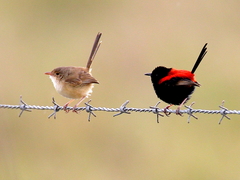
The red-backed fairywren (Malurus melanocephalus) is a species of passerine bird in the Australasian wren family, Maluridae. It is endemic to Australia and can be found near rivers and coastal areas along the northern and eastern coastlines from the Kimberley in the northwest to the Hunter Region in New South Wales. The male adopts a striking breeding plumage, with a black head, upperparts and tail, and a brightly coloured red back and brown wings. The female has brownish upperparts and paler underparts. The male in eclipse plumage and the juvenile resemble the female. Some males remain in non-breeding plumage while breeding.

The red-backed fairywren mainly eats insects, and supplements its diet with seed and small fruit. The preferred habitat is heathland and savannah, particularly where low shrubs and tall grasses provide cover. It can be nomadic in areas where there are frequent bushfires, although pairs or small groups of birds maintain and defend territories year-round in other parts of its range. Groups consist of a socially monogamous pair with one or more helper birds who assist in raising the young. These helpers are progeny that have attained sexual maturity yet remain with the family group for one or more years after fledging. The red-backed fairywren is sexually promiscuous, and each partner may mate with other individuals and even assist in raising the young from such pairings. Older males in breeding plumage are more likely to engage in this behaviour than are those breeding in eclipse plumage. As part of a courtship display, the male wren plucks red petals from flowers and displays them to females. Wikipedia →

Sounds

Call0:25

Australia · 2026

© Marc Anderson · XC1086949 · CC BY-NC-ND 4.0

Song0:04

Australia · 2022

© James Lambert · XC749892 · CC BY-NC-ND 4.0

Song0:37

Australia · 2009

© Simon Elliott · XC592567 · CC BY-NC-ND 4.0

Global Distribution

Parks Where Found

# Park Country Daily sighting probability
1 Kakadu National Park 🇦🇺 Australia
~20%
2 Springbrook National Park 🇦🇺 Australia
~10%
3 Nitmiluk National Park 🇦🇺 Australia
~10%
4 Noosa National Park 🇦🇺 Australia
~10%
5 Litchfield National Park 🇦🇺 Australia
~10%
6 Lamington National Park 🇦🇺 Australia
<5%
7 Daintree National Park 🇦🇺 Australia
<5%

Cities Where Found

# City Country Daily sighting probability
1 Brisbane 🇦🇺 Australia
~30%

Before you go

What are the chances of seeing a Red-backed Fairy-wren in Nitmiluk National Park?

With luck

About 10% of wildlife watchers report a Red-backed Fairy-wren sighting in Nitmiluk National Park on a given day, based on 44 verified sightings from GBIF citizen-science data from 2019 to 2026. It is the 55th most-seen of the 103 birds we can rate there. Over three days the chance rises to about 30%, and over a week to about 50%, if each day is a fresh chance.

When is the best time to see a Red-backed Fairy-wren in Nitmiluk National Park?

December and January

In those months about 20% of wildlife watchers report a Red-backed Fairy-wren in Nitmiluk National Park on a given day, against under 5% in April and June–July, the lowest months. Those are among Nitmiluk National Park's wettest months, with about 250 mm of rain a month against almost none in August.

What time of day is best to see a Red-backed Fairy-wren?

Between 8 and 11 am

Across all the parks we cover, that three-hour window holds the most Red-backed Fairy-wren sightings with a recorded time, and about 9 in 10 of them come between 6 am and 6 pm: it is a daytime animal.

Is Nitmiluk National Park the best place to see a Red-backed Fairy-wren?

3rd of 7

Of the 7 parks where we can rate Red-backed Fairy-wren sightings, Nitmiluk National Park ranks 3rd at about 10%. The best odds are in Kakadu National Park (Australia, about 20%) and Springbrook National Park (Australia, about 10%).

Where does the Red-backed Fairy-wren sighting chance come from?

GBIF citizen-science records

It is estimated from how often the Red-backed Fairy-wren is recorded against all the birds logged in Nitmiluk National Park (44 verified sightings from 2019 to 2026), calibrated against known sighting rates. Figures are rounded to the nearest 10% because citizen-science data supports honest approximations, not decimals, and months with records from fewer than five people show "—". How it works.

← Back to Nitmiluk National Park