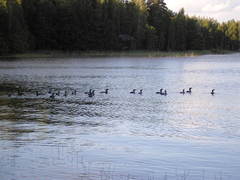
Arctic Loon

Arctic Loon

Gavia arctica

Silhouette: Andy Wilson · PhyloPic

LCLeast ConcernNTVUENCR
Daily sighting probability <5% · Rare
at Olympic National Park

In 3 days <5% in a week ~10%

81 Verified sightings at Olympic National Park From 2019 to 2026
226 In all 6 parks
December Best month
☀️ Diurnal When it's spotted

About the Arctic Loon

The black-throated loon (Gavia arctica), also known as the Arctic loon and the black-throated diver, is a migratory aquatic bird found in the Northern Hemisphere, primarily breeding in freshwater lakes in northern Europe and Asia. It winters along sheltered, ice-free coasts of the north-east Atlantic Ocean and the eastern and western Pacific Ocean. This loon was first described by Carl Linnaeus in 1758 and has two subspecies. It was previously considered to be the same species as the Pacific loon, of which it is traditionally considered to be a sister species, although this is debated. In a study that used mitochondrial and nuclear intron DNA, the black-throated loon was found to be sister to a clade consisting of the Pacific loon and two sister species, the common loon and the yellow-billed loon.

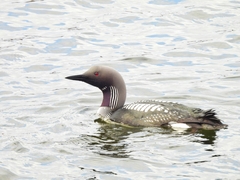
The black-throated loon measures about 70 cm (28 in) in length and can weigh anywhere from 1.3 to 3.4 kilograms (2.9 to 7.5 lb). In breeding plumage, the adult of the nominate subspecies has mostly black upperparts, with the exception of some of the mantle and scapulars, which have white squares. The head and hindneck are grey, and the sides white and striped black. Most of the throat is also black, giving this bird the name "black-throated loon". The colour of the throat patch can be used to distinguish the two subspecies; the throat patch of the other subspecies, G. a. viridigularis, is green. The underparts are mostly white, including the bottom of the throat. The flanks are also white, a feature that can be used to separate this bird from the Pacific loon. When the bird is not breeding, the black patch on the throat is absent, replaced with white; most of the black lines on the throat are also missing, except those on the bottom sides, and the upperparts are unpatterned except for a few white spots on the upperwing. The juvenile is similar to the non-breeding adult, except that it is overall browner.

The timing of the breeding season is variable; in the southern part of its range, this loon starts breeding in April, whereas in the northern portion, it waits until after the spring thaw. It builds an oval nest about 23 centimetres (9.1 in) across, either near the breeding lake or on vegetation emerging from it. The black-throated loon usually lays a clutch of two, rarely one or three, brown-green eggs with dark splotches. After an incubation period of 27 to 29 days, the chick hatches and is fed a diet of small fish and invertebrates. The adult mostly eats fish. To catch this food, it forages by itself or in pairs, very rarely foraging in groups. Wikipedia →

Sounds

Call0:53

Sweden · 2026

© SonoNatura · XC1154637 · CC BY-NC-ND 4.0

Song0:05

Sweden · 2026

© Dag Österlund · XC1144805 · CC BY-NC-SA 4.0

Alarm call0:25

Sweden · 2021

© Lars Edenius · XC675951 · CC BY-NC-SA 4.0

Global Distribution

Parks Where Found

# Park Country Daily sighting probability
1 Cairngorms National Park 🇬🇧 United Kingdom
~10%
2 Triglav National Park 🇸🇮 Slovenia
<5%
3 Kiskunság National Park 🇭🇺 Hungary
<5%
4 Wadden Sea National Park 🇩🇪 Germany
<5%
5 Olympic National Park 🇺🇸 United States
<5%
6 Biebrza National Park 🇵🇱 Poland
<5%

Cities Where Found

# City Country Daily sighting probability
1 Qingdao 🇨🇳 China
~20%
2 Bucharest 🇷🇴 Romania
~10%
3 Nizhny Novgorod 🇷🇺 Russia
<5%
4 Helsinki 🇫🇮 Finland
<5%
5 Kyiv 🇺🇦 Ukraine
<5%
6 Liverpool 🇬🇧 United Kingdom
<5%
7 Belgrade 🇷🇸 Serbia
<5%
8 London 🇬🇧 United Kingdom
<5%
9 Milan 🇮🇹 Italy
<5%
10 Vienna 🇦🇹 Austria
<5%

Zoos & Centres Where Found

# Zoo / Centre Country
1 Tallinn Zoo 🇪🇪 Estonia In captivity

Before you go

What are the chances of seeing an Arctic Loon in Olympic National Park?

Rare

Under 5% of wildlife watchers report an Arctic Loon sighting in Olympic National Park on a given day, based on 81 verified sightings from GBIF citizen-science data from 2019 to 2026. It is the 146th most-seen of the 216 birds we can rate there. Over three days the chance rises to under 5%, and over a week to about 10%, if each day is a fresh chance.

When is the best time to see an Arctic Loon in Olympic National Park?

December

In that month about 20% of wildlife watchers report an Arctic Loon in Olympic National Park on a given day, against under 5% in January to November, the lowest months. That is one of Olympic National Park's wettest months, with about 370 mm of rain against 35 mm in July.

What time of day is best to see an Arctic Loon?

Between 11 am and 2 pm

Across all the parks we cover, that three-hour window holds the most Arctic Loon sightings with a recorded time, and about 8 in 10 of them come between 6 am and 6 pm: it is a daytime animal.

Which relatives of the Arctic Loon live in Olympic National Park?

Same genus: Gavia

The closest relatives of the Arctic Loon that you can see in Olympic National Park (genus Gavia, Loons) are Common Loon (about 20%), Red-throated Loon (about 10%) and Pacific Loon (about 10%), with each one's daily chance of a sighting.

Where does the Arctic Loon sighting chance come from?

GBIF citizen-science records

It is estimated from how often the Arctic Loon is recorded against all the birds logged in Olympic National Park (81 verified sightings from 2019 to 2026), calibrated against known sighting rates. Figures are rounded to the nearest 10% because citizen-science data supports honest approximations, not decimals, and months with records from fewer than five people show "—". How it works.

← Back to Olympic National Park