Surfbird

Surfbird

Calidris virgata

Silhouette: Edwin Price · PhyloPic

LCLeast ConcernNTVUENCR
Daily sighting probability <5% · Rare
at Olympic National Park

In 3 days <5% in a week ~10%

51 Verified sightings at Olympic National Park From 2019 to 2026
1,290 In all 12 parks
December Best month
☀️ Diurnal When it's spotted

About the Surfbird

The surfbird (Calidris virgata) is a small stocky wader in the family Scolopacidae. It was once considered to be allied to the turnstones, and placed in the monotypic genus Aphriza, but is now placed in the genus Calidris.

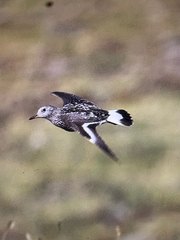
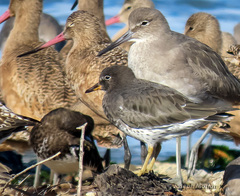
This bird has a short dark bill, yellow legs and a black band at the end of the white rump. In breeding plumage, it has dark streaks on the brownish head and breast with dark spots on its white underparts; the upperparts are dark with flax or sometimes rust colouring on the wings. Birds in winter plumage and immature birds are mainly grey on the upperparts and breast and white on the underparts with streaking.

Their breeding habitat is rocky tundra areas in Alaska and the Yukon. The female lays 4 eggs in a depression on the ground lined with vegetation. Both parents look after the young birds, who feed themselves. These birds migrate to the Pacific coasts of North and South America, from southern Alaska to Tierra del Fuego.

On the nesting grounds, these birds mainly eat insects and some seeds. At other times of year, they eat mollusks and crustaceans found along the surf line on rocky coasts and are usually found in small flocks, often with turnstones.

The song is a whistled tee tee tee. Wikipedia →

Sounds

Call0:14

United States · 2013

© Davyd Betchkal · XC243979 · CC BY-NC-SA 4.0

Call0:45

United States · 2013

© Andrew Spencer · XC134486 · CC BY-NC-SA 3.0

Call1:25

Canada · 2017

© Logan McLeod · XC432405 · CC BY-NC-SA 4.0

Global Distribution

Parks Where Found

# Park Country Daily sighting probability
1 Channel Islands National Park 🇺🇸 United States
~10%
2 Pacific Rim National Park Reserve 🇨🇦 Canada
~10%
3 Great Bear Rainforest 🇨🇦 Canada
<5%
4 Cabo Blanco Absolute Nature Reserve 🇨🇷 Costa Rica
<5%
5 Ostional Wildlife Refuge 🇨🇷 Costa Rica
<5%
6 Las Baulas Marine National Park 🇨🇷 Costa Rica
<5%
7 Denali National Park 🇺🇸 United States
<5%
8 Olympic National Park 🇺🇸 United States
<5%
9 Redwood National Park 🇺🇸 United States
<5%
10 Galápagos Islands 🇪🇨 Ecuador
<5%
11 Parque Natural Metropolitano 🇵🇦 Panama
<5%
12 Carara National Park 🇨🇷 Costa Rica
<5%

Cities Where Found

# City Country Daily sighting probability
1 San Diego 🇺🇸 United States
<5%
2 Anchorage 🇺🇸 United States
<5%
3 Panama City 🇵🇦 Panama
<5%
4 San Francisco 🇺🇸 United States
<5%
5 Los Angeles 🇺🇸 United States
<5%
6 Lima 🇵🇪 Peru
<5%
7 Seattle 🇺🇸 United States
<5%

Before you go

What are the chances of seeing a Surfbird in Olympic National Park?

Rare

Under 5% of wildlife watchers report a Surfbird sighting in Olympic National Park on a given day, based on 51 verified sightings from GBIF citizen-science data from 2019 to 2026. It is the 162nd most-seen of the 216 birds we can rate there. Over three days the chance rises to under 5%, and over a week to about 10%, if each day is a fresh chance.

When is the best time to see a Surfbird in Olympic National Park?

December

In that month about 10% of wildlife watchers report a Surfbird in Olympic National Park on a given day, against under 5% in January to November, the lowest months. That is one of Olympic National Park's wettest months, with about 370 mm of rain against 35 mm in July.

What time of day is best to see a Surfbird?

Between 2 and 5 pm

Across all the parks we cover, that three-hour window holds the most Surfbird sightings with a recorded time, and about 9 in 10 of them come between 6 am and 6 pm: it is a daytime animal.

Where does the Surfbird sighting chance come from?

GBIF citizen-science records

It is estimated from how often the Surfbird is recorded against all the birds logged in Olympic National Park (51 verified sightings from 2019 to 2026), calibrated against known sighting rates. Figures are rounded to the nearest 10% because citizen-science data supports honest approximations, not decimals, and months with records from fewer than five people show "—". How it works.

← Back to Olympic National Park