Rose-bellied Lizard

Rose-bellied Lizard

Sceloporus variabilis

Silhouette: SeismicShrimp · PhyloPic

LCLeast ConcernNTVUENCR
Daily sighting probability ~40% · Likely
at Ostional Wildlife Refuge

In 3 days ~80% in a week >90%

49 Verified sightings at Ostional Wildlife Refuge From 2019 to 2026
419 In all 9 parks
February Best month
☀️ Diurnal When it's spotted

About the Rose-bellied Lizard

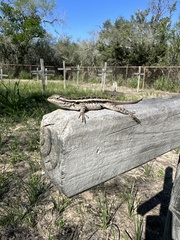
Sceloporus variabilis, commonly known as the rose-bellied lizard, is a species of lizard in the family Phrynosomatidae. The species is found from Central America to southern Texas Sceloporus variabilis can be found from southern Texas to northern Costa Rica, often in more arid regions.

Sceloporus variabilis is found in a variety of habitats including ocean beaches, grassland, shrubland, and forest, at elevations from sea level to 2,500 m (8,200 ft). Sceloporus variabilis is one of the smaller species of the genus Sceloporus. Adults may attain a snout-to-vent length (SVL) of 54 mm (2.1 in). With an unbroken tail, it may reach a maximum total length of 140 mm (5.5 in).

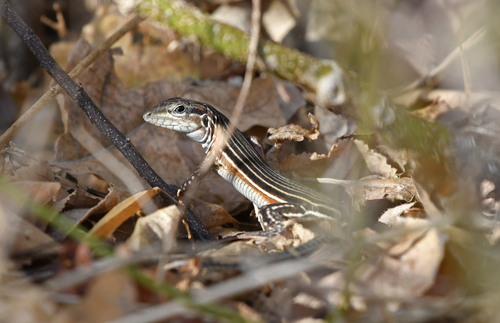
Dorsally, it is tan or olive, with a double series of dark brown spots. There are two yellowish dorsolateral stripes, one at each side of the back. Males are darker on the side below the dorsolateral stripe. Ventrally, it is dirty white or yellowish. Males have a large pink blotch on each side of the belly, which is bordered with dark blue, and they also have a black mark on the axilla.

The supraoculars are small, and they are bordered medially by a row of... Wikipedia →

Global Distribution

Parks Where Found

# Park Country Daily sighting probability
1 Cabo Blanco Absolute Nature Reserve 🇨🇷 Costa Rica
~50%
2 Ostional Wildlife Refuge 🇨🇷 Costa Rica
~40%
3 Las Baulas Marine National Park 🇨🇷 Costa Rica
~40%
4 Celaque National Park 🇭🇳 Honduras
~40%
5 Cerro Azul Meámbar National Park 🇭🇳 Honduras
~30%
6 Santa Rosa National Park 🇨🇷 Costa Rica
~30%
7 Cañón del Sumidero National Park 🇲🇽 Mexico
~30%
8 Cumbres de Monterrey National Park 🇲🇽 Mexico
~30%
9 Lago de Yojoa 🇭🇳 Honduras
~20%

Cities Where Found

# City Country Daily sighting probability
1 Tegucigalpa 🇭🇳 Honduras
~40%
2 San Antonio 🇺🇸 United States
~30%
3 Managua 🇳🇮 Nicaragua
~20%
4 Monterrey 🇲🇽 México
<5%

Closest Relatives at Ostional Wildlife Refuge

No species of the same family or order lives in Ostional Wildlife Refuge, so these are its closest relatives here: other reptiles.

Before you go

What are the chances of seeing a Rose-bellied Lizard in Ostional Wildlife Refuge?

Likely

About 40% of wildlife watchers report a Rose-bellied Lizard sighting in Ostional Wildlife Refuge on a given day, based on 49 verified sightings from GBIF citizen-science data from 2019 to 2026. It is the 3rd most-seen of the 20 reptiles we can rate there. Over three days the chance rises to about 80%, and over a week to over 90%, if each day is a fresh chance.

When is the best time to see a Rose-bellied Lizard in Ostional Wildlife Refuge?

February

In that month about 60% of wildlife watchers report a Rose-bellied Lizard in Ostional Wildlife Refuge on a given day, against under 5% in September and November, the lowest months. That is one of Ostional Wildlife Refuge's driest months, with about 15 mm of rain against 560 mm in October.

What time of day is best to see a Rose-bellied Lizard?

Between 10 am and 1 pm

Across all the parks we cover, that three-hour window holds the most Rose-bellied Lizard sightings with a recorded time, and about 8 in 10 of them come between 6 am and 6 pm: it is a daytime animal.

Is Ostional Wildlife Refuge the best place to see a Rose-bellied Lizard?

2nd of 9

Of the 9 parks where we can rate Rose-bellied Lizard sightings, Ostional Wildlife Refuge ranks 2nd at about 40%. The best odds are in Cabo Blanco Absolute Nature Reserve (Costa Rica, about 50%). All parks ranked.

Where does the Rose-bellied Lizard sighting chance come from?

GBIF citizen-science records

It is estimated from how often the Rose-bellied Lizard is recorded against all the reptiles logged in Ostional Wildlife Refuge (49 verified sightings from 2019 to 2026), calibrated against known sighting rates. Figures are rounded to the nearest 10% because citizen-science data supports honest approximations, not decimals, and months with records from fewer than five people show "—". How it works.

← Back to Ostional Wildlife Refuge