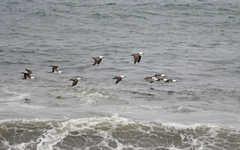
Peruvian Booby

Peruvian Booby

Sula variegata

Silhouette: Jon Hill (Photo by Benjamint444: http://en.wikipedia.org/wiki/File:Blue-footed-booby.jpg) · PhyloPic

LCLeast ConcernNTVUENCR
Daily sighting probability ~80% · Very likely
at Paracas National Reserve

In 3 days >90%

1,122 Verified sightings at Paracas National Reserve From 2019 to 2026
1,197 In all 3 parks
May Best month
☀️ Diurnal When it's spotted

About the Peruvian Booby

The Peruvian booby (Sula variegata) is an endemic bird of the Peruvian current, and an important predator of the marine community to which it belongs. Its distribution is much less widespread than other closely related booby species. It is the most abundant seabird species that inhabits the Peruvian coast and the second most important guano-producing seabird. During the mid-twentieth century, the Peruvian booby population reached 3 million birds.

The Peruvian booby has brown upperparts and a white head and underparts. There is noticeable white mottling on the upper side of the wings. Their wing-coverts are tipped white, creating a scale-like pattern. They have a long, pointed, grey bill and grey webbed feet. This differentiates them from characteristic coloring of the blue-footed and red-footed boobies.

Female boobies tend to be larger than their male counterparts: their bodies an average of 19% heavier, and their wings 4% larger. The Peruvian booby is within the genus Sula. It shares this genus with other boobies, including the blue-footed booby, the red-footed booby, the brown booby, the masked booby, and the Nazca booby.

There are no subspecies of...

Wikipedia →

Sounds

Flight call0:18

Chile · 2022

© Cristian Pinto Fernandez · XC727034 · CC BY-NC-SA 4.0

Call0:10

Chile · 2021

© Ignacio Escobar · XC626094 · CC BY-NC-SA 4.0

Global Distribution

Parks Where Found

# Park Country Daily sighting probability
1 Paracas National Reserve 🇵🇪 Peru
~80%
2 Pan de Azúcar National Park 🇨🇱 Chile
~60%
3 Machalilla National Park 🇪🇨 Ecuador
~10%

Cities Where Found

# City Country Daily sighting probability
1 Lima 🇵🇪 Peru
~20%
2 Panama City 🇵🇦 Panama
<5%

Zoos & Centres Where Found

# Zoo / Centre Country
1 Amaru 🇪🇨 Ecuador In captivity
2 Parque de las Leyendas 🇵🇪 Peru In captivity
3 Marino Valdivia Park 🇪🇨 Ecuador In captivity

Before you go

What are the chances of seeing a Peruvian Booby in Paracas National Reserve?

Very likely

About 80% of wildlife watchers report a Peruvian Booby sighting in Paracas National Reserve on a given day, based on 1,122 verified sightings from GBIF citizen-science data from 2019 to 2026. It is the 3rd most-seen of the 84 birds we can rate there. Over three days the chance rises to over 90%, if each day is a fresh chance.

When is the best time to see a Peruvian Booby in Paracas National Reserve?

May

In that month about 90% of wildlife watchers report a Peruvian Booby in Paracas National Reserve on a given day, against about 70% in September and November–March, the lowest months.

What time of day is best to see a Peruvian Booby?

Between 8 and 11 am

Across all the parks we cover, that three-hour window holds the most Peruvian Booby sightings with a recorded time, and about 9 in 10 of them come between 6 am and 6 pm: it is a daytime animal.

Is Paracas National Reserve the best place to see a Peruvian Booby?

Yes

Of the 3 parks where we can rate Peruvian Booby sightings, Paracas National Reserve has the highest daily chance: about 80%. Next come Pan de Azúcar National Park (Chile, about 60%) and Machalilla National Park (Ecuador, about 10%).

Where does the Peruvian Booby sighting chance come from?

GBIF citizen-science records

It is estimated from how often the Peruvian Booby is recorded against all the birds logged in Paracas National Reserve (1,122 verified sightings from 2019 to 2026), calibrated against known sighting rates. Figures are rounded to the nearest 10% because citizen-science data supports honest approximations, not decimals, and months with records from fewer than five people show "—". How it works.

← Back to Paracas National Reserve