Red-legged Cormorant

Red-legged Cormorant

Phalacrocorax gaimardi

Silhouette: Edwin Price · PhyloPic

LCNTNear ThreatenedVUENCR
Daily sighting probability ~40% · Likely
at Paracas National Reserve

In 3 days ~80% in a week >90%

382 Verified sightings at Paracas National Reserve From 2019 to 2026
391 In all 2 parks
May Best month
☀️ Diurnal When it's spotted

About the Red-legged Cormorant

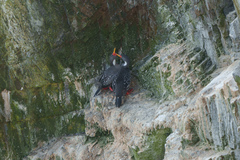
The red-legged cormorant (Poikilocarbo gaimardi), also known as the red-legged shag, red-footed cormorant, red-footed shag, Gaimard's cormorant and grey cormorant, is a species of cormorant resident to the coastline of South America. It is the only member of the genus Poikilocarbo. It is non-colonial unlike most seabirds. The red-legged cormorant has not been observed wing-spreading, which is unusual among cormorant species.

The red-legged cormorant was traditionally placed within the genus Phalacrocorax, but this assignment has been contested in recent years. Some phylogenetic studies have suggested that this species should be placed within Notocarbo, finding it to be most closely related to other southern-hemisphere shags, such as the spotted shag. A 2014 study found it to represent the second most basal genus of cormorant, with only Microcarbo being more basal, and thus reclassified into the genus Poikilocarbo. This classification was followed by the IOC in 2021. It has been suggested that the population of red-legged cormorants on the Atlantic coast are a separate subspecies. They are slightly smaller and have marginally paler plumage compared to the birds of the...

Wikipedia →

Global Distribution

Parks Where Found

# Park Country Daily sighting probability
1 Paracas National Reserve 🇵🇪 Peru
~40%
2 Pan de Azúcar National Park 🇨🇱 Chile
~30%

Cities Where Found

# City Country Daily sighting probability
1 Lima 🇵🇪 Peru
~10%

Before you go

What are the chances of seeing a Red-legged Cormorant in Paracas National Reserve?

Likely

About 40% of wildlife watchers report a Red-legged Cormorant sighting in Paracas National Reserve on a given day, based on 382 verified sightings from GBIF citizen-science data from 2019 to 2026. It is the 22nd most-seen of the 84 birds we can rate there. Over three days the chance rises to about 80%, and over a week to over 90%, if each day is a fresh chance.

When is the best time to see a Red-legged Cormorant in Paracas National Reserve?

May

In that month about 50% of wildlife watchers report a Red-legged Cormorant in Paracas National Reserve on a given day, against about 20% in January, the lowest month.

What time of day is best to see a Red-legged Cormorant?

Between 8 and 11 am

Across all the parks we cover, that three-hour window holds the most Red-legged Cormorant sightings with a recorded time, and about 9 in 10 of them come between 6 am and 6 pm: it is a daytime animal.

Is Paracas National Reserve the best place to see a Red-legged Cormorant?

Yes

Of the 2 parks where we can rate Red-legged Cormorant sightings, Paracas National Reserve has the highest daily chance: about 40%. Next come Pan de Azúcar National Park (Chile, about 30%).

Where does the Red-legged Cormorant sighting chance come from?

GBIF citizen-science records

It is estimated from how often the Red-legged Cormorant is recorded against all the birds logged in Paracas National Reserve (382 verified sightings from 2019 to 2026), calibrated against known sighting rates. Figures are rounded to the nearest 10% because citizen-science data supports honest approximations, not decimals, and months with records from fewer than five people show "—". How it works.

← Back to Paracas National Reserve