

Riverside Wren

Riverside Wren

Cantorchilus semibadius

Silhouette: Matt Wilkins · PhyloPic

LCLeast ConcernNTVUENCR
Daily sighting probability ~50% · Likely
at Piedras Blancas National Park

In 3 days ~90% in a week >90%

1,387 Verified sightings at Piedras Blancas National Park From 2019 to 2026
6,602 In all 7 parks
March Best month
☀️ Diurnal When it's spotted

About the Riverside Wren

The riverside wren (Cantorchilus semibadius) is a species of bird in the family Troglodytidae. It is found in Costa Rica and Panama. The riverside wren has sometimes been treated as conspecific with bay wren (Cantorchilus nigricapillus) but their plumages are quite different as are DNA analyses. The species is monotypic.

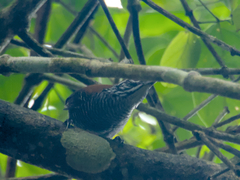
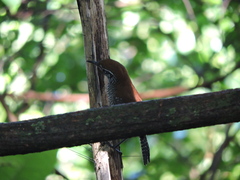
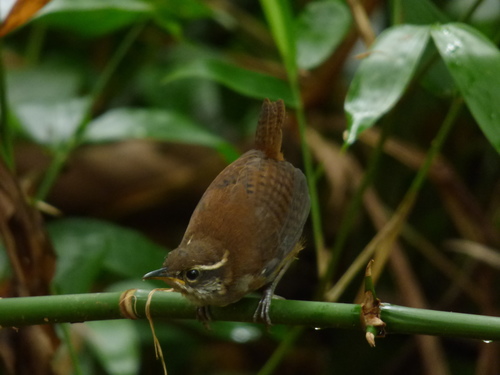
The riverside wren is 13 to 14 cm (5.1 to 5.5 in) long and weighs 17 g (0.60 oz). The adults have a bright orange-brown crown; chestnut nape, back, and rump; and a blackish tail with buff-white bars. They have a black-over-white supercilium and the rest of the face is streaked and spotted black and white. From throat to vent their underparts are pale gray with narrow black bars; the gray becomes somewhat buffy to the rear. Juveniles are duller overall, have fine black scaling on the crown, and the underparts' black bars are not as crisp.

The riverside wren is found along the Pacific slope from Costa Rica's Gulf of Nicoya into western Panama. It inhabits dense vegetation, preferably along watercourses, swampy edges of woodlands, or on steep precipices. In elevation it ranges from sea level... Wikipedia →

Sounds

Call0:58

Costa Rica · 2024

© Johan Chaves · XC943546 · CC BY-NC-SA 4.0

Song0:30

Costa Rica · 2023

© Scott Olmstead · XC861267 · CC BY-NC-SA 4.0

Scold0:05

Costa Rica · 1994

© Rick Bowers · XC29628 · CC BY-NC-ND 2.5

Global Distribution

Parks Where Found

# Park Country Daily sighting probability
1 Piedras Blancas National Park 🇨🇷 Costa Rica
~50%
2 Corcovado National Park 🇨🇷 Costa Rica
~50%
3 Manuel Antonio National Park 🇨🇷 Costa Rica
~30%
4 Carara National Park 🇨🇷 Costa Rica
~30%
5 Marino Ballena National Park 🇨🇷 Costa Rica
~20%
6 Chirripó National Park 🇨🇷 Costa Rica
~10%
7 La Amistad International Park (Panama) 🇵🇦 Panama
<5%

Before you go

What are the chances of seeing a Riverside Wren in Piedras Blancas National Park?

Likely

About 50% of wildlife watchers report a Riverside Wren sighting in Piedras Blancas National Park on a given day, based on 1,387 verified sightings from GBIF citizen-science data from 2019 to 2026. It is the 7th most-seen of the 344 birds we can rate there. Over three days the chance rises to about 90%, and over a week to over 90%, if each day is a fresh chance.

When is the best time to see a Riverside Wren in Piedras Blancas National Park?

January, March, June–July and October

In those months about 60% of wildlife watchers report a Riverside Wren in Piedras Blancas National Park on a given day, against about 40% in February, September and November–December, the lowest months.

What time of day is best to see a Riverside Wren?

Between 6 and 9 am

Across all the parks we cover, that three-hour window holds the most Riverside Wren sightings with a recorded time, and about 8 in 10 of them come between 6 am and 6 pm: it is a daytime animal.

Is Piedras Blancas National Park the best place to see a Riverside Wren?

Yes

Of the 7 parks where we can rate Riverside Wren sightings, Piedras Blancas National Park has the highest daily chance: about 50%. Next come Corcovado National Park (Costa Rica, about 50%) and Manuel Antonio National Park (Costa Rica, about 30%). All parks ranked.

Where does the Riverside Wren sighting chance come from?

GBIF citizen-science records

It is estimated from how often the Riverside Wren is recorded against all the birds logged in Piedras Blancas National Park (1,387 verified sightings from 2019 to 2026), calibrated against known sighting rates. Figures are rounded to the nearest 10% because citizen-science data supports honest approximations, not decimals, and months with records from fewer than five people show "—". How it works.

← Back to Piedras Blancas National Park