Spangle-cheeked Tanager

Spangle-cheeked Tanager

Tangara dowii

Silhouette: Sheatherius · PhyloPic

LCLeast ConcernNTVUENCR
Daily sighting probability ~10% · With luck
at Poás Volcano National Park

In 3 days ~20% in a week ~30%

181 Verified sightings at Poás Volcano National Park From 2019 to 2026
6,664 In all 9 parks
January Best month
☀️ Diurnal When it's spotted

About the Spangle-cheeked Tanager

The spangle-cheeked tanager (Tangara dowii) is a medium-sized passerine bird. This tanager is an endemic resident breeder in the highlands of Costa Rica and western Panama. Formerly considered conspecific with the green-naped tanager, it is now known that these two species differ geographically and genetically.

It is common from about 1,200 to 3,000 m (3,900 to 9,800 ft) altitude in the canopy of epiphyte-laden wet mountain forests, and at lower levels in semi-open areas like clearings with trees, second growth and woodland edges. The bulky cup nest, lined with bromeliad leaves, is built in a tree fork or on a branch high amongst the epiphytes. The normal clutch is two eggs.

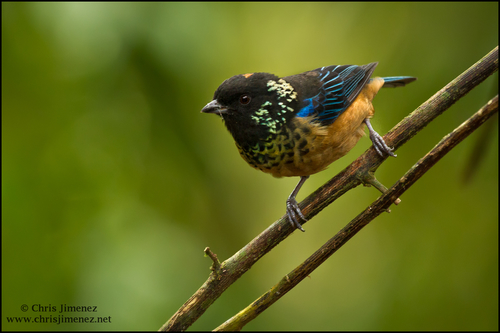
The adult spangle-cheeked tanager is 13 cm (5.1 in) long and weighs 20 g (0.71 oz). It has a mainly black head, upperparts and breast, with blue scaling on the breast, sides of the face and neck, and a rufous crown patch. The wings and tail have blue edgings. The rump is green and the belly is cinnamon. The sexes are very similar, but adult males have more extensive blue scaling. Immatures are generally duller, with no crown patch, and less distinct blue scaling.

Spangle-cheeked tanagers occur in pairs, family groups, or as part of a mixed-species feeding flock (particularly those containing common bush tanagers). They eat small fruit, usually swallowed whole, insects and spiders.

The spangle-cheeked tanager's call is a high tsip. Wikipedia →
Sounds

Call1:20

Costa Rica · 2019

© Odirlei Vieira da Fonseca · XC552919 · CC BY-NC-SA 4.0

Call0:25

Costa Rica · 2016

© Frank Lambert · XC411184 · CC BY-NC-ND 4.0

Call0:40

Costa Rica · 2017

© Scott Olmstead · XC403201 · CC BY-NC-SA 4.0

Global Distribution

Parks Where Found

# Park Country Daily sighting probability
1 Los Quetzales National Park 🇨🇷 Costa Rica
~20%
2 Volcán Barú National Park 🇵🇦 Panama
~20%
3 Braulio Carrillo National Park 🇨🇷 Costa Rica
~10%
4 Monteverde Cloud Forest Reserve 🇨🇷 Costa Rica
~10%
5 Tapantí-Macizo de la Muerte National Park 🇨🇷 Costa Rica
~10%
6 Poás Volcano National Park 🇨🇷 Costa Rica
~10%
7 La Amistad International Park (Panama) 🇵🇦 Panama
<5%
8 Chirripó National Park 🇨🇷 Costa Rica
<5%
9 Arenal Volcano National Park 🇨🇷 Costa Rica
<5%

Before you go

What are the chances of seeing a Spangle-cheeked Tanager in Poás Volcano National Park?

With luck

About 10% of wildlife watchers report a Spangle-cheeked Tanager sighting in Poás Volcano National Park on a given day, based on 181 verified sightings from GBIF citizen-science data from 2019 to 2026. It is the 87th most-seen of the 356 birds we can rate there. Over three days the chance rises to about 20%, and over a week to about 30%, if each day is a fresh chance.

When is the best time to see a Spangle-cheeked Tanager in Poás Volcano National Park?

January–February, May and July–October

In those months about 10% of wildlife watchers report a Spangle-cheeked Tanager in Poás Volcano National Park on a given day, against under 5% in March–April, June and November–December, the lowest months.

What time of day is best to see a Spangle-cheeked Tanager?

Between 8 and 11 am

Across all the parks we cover, that three-hour window holds the most Spangle-cheeked Tanager sightings with a recorded time, and about 9 in 10 of them come between 6 am and 6 pm: it is a daytime animal.

Which relatives of the Spangle-cheeked Tanager live in Poás Volcano National Park?

Same genus: Tangara

The closest relatives of the Spangle-cheeked Tanager that you can see in Poás Volcano National Park (genus Tangara, Tangara Tanagers) are Silver-throated Tanager (about 80%) and Bay-headed Tanager (about 10%), with each one's daily chance of a sighting.

Where does the Spangle-cheeked Tanager sighting chance come from?

GBIF citizen-science records

It is estimated from how often the Spangle-cheeked Tanager is recorded against all the birds logged in Poás Volcano National Park (181 verified sightings from 2019 to 2026), calibrated against known sighting rates. Figures are rounded to the nearest 10% because citizen-science data supports honest approximations, not decimals, and months with records from fewer than five people show "—". How it works.

← Back to Poás Volcano National Park

