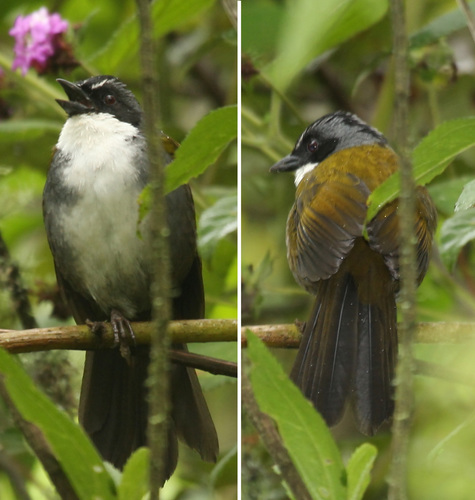
Gray-browed Brushfinch

Gray-browed Brushfinch

Arremon assimilis

Silhouette: Juan Camilo Cepeda-Duque · PhyloPic

LCLeast ConcernNTVUENCR
Daily sighting probability <5% · Rare
at Podocarpus National Park

In 3 days <5% in a week ~10%

15 Verified sightings at Podocarpus National Park From 2019 to 2026
1,058 In all 4 parks
March Best month
☀️ Diurnal When it's spotted

About the Gray-browed Brushfinch

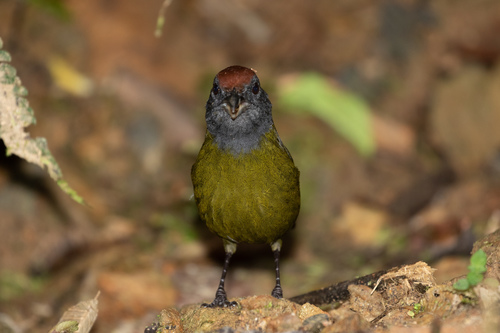
The grey-browed brushfinch (Arremon assimilis) is a species of bird in the family Passerellidae, the New World sparrows. It is found in Colombia, Ecuador, Peru and Venezuela. The grey-browed brushfinch has a complicated taxonomic history. It was formally described in 1840 with the binomial Tanagra (Arrémon, Vieillot; Embernagra, Lesson) assimilis. It was later reassigned to the genus Buarremon that was later merged into genus Atlapetes. Further study resulted in Buarremon's being resurrected. Buarremon assimilis was later reassigned as one of many subspecies of what was then the "stripe-headed brushfinch" (Buarremon torquatus). In 2008 taxonomists began merging Buarremon into Arremon. Following a study published in 2010 and some earlier studies, taxonomists began splitting the "stripe-headed brushfinch" into eight species, one of which was the grey-browed brushfinch.

The grey-browed brushfinch has these four subspecies: Wikipedia →

Sounds

Duet0:14

Ecuador · 2026

© Paul Molina Abril · XC1182390 · CC BY-NC-SA 4.0

Call1:04

Ecuador · 2026

© Manuel Sánchez-Nivicela · XC1166923 · CC BY-NC-ND 4.0

Song0:53

Ecuador · 2025

© Scott Olmstead · XC1151004 · CC BY-NC-SA 4.0

Global Distribution

Parks Where Found

# Park Country Daily sighting probability
1 Los Nevados National Natural Park 🇨🇴 Colombia
~20%
2 Chingaza National Natural Park 🇨🇴 Colombia
<5%
3 Podocarpus National Park 🇪🇨 Ecuador
<5%
4 Farallones de Cali National Natural Park 🇨🇴 Colombia
<5%

Cities Where Found

# City Country Daily sighting probability
1 Quito 🇪🇨 Ecuador
~10%
2 Bogota 🇨🇴 Colombia
<5%

Before you go

What are the chances of seeing a Gray-browed Brushfinch in Podocarpus National Park?

Rare

Under 5% of wildlife watchers report a Gray-browed Brushfinch sighting in Podocarpus National Park on a given day, based on 15 verified sightings from GBIF citizen-science data from 2019 to 2026. It is the 337th most-seen of the 446 birds we can rate there. Over three days the chance rises to under 5%, and over a week to about 10%, if each day is a fresh chance.

When is the best time to see a Gray-browed Brushfinch in Podocarpus National Park?

Any time of year

In every month with enough records, under 5% of wildlife watchers report a Gray-browed Brushfinch in Podocarpus National Park on a given day, so our monthly data shows no clear season.

What time of day is best to see a Gray-browed Brushfinch?

Between 7 and 10 am

Across all the parks we cover, that three-hour window holds the most Gray-browed Brushfinch sightings with a recorded time, and about 9 in 10 of them come between 6 am and 6 pm: it is a daytime animal.

Is Podocarpus National Park the best place to see a Gray-browed Brushfinch?

3rd of 4

Of the 4 parks where we can rate Gray-browed Brushfinch sightings, Podocarpus National Park ranks 3rd at under 5%. The best odds are in Los Nevados National Natural Park (Colombia, about 20%) and Chingaza National Natural Park (Colombia, under 5%).

Which relatives of the Gray-browed Brushfinch live in Podocarpus National Park?

Same genus: Arremon

The closest relatives of the Gray-browed Brushfinch that you can see in Podocarpus National Park (genus Arremon, Arremon Brushfinches and Sparrows) are Orange-billed Sparrow (about 30%), Chestnut-capped Brushfinch (about 10%) and Olive Finch (about 10%), with each one's daily chance of a sighting.

Where does the Gray-browed Brushfinch sighting chance come from?

GBIF citizen-science records

It is estimated from how often the Gray-browed Brushfinch is recorded against all the birds logged in Podocarpus National Park (15 verified sightings from 2019 to 2026), calibrated against known sighting rates. Figures are rounded to the nearest 10% because citizen-science data supports honest approximations, not decimals, and months with records from fewer than five people show "—". How it works.

← Back to Podocarpus National Park