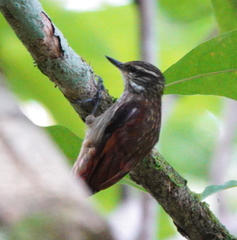

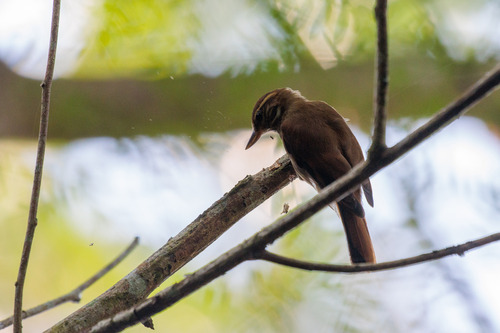
Slender-billed Xenops

Slender-billed Xenops

Xenops tenuirostris

Silhouette: Sheatherius · PhyloPic

LCLeast ConcernNTVUENCR
Daily sighting probability <5% · Rare
at Podocarpus National Park

In 3 days ~10% in a week ~30%

73 Verified sightings at Podocarpus National Park From 2019 to 2026
175 In all 5 parks
December Best month
☀️ Diurnal When it's spotted

About the Slender-billed Xenops

The slender-billed xenops (Xenops tenuirostris) is a species of bird in the Furnariinae subfamily of the ovenbird family Furnariidae. It is found in Bolivia, Brazil, Colombia, Ecuador, French Guiana, Guyana, Peru, Suriname, and Venezuela.

The slender-billed xenops is 10 to 11.5 cm (3.9 to 4.5 in) long and weighs 9 to 11 g (0.32 to 0.39 oz). Its namesake bill is wedge-shaped, and longer and thinner than those of other xenops. The sexes are alike. Adults of the nominate subspecies have a blackish brown face with a dark brown crown that is spotted and streaked buff, a buffish white supercilium, and a pure white malar streak. Their back is rufescent brown with short, wide, elongated creamy buff spots on its upper part. Their rump and uppertail coverts are reddish rufous. Their tail's central and outermost pairs of feathers are rufous and the others mixed black and rufous; the black is visible in the field. Their wing coverts are dark brown with rufous edges and their flight... Wikipedia →

Sounds

Song0:42

Ecuador · 2025

© Scott Olmstead · XC1064620 · CC BY-NC-SA 4.0

Recording0:27

Brazil · 2021

© GABRIEL LEITE · XC691180 · CC BY-NC-SA 4.0

Call0:28

Brazil · 2009

© Andrew Spencer · XC39113 · CC BY-NC-ND 2.5

Global Distribution

Parks Where Found

# Park Country Daily sighting probability
1 Podocarpus National Park 🇪🇨 Ecuador
<5%
2 Manu National Park 🇵🇪 Peru
<5%
3 Sierra de la Macarena National Park 🇨🇴 Colombia
<5%
4 Yasuní National Park 🇪🇨 Ecuador
<5%
5 Tambopata National Reserve 🇵🇪 Peru
<5%

Before you go

What are the chances of seeing a Slender-billed Xenops in Podocarpus National Park?

Rare

Under 5% of wildlife watchers report a Slender-billed Xenops sighting in Podocarpus National Park on a given day, based on 73 verified sightings from GBIF citizen-science data from 2019 to 2026. It is the 195th most-seen of the 446 birds we can rate there. Over three days the chance rises to about 10%, and over a week to about 30%, if each day is a fresh chance.

When is the best time to see a Slender-billed Xenops in Podocarpus National Park?

March, May and December–January

In those months about 10% of wildlife watchers report a Slender-billed Xenops in Podocarpus National Park on a given day, against under 5% in February, April and June–November, the lowest months.

What time of day is best to see a Slender-billed Xenops?

Between 9 am and noon

Across all the parks we cover, that three-hour window holds the most Slender-billed Xenops sightings with a recorded time, and nearly all of them come between 6 am and 6 pm: it is a daytime animal.

Is Podocarpus National Park the best place to see a Slender-billed Xenops?

Yes

Of the 5 parks where we can rate Slender-billed Xenops sightings, Podocarpus National Park has the highest daily chance: under 5%. Next come Manu National Park (Peru, under 5%) and Sierra de la Macarena National Park (Colombia, under 5%).

Where does the Slender-billed Xenops sighting chance come from?

GBIF citizen-science records

It is estimated from how often the Slender-billed Xenops is recorded against all the birds logged in Podocarpus National Park (73 verified sightings from 2019 to 2026), calibrated against known sighting rates. Figures are rounded to the nearest 10% because citizen-science data supports honest approximations, not decimals, and months with records from fewer than five people show "—". How it works.

← Back to Podocarpus National Park