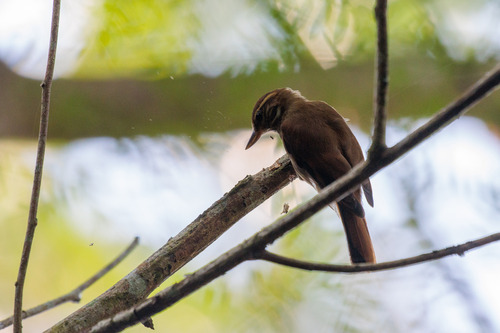
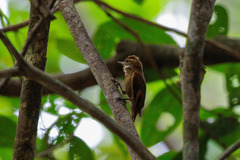
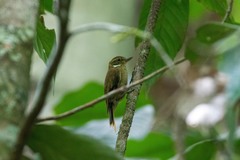
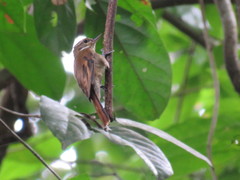

Amazonian Plain-Xenops

Amazonian Plain-Xenops

Xenops genibarbis

Silhouette: Sheatherius · PhyloPic

LCLeast ConcernNTVUENCR
Daily sighting probability <5% · Rare
at Podocarpus National Park

In 3 days <5%

5 Verified sightings at Podocarpus National Park From 2019 to 2026
465 In all 7 parks
September Best month
☀️ Diurnal When it's spotted

About the Amazonian Plain-Xenops

The Amazonian plain xenops (Xenops genibarbis) is a passerine bird in the Furnariinae subfamily of the ovenbird family Furnariidae. It is found in every mainland South American country except Argentina, Chile, Paraguay, and Uruguay.

The Amazonian plain xenops was formally described in 1811 by the German zoologist Johann Illiger based on a specimen collected near Cametá in northeastern Brazil. He coined the binomial name Xenops genibarbis where the specific epithet combines Latin gena meaning "cheek" with barba meaning "beard".

What are now the five subspecies of the Amazonian plain xenops were formerly included in the "plain xenops" (X. minutus). A study published in 2020 described differences in plumage, vocalizations and DNA among the subspecies of X. genibabis. Based on it and other studies, in August... Wikipedia →

Global Distribution

Parks Where Found

# Park Country Daily sighting probability
1 Brownsberg Nature Park 🇸🇷 Suriname
~10%
2 Manu National Park 🇵🇪 Peru
<5%
3 Tambopata National Reserve 🇵🇪 Peru
<5%
4 Yasuní National Park 🇪🇨 Ecuador
<5%
5 Anavilhanas National Park 🇧🇷 Brazil
<5%
6 Sierra de la Macarena National Park 🇨🇴 Colombia
<5%
7 Podocarpus National Park 🇪🇨 Ecuador
<5%

Cities Where Found

# City Country Daily sighting probability
1 João Pessoa 🇧🇷 Brazil
<5%

Before you go

What are the chances of seeing an Amazonian Plain-Xenops in Podocarpus National Park?

Rare

Under 5% of wildlife watchers report an Amazonian Plain-Xenops sighting in Podocarpus National Park on a given day, based on 5 verified sightings from GBIF citizen-science data from 2019 to 2026. It is the 435th most-seen of the 446 birds we can rate there. Over three days the chance rises to under 5%, if each day is a fresh chance.

When is the best time to see an Amazonian Plain-Xenops in Podocarpus National Park?

Any time of year

In every month with enough records, under 5% of wildlife watchers report an Amazonian Plain-Xenops in Podocarpus National Park on a given day, so our monthly data shows no clear season.

What time of day is best to see an Amazonian Plain-Xenops?

Between 8 and 11 am

Across all the parks we cover, that three-hour window holds the most Amazonian Plain-Xenops sightings with a recorded time, and about 9 in 10 of them come between 6 am and 6 pm: it is a daytime animal.

Is Podocarpus National Park the best place to see an Amazonian Plain-Xenops?

7th of 7

Of the 7 parks where we can rate Amazonian Plain-Xenops sightings, Podocarpus National Park ranks 7th at under 5%. The best odds are in Brownsberg Nature Park (Suriname, about 10%), Manu National Park (Peru, under 5%) and Tambopata National Reserve (Peru, under 5%).

Where does the Amazonian Plain-Xenops sighting chance come from?

GBIF citizen-science records

It is estimated from how often the Amazonian Plain-Xenops is recorded against all the birds logged in Podocarpus National Park (5 verified sightings from 2019 to 2026), calibrated against known sighting rates. Figures are rounded to the nearest 10% because citizen-science data supports honest approximations, not decimals, and months with records from fewer than five people show "—". How it works.

← Back to Podocarpus National Park