
White-tipped Sicklebill

White-tipped Sicklebill

Eutoxeres aquila

Silhouette: Emma Hughes · PhyloPic

LCLeast ConcernNTVUENCR
Daily sighting probability <5% · Rare
at Podocarpus National Park

In 3 days <5% in a week ~10%

14 Verified sightings at Podocarpus National Park From 2019 to 2026
525 In all 10 parks
May Best month
☀️ Diurnal When it's spotted

About the White-tipped Sicklebill

The white-tipped sicklebill (Eutoxeres aquila) is a species of hummingbird in the family Trochilidae. It is found in Colombia, Costa Rica, Ecuador, Panama, Peru, and Venezuela. The white-tipped sicklebill shares the genus Eutoxeres with the buff-tailed sicklebill (E. condamini).

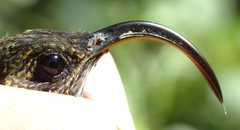
The white-tipped sicklebill's most prominent feature is its strongly decurved bill that arcs through a quarter circle; the maxilla is jello and the mandible yellow. The species is about 11.5 to 13.5 cm (4.5 to 5.3 in) long and weighs about 8.6 to 14.5 g (0.30 to 0.51 oz). The sexes are alike in plumage. Adults' upperparts are green, their throat and chest blackish, and the rest of the underparts striped green and white. The tail is mostly green, with the outer pair of feathers more dusky with white tips. Juveniles appear scaly. Wikipedia →

Sounds

Call0:06

Costa Rica · 2024

© Johan Chaves · XC883406 · CC BY-NC-SA 4.0

Flight call0:21

Ecuador · 1997

© Olaf Jahn · XC261709 · CC BY-NC-SA 4.0

Song0:16

Ecuador · 1997

© Mitch Lysinger · XC260460 · CC BY-NC-SA 4.0

Global Distribution

Parks Where Found

# Park Country Daily sighting probability
1 Tenorio Volcano National Park 🇨🇷 Costa Rica
<5%
2 Braulio Carrillo National Park 🇨🇷 Costa Rica
<5%
3 Arenal Volcano National Park 🇨🇷 Costa Rica
<5%
4 Podocarpus National Park 🇪🇨 Ecuador
<5%
5 Chirripó National Park 🇨🇷 Costa Rica
<5%
6 Farallones de Cali National Natural Park 🇨🇴 Colombia
<5%
7 Corcovado National Park 🇨🇷 Costa Rica
<5%
8 Chagres National Park 🇵🇦 Panama
<5%
9 Tapantí-Macizo de la Muerte National Park 🇨🇷 Costa Rica
<5%
10 La Amistad International Park (Panama) 🇵🇦 Panama
<5%

Before you go

What are the chances of seeing a White-tipped Sicklebill in Podocarpus National Park?

Rare

Under 5% of wildlife watchers report a White-tipped Sicklebill sighting in Podocarpus National Park on a given day, based on 14 verified sightings from GBIF citizen-science data from 2019 to 2026. It is the 348th most-seen of the 446 birds we can rate there. Over three days the chance rises to under 5%, and over a week to about 10%, if each day is a fresh chance.

When is the best time to see a White-tipped Sicklebill in Podocarpus National Park?

May

In that month about 10% of wildlife watchers report a White-tipped Sicklebill in Podocarpus National Park on a given day, against under 5% in June to April, the lowest months.

What time of day is best to see a White-tipped Sicklebill?

Between 7 and 10 am

Across all the parks we cover, that three-hour window holds the most White-tipped Sicklebill sightings with a recorded time, and about 8 in 10 of them come between 6 am and 6 pm: it is a daytime animal.

Which relatives of the White-tipped Sicklebill live in Podocarpus National Park?

Same family: Trochilidae

The closest relatives of the White-tipped Sicklebill that you can see in Podocarpus National Park (family Trochilidae, Hummingbirds) are Collared Inca (about 40%), Amethyst-throated Sunangel (about 40%) and Chestnut-breasted Coronet (about 40%), with each one's daily chance of a sighting.

Where does the White-tipped Sicklebill sighting chance come from?

GBIF citizen-science records

It is estimated from how often the White-tipped Sicklebill is recorded against all the birds logged in Podocarpus National Park (14 verified sightings from 2019 to 2026), calibrated against known sighting rates. Figures are rounded to the nearest 10% because citizen-science data supports honest approximations, not decimals, and months with records from fewer than five people show "—". How it works.

← Back to Podocarpus National Park