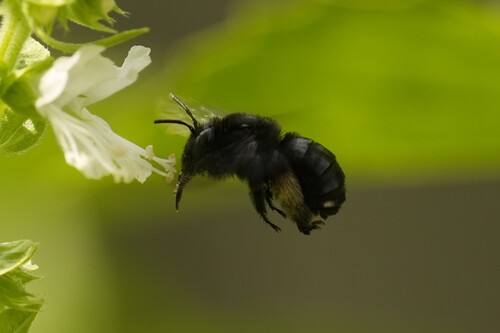
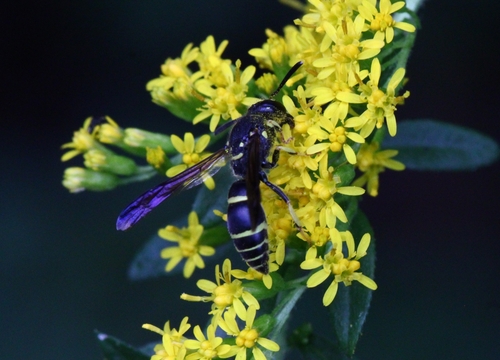
Common Eastern Bumble Bee

Common Eastern Bumble Bee

Bombus impatiens

Daily sighting probability ~10% · With luck
at Point Pelee National Park

In 3 days ~30% in a week ~50%

15 Verified sightings at Point Pelee National Park From 2019 to 2026
1,534 In all 6 parks
September Best month
☀️ Diurnal When it's spotted

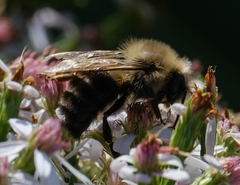
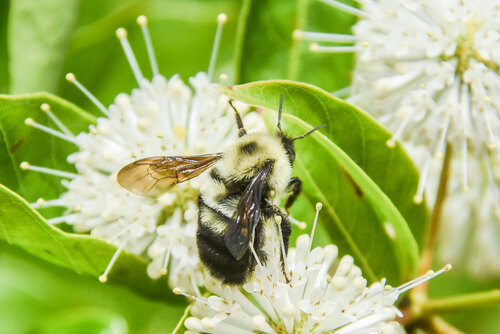
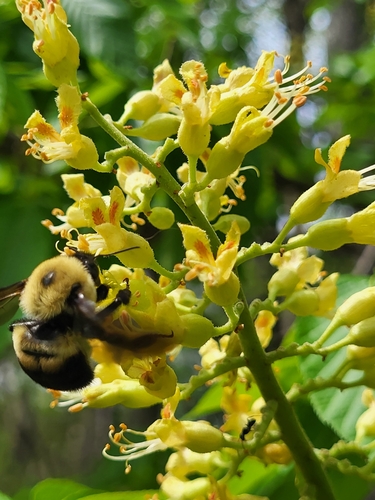
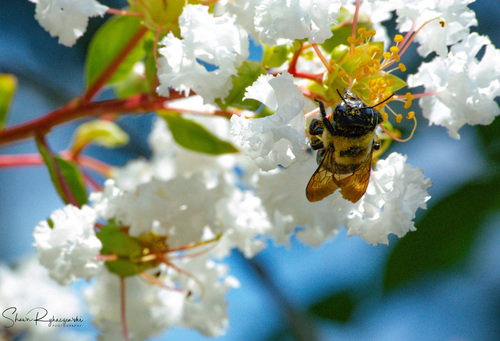
About the Common Eastern Bumble Bee

Bombus impatiens, the common eastern bumblebee, is the most commonly encountered bumblebee across much of eastern North America. They can be found in the Eastern temperate forest region of the eastern United States, southern Canada, and the eastern Great Plains. They are adapted to suburban and urban environments, and as a pollinator species in commercial use by the greenhouse industry. This increase consequently led to their farther spread outside their previous distribution range. They are considered one of the most important species of pollinator bees in North America.

The generic epithet (the first part of the name) Bombus comes from the genus Bombus, which is also commonly known as bumblebee and belongs to the tribe Bombini. The specific name (the latter half of its scientific name) may come from the flowers of the genus Impatiens, which is one of its food sources.

Including B. impatiens, the genus Bombus contains 250 species and most species are characterized by their eusociality or parasitic nature. Specifically, the genus Bombus has 49 subgenera, and B. impatiens belongs to the subgenus Pyrobombus. B. impatiens is also of the order Hymenoptera and... Wikipedia →
Global Distribution

Parks Where Found

# Park Country Daily sighting probability
1 Shenandoah National Park 🇺🇸 United States
~40%
2 Great Smoky Mountains National Park 🇺🇸 United States
~40%
3 Acadia National Park 🇺🇸 United States
~30%
4 Merritt Island National Wildlife Refuge 🇺🇸 United States
~10%
5 Congaree National Park 🇺🇸 United States
~10%
6 Point Pelee National Park 🇨🇦 Canada
~10%

Cities Where Found

# City Country Daily sighting probability
1 Minneapolis [Saint Paul] 🇺🇸 United States
~60%
2 Boston 🇺🇸 United States
~50%
3 Montreal 🇨🇦 Canada
~40%
4 Philadelphia 🇺🇸 United States
~40%
5 New York City 🇺🇸 United States
~30%
6 Washington 🇺🇸 United States
~30%
7 Vancouver 🇨🇦 Canada
~30%
8 Chicago 🇺🇸 United States
~30%
9 Detroit 🇺🇸 United States
~30%
10 Baltimore 🇺🇸 United States
~30%

Before you go

What are the chances of seeing a Common Eastern Bumble Bee in Point Pelee National Park?

With luck

About 10% of wildlife watchers report a Common Eastern Bumble Bee sighting in Point Pelee National Park on a given day, based on 15 verified sightings from GBIF citizen-science data from 2019 to 2026. It is the 69th most-seen of the 196 insects we can rate there. Over three days the chance rises to about 30%, and over a week to about 50%, if each day is a fresh chance.

When is the best time to see a Common Eastern Bumble Bee in Point Pelee National Park?

June and September

In those months about 20% of wildlife watchers report a Common Eastern Bumble Bee in Point Pelee National Park on a given day, against under 5% in August and November–April, the lowest months.

What time of day is best to see a Common Eastern Bumble Bee?

Between 10 am and 1 pm

Across all the parks we cover, that three-hour window holds the most Common Eastern Bumble Bee sightings with a recorded time, and about 9 in 10 of them come between 6 am and 6 pm: it is a daytime animal.

Is Point Pelee National Park the best place to see a Common Eastern Bumble Bee?

6th of 6

Of the 6 parks where we can rate Common Eastern Bumble Bee sightings, Point Pelee National Park ranks 6th at about 10%. The best odds are in Shenandoah National Park (United States, about 40%), Great Smoky Mountains National Park (United States, about 40%) and Acadia National Park (United States, about 30%).

Which relatives of the Common Eastern Bumble Bee live in Point Pelee National Park?

Same genus: Bombus

The closest relatives of the Common Eastern Bumble Bee that you can see in Point Pelee National Park (genus Bombus, Bumble Bees) are Two-Spotted Bumble Bee (about 10%) and Brown-Belted Bumble Bee (about 10%), with each one's daily chance of a sighting.

Where does the Common Eastern Bumble Bee sighting chance come from?

GBIF citizen-science records

It is estimated from how often the Common Eastern Bumble Bee is recorded against all the insects logged in Point Pelee National Park (15 verified sightings from 2019 to 2026), calibrated against known sighting rates. Figures are rounded to the nearest 10% because citizen-science data supports honest approximations, not decimals, and months with records from fewer than five people show "—". How it works.

← Back to Point Pelee National Park