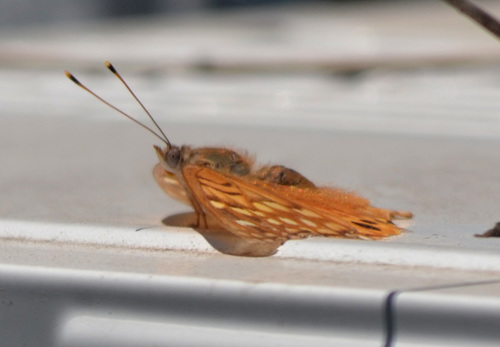
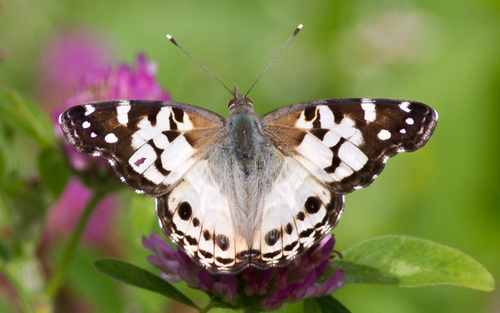
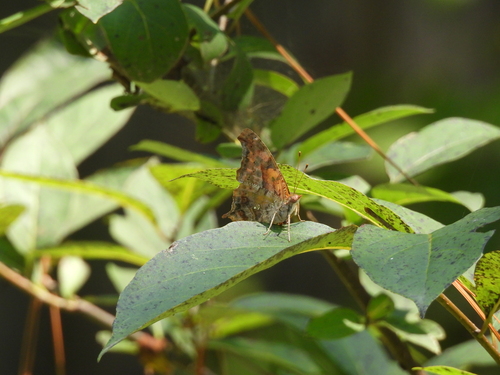
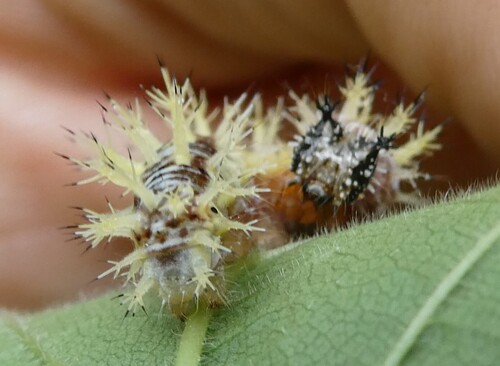
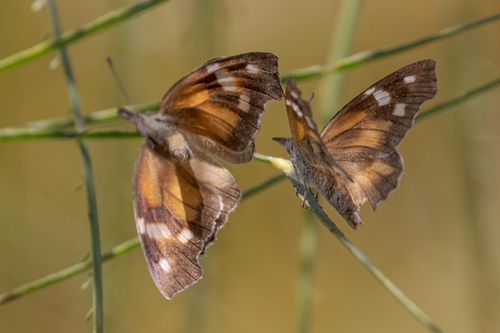
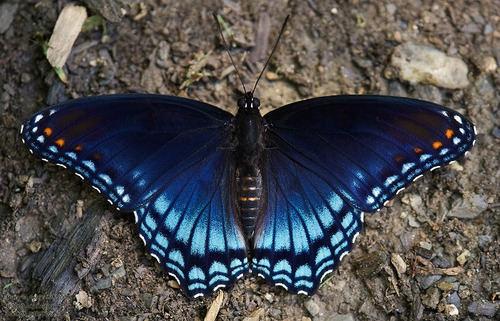
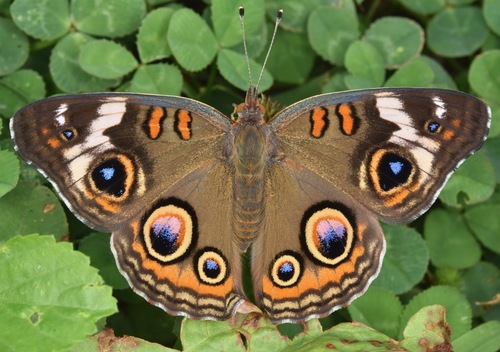
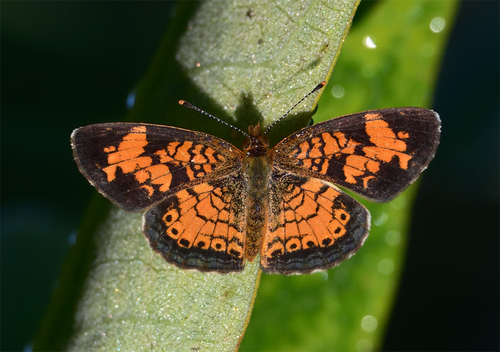
Hackberry Emperor

Hackberry Emperor

Asterocampa celtis

Daily sighting probability ~40% · Likely
at Point Pelee National Park

In 3 days ~80% in a week >90%

163 Verified sightings at Point Pelee National Park From 2019 to 2026
268 In all 5 parks
September Best month
☀️ Diurnal When it's spotted

About the Hackberry Emperor

Asterocampa celtis, the hackberry emperor, is a North American butterfly that belongs to the brushfooted butterfly family, Nymphalidae. It gets its name from the hackberry tree (Celtis occidentalis and others in the genus Celtis) upon which it lays its eggs. The hackberry tree is the only host plant for A. celtis and is the food source for larvae.

The hackberry emperor is known for being a quick, mercurial butterfly. It often is found along water sources and lowlands, although it lives in a broad range of habitats. Another notable characteristic is that it rarely is spotted visiting a flower, which is considered unusual for a butterfly.

Species in the genus Asterocampa are regarded as being "cheater" organisms, since these butterflies do not pollinate flowers when they feed from them. This species can more accurately be described as parasitizing their hosts and plant food sources since they extract nutrients without providing any benefits to the host.

As a member of the family Nymphalidae, the hackberry emperor oviposits its eggs in clutches, or clusters, upon hackberry leaves. There are a few plausible evolutionary reasons for this behavior, but the exact cause for this species' behavior is in contention. Possible explanations include higher fecundity that may be aided by aposematic coloration. Wikipedia →

Global Distribution

Parks Where Found

# Park Country Daily sighting probability
1 Point Pelee National Park 🇨🇦 Canada
~40%
2 Congaree National Park 🇺🇸 United States
~30%
3 Shenandoah National Park 🇺🇸 United States
~10%
4 Zion National Park 🇺🇸 United States
~10%
5 Great Smoky Mountains National Park 🇺🇸 United States
~10%

Cities Where Found

# City Country Daily sighting probability
1 Dallas 🇺🇸 United States
~20%
2 Austin 🇺🇸 United States
~10%
3 Chicago 🇺🇸 United States
~10%
4 San Antonio 🇺🇸 United States
~10%
5 Minneapolis [Saint Paul] 🇺🇸 United States
~10%
6 Houston 🇺🇸 United States
~10%
7 Montreal 🇨🇦 Canada
<5%
8 New York City 🇺🇸 United States
<5%
9 Washington 🇺🇸 United States
<5%
10 Philadelphia 🇺🇸 United States
<5%

Before you go

What are the chances of seeing a Hackberry Emperor in Point Pelee National Park?

Likely

About 40% of wildlife watchers report a Hackberry Emperor sighting in Point Pelee National Park on a given day, based on 163 verified sightings from GBIF citizen-science data from 2019 to 2026. It is the 2nd most-seen of the 196 insects we can rate there. Over three days the chance rises to about 80%, and over a week to over 90%, if each day is a fresh chance.

When is the best time to see a Hackberry Emperor in Point Pelee National Park?

September

In that month about 70% of wildlife watchers report a Hackberry Emperor in Point Pelee National Park on a given day, against under 5% in February–May and November–December, the lowest months.

What time of day is best to see a Hackberry Emperor?

Between 10 am and 1 pm

Across all the parks we cover, that three-hour window holds the most Hackberry Emperor sightings with a recorded time, and about 9 in 10 of them come between 6 am and 6 pm: it is a daytime animal.

Is Point Pelee National Park the best place to see a Hackberry Emperor?

Yes

Of the 5 parks where we can rate Hackberry Emperor sightings, Point Pelee National Park has the highest daily chance: about 40%. Next come Congaree National Park (United States, about 30%) and Shenandoah National Park (United States, about 10%).

Where does the Hackberry Emperor sighting chance come from?

GBIF citizen-science records

It is estimated from how often the Hackberry Emperor is recorded against all the insects logged in Point Pelee National Park (163 verified sightings from 2019 to 2026), calibrated against known sighting rates. Figures are rounded to the nearest 10% because citizen-science data supports honest approximations, not decimals, and months with records from fewer than five people show "—". How it works.

← Back to Point Pelee National Park