

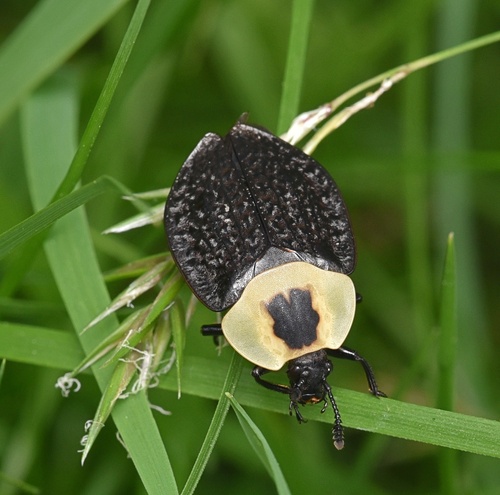
Twice-Stabbed Lady Beetle

Twice-Stabbed Lady Beetle

Chilocorus stigma

Daily sighting probability ~10% · With luck
at Point Pelee National Park

In 3 days ~20% in a week ~40%

5 Verified sightings at Point Pelee National Park From 2019 to 2026
5 In 1 park
October Best month
☀️ Diurnal When it's spotted

About the Twice-Stabbed Lady Beetle

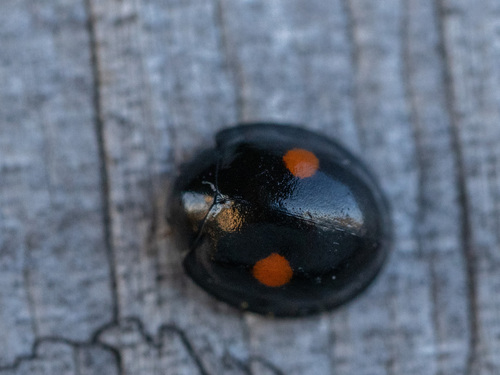
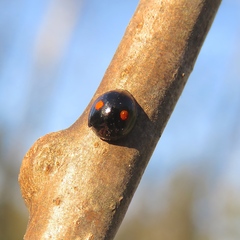
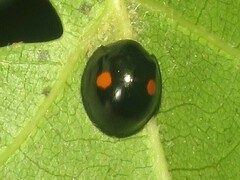
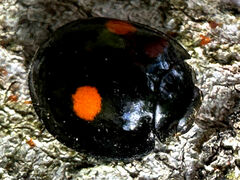
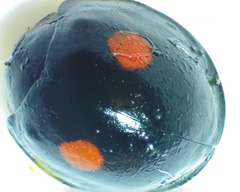
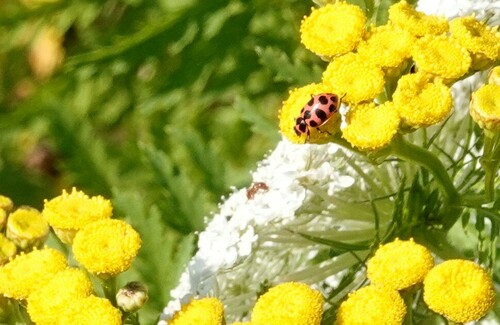
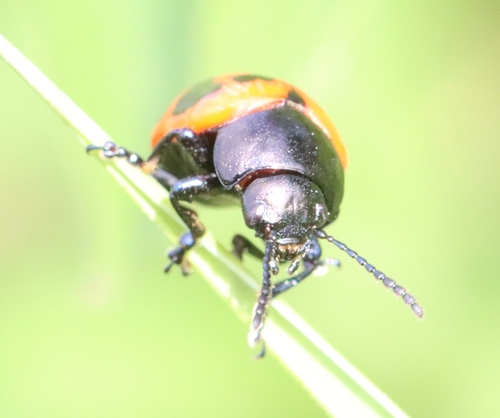
Chilocorus stigma, commonly known as the twice-stabbed ladybug, is a native resident of the United States and Canada. It also has been introduced to Hawaii. It is shiny black, and there is one red spot on each elytron. The remainder of the body is black as well, but the abdomen is either yellow or red. It is sometimes confused with the "two-stabbed lady beetle", Chilocorus orbus, which is widespread in California.

C. stigma mainly lives within terrestrial/arboreal habitats, primarily feeding on aphids found in these habitats as well as scales (such as pine needle scale, beech bark scale and Florida red scale) and mealybugs. It is a beneficial insect, and is useful in both natural wood stands and commercial forests such as orchards and citrus groves. It is beneficial against non native species. An introduced Hemlock pest, the elongate hemlock scale (Fiorinia externa Ferris), which has been doing considerable damage to Hemlock trees throughout North America, can be moderately controlled by the presence of C. stigma. C. stigma is currently not a lady beetle that can be sold for commercial use in orchards or on farms.

Chilocorus... Wikipedia →

Global Distribution

Parks Where Found

# Park Country Daily sighting probability
1 Point Pelee National Park 🇨🇦 Canada
~10%

More parks will be added in future updates.

Cities Where Found

# City Country Daily sighting probability
1 Boston 🇺🇸 United States
~10%
2 Detroit 🇺🇸 United States
<5%
3 Toronto 🇨🇦 Canada
<5%
4 Salt Lake City 🇺🇸 United States
<5%
5 Baltimore 🇺🇸 United States
<5%
6 Philadelphia 🇺🇸 United States
<5%
7 Denver 🇺🇸 United States
<5%
8 Montreal 🇨🇦 Canada
<5%
9 Houston 🇺🇸 United States
<5%
10 Minneapolis [Saint Paul] 🇺🇸 United States
<5%

Before you go

What are the chances of seeing a Twice-Stabbed Lady Beetle in Point Pelee National Park?

With luck

About 10% of wildlife watchers report a Twice-Stabbed Lady Beetle sighting in Point Pelee National Park on a given day, based on 5 verified sightings from GBIF citizen-science data from 2019 to 2026. It is the 167th most-seen of the 196 insects we can rate there. Over three days the chance rises to about 20%, and over a week to about 40%, if each day is a fresh chance.

When is the best time to see a Twice-Stabbed Lady Beetle in Point Pelee National Park?

October

In that month about 20% of wildlife watchers report a Twice-Stabbed Lady Beetle in Point Pelee National Park on a given day, against under 5% in August and November–June, the lowest months.

What time of day is best to see a Twice-Stabbed Lady Beetle?

Between 1 and 4 pm

Across all the parks we cover, that three-hour window holds the most Twice-Stabbed Lady Beetle sightings with a recorded time, and about 8 in 10 of them come between 6 am and 6 pm: it is a daytime animal.

Where else can you see a Twice-Stabbed Lady Beetle?

Only Point Pelee National Park, in our data

Point Pelee National Park is the only park on Wallace's Line with enough records to rate Twice-Stabbed Lady Beetle sightings: about 10% of wildlife watchers there report one on a given day.

Which relatives of the Twice-Stabbed Lady Beetle live in Point Pelee National Park?

Same family: Coccinellidae

The closest relatives of the Twice-Stabbed Lady Beetle that you can see in Point Pelee National Park (family Coccinellidae, Lady Beetles) are Asian Lady Beetle (about 20%), Spotted Pink Lady Beetle (about 20%) and Seven-Spotted Lady Beetle (about 10%), with each one's daily chance of a sighting.

Where does the Twice-Stabbed Lady Beetle sighting chance come from?

GBIF citizen-science records

It is estimated from how often the Twice-Stabbed Lady Beetle is recorded against all the insects logged in Point Pelee National Park (5 verified sightings from 2019 to 2026), calibrated against known sighting rates. Figures are rounded to the nearest 10% because citizen-science data supports honest approximations, not decimals, and months with records from fewer than five people show "—". How it works.

← Back to Point Pelee National Park