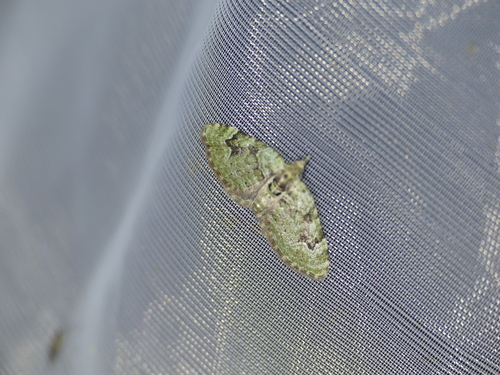
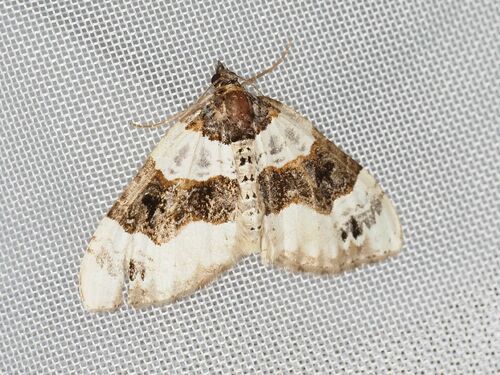
Common White Wave

Common White Wave

Cabera pusaria

Daily sighting probability <5% · Rare
at Pyrénées National Park

In 3 days ~10% in a week ~30%

11 Verified sightings at Pyrénées National Park From 2019 to 2026
135 In all 6 parks
June Best month
☀️🌙 Day & Night When it's spotted

About the Common White Wave

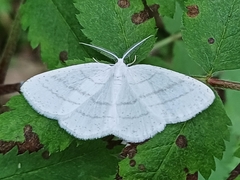
The common white wave (Cabera pusaria) is a moth of the family Geometridae. The species was first described by Carl Linnaeus in his 1758 10th edition of Systema Naturae. It is found throughout the Palearctic region. Their habitat is deciduous forests and their surroundings.

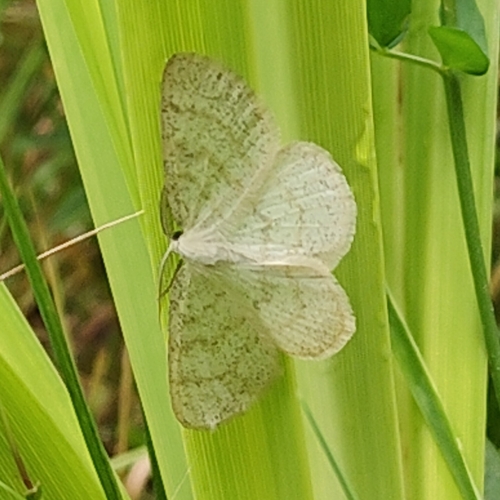
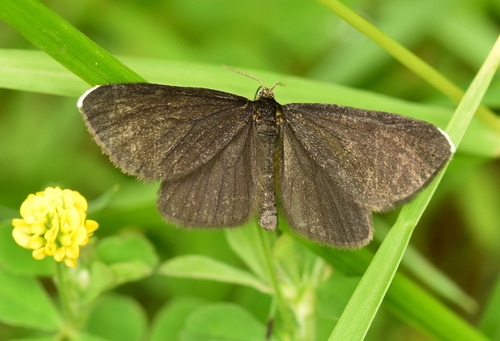
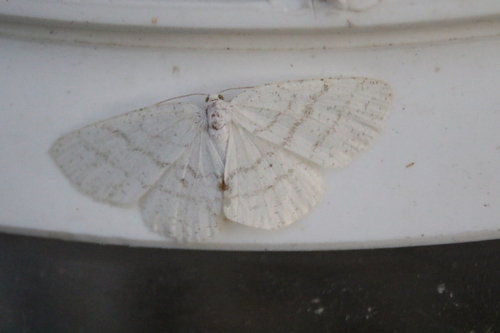
This species has white wings, sometimes tinged with pink, slight grey dusted grey and with fine grey fascia (the first curved) on the forewing and two on the hindwing. ab. heveraria H.-Schiff. is a rare form in which the grey dusting densely covers almost the entire wings. ab. rotundaria Haw. is a rounder-winged form with the first lines strongly approximated and said to be the product of under-feeding the larvae. Hybrid fletcheri Tutt (pusaria male x exanthemata female) is just intermediate between the parent forms, rather pure white, the lines tinged with ochreous. The wingspan is 32–35 mm.

One or two broods are produced each year and the adults can be seen at any time from May to August.[1] This moth flies at night and is attracted to light. The larva is elongate, with a rather flattened head is very variable -green with purplish brown or blackish dorsal spots sometimes vague, purplish-brown... Wikipedia →

Global Distribution

Parks Where Found

# Park Country Daily sighting probability
1 Cairngorms National Park 🇬🇧 United Kingdom
~10%
2 Snowdonia National Park 🇬🇧 United Kingdom
~10%
3 Bavarian Forest National Park 🇩🇪 Germany
~10%
4 Wadden Sea National Park 🇩🇪 Germany
~10%
5 Cévennes National Park 🇫🇷 France
~10%
6 Pyrénées National Park 🇫🇷 France
<5%

Cities Where Found

# City Country Daily sighting probability
1 Liverpool 🇬🇧 United Kingdom
~10%
2 Porto 🇵🇹 Portugal
~10%
3 Birmingham 🇬🇧 United Kingdom
~10%
4 Manchester 🇬🇧 United Kingdom
~10%
5 London 🇬🇧 United Kingdom
<5%
6 Helsinki 🇫🇮 Finland
<5%
7 Essen 🇩🇪 Germany
<5%
8 Berlin 🇩🇪 Germany
<5%
9 Moscow 🇷🇺 Russia
<5%
10 Saint Petersburg 🇷🇺 Russia
<5%

Before you go

What are the chances of seeing a Common White Wave in Pyrénées National Park?

Rare

Under 5% of wildlife watchers report a Common White Wave sighting in Pyrénées National Park on a given day, based on 11 verified sightings from GBIF citizen-science data from 2019 to 2026. It is the 703rd most-seen of the 1277 insects we can rate there. Over three days the chance rises to about 10%, and over a week to about 30%, if each day is a fresh chance.

When is the best time to see a Common White Wave in Pyrénées National Park?

May–June and August

In those months about 10% of wildlife watchers report a Common White Wave in Pyrénées National Park on a given day, against under 5% in July and September–April, the lowest months.

What time of day is best to see a Common White Wave?

Between 11 pm and 2 am

Across all the parks we cover, that three-hour window holds the most Common White Wave sightings with a recorded time, and about half of them come between 6 am and 6 pm: it is seen both by day and at night.

Where does the Common White Wave sighting chance come from?

GBIF citizen-science records

It is estimated from how often the Common White Wave is recorded against all the insects logged in Pyrénées National Park (11 verified sightings from 2019 to 2026), calibrated against known sighting rates. Figures are rounded to the nearest 10% because citizen-science data supports honest approximations, not decimals, and months with records from fewer than five people show "—". How it works.

← Back to Pyrénées National Park