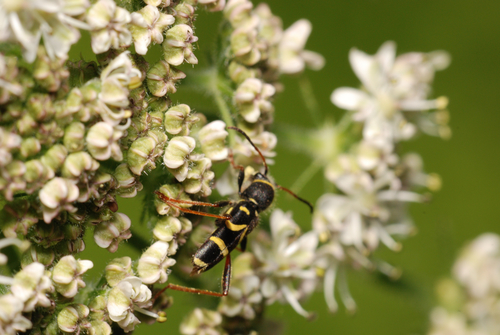
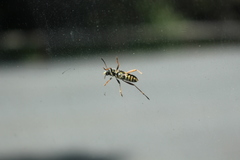
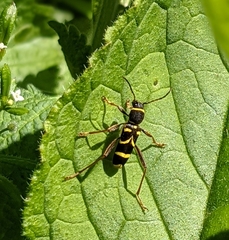
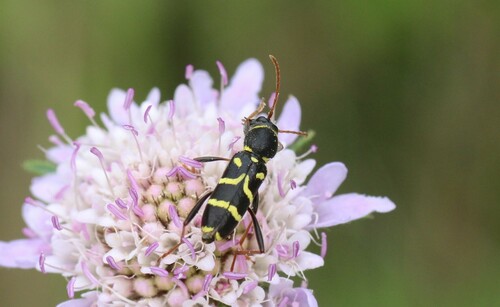
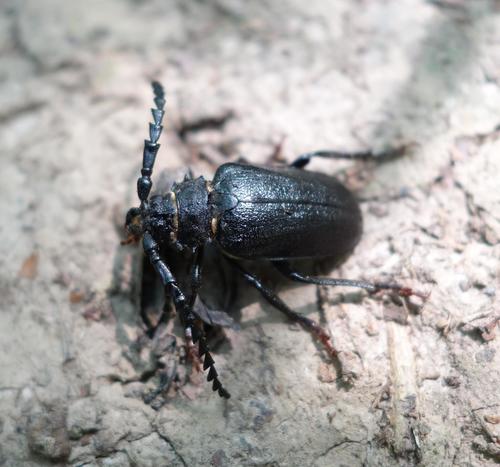
Wasp Beetle

Wasp Beetle

Clytus arietis

Daily sighting probability ~10% · With luck
at Pyrénées National Park

In 3 days ~20% in a week ~30%

19 Verified sightings at Pyrénées National Park From 2019 to 2026
105 In all 6 parks
May Best month
☀️ Diurnal When it's spotted

About the Wasp Beetle

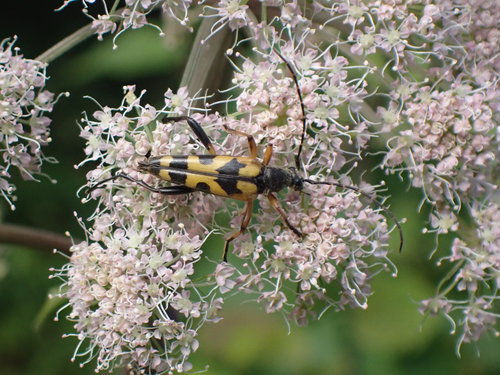
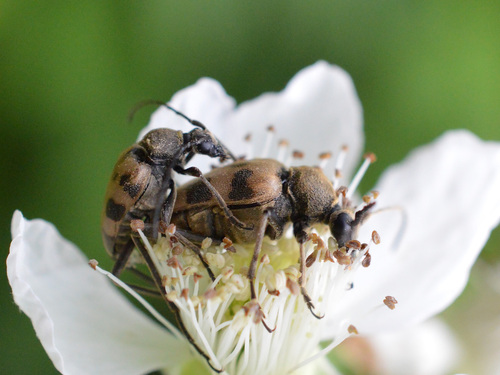
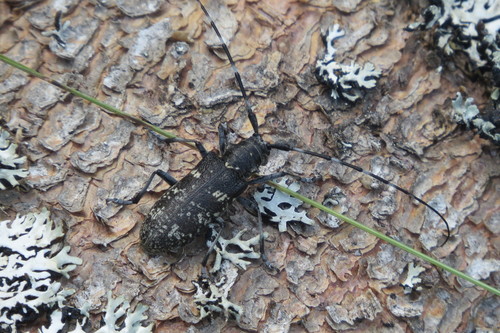
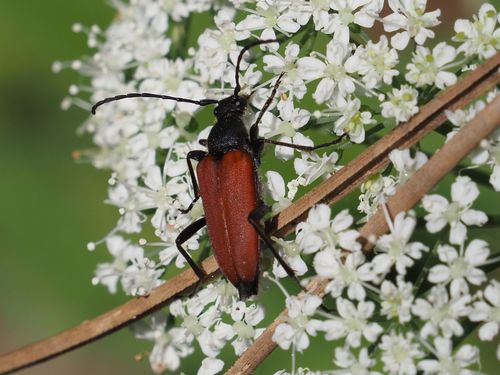
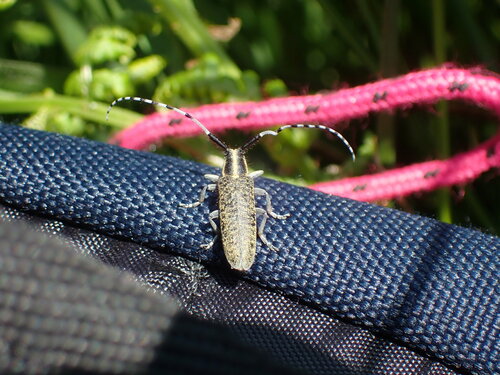
Clytus arietis, the wasp beetle, is a wasp-mimicking longhorn beetle species in the genus Clytus belonging to the family Cerambycidae. Renowned for its mimicry of wasps, this beetle exhibits black and yellow coloration and behaviors that deter potential predators.

Measuring between 9 and 18 millimeters in length, Clytus arietis is prevalent across Europe and is typically observed from May to July. Adults are frequently found on flowers and decaying wood, where they feed on pollen. The larvae develop in dead or decaying wood, playing a role in the decomposition process. Despite their wasp-like appearance, wasp beetles are harmless to humans and contribute to the ecosystem by aiding in wood decomposition.

It reaches 9–18 millimetres (0.35–0.71 in) in length. It features prominent yellow and black patterns along its head and abdomen, in what is believed to be an evolutionary attempt to mimic wasps and avoid predation. It also possesses thin legs and antennae that move in small, quick movements, which supports the wasp-mimicking hypothesis. It has relatively short antennae compared to other beetles of the same Family. Usually, other longhorn beetles will also... Wikipedia →

Global Distribution

Parks Where Found

# Park Country Daily sighting probability
1 Bavarian Forest National Park 🇩🇪 Germany
~10%
2 Ecrins National Park 🇫🇷 France
~10%
3 Cévennes National Park 🇫🇷 France
~10%
4 Wadden Sea National Park 🇩🇪 Germany
~10%
5 Snowdonia National Park 🇬🇧 United Kingdom
~10%
6 Pyrénées National Park 🇫🇷 France
~10%

Cities Where Found

# City Country Daily sighting probability
1 Essen 🇩🇪 Germany
~10%
2 Copenhagen 🇩🇰 Denmark
~10%
3 Birmingham 🇬🇧 United Kingdom
~10%
4 Hamburg 🇩🇪 Germany
~10%
5 London 🇬🇧 United Kingdom
~10%
6 Amsterdam 🇳🇱 Netherlands
~10%
7 Cologne 🇩🇪 Germany
~10%
8 Budapest 🇭🇺 Hungary
~10%
9 Rotterdam [The Hague] 🇳🇱 Netherlands
~10%
10 Brussels 🇧🇪 Belgium
~10%

Before you go

What are the chances of seeing a Wasp Beetle in Pyrénées National Park?

With luck

About 10% of wildlife watchers report a Wasp Beetle sighting in Pyrénées National Park on a given day, based on 19 verified sightings from GBIF citizen-science data from 2019 to 2026. It is the 458th most-seen of the 1277 insects we can rate there. Over three days the chance rises to about 20%, and over a week to about 30%, if each day is a fresh chance.

When is the best time to see a Wasp Beetle in Pyrénées National Park?

March to July

In those months about 10% of wildlife watchers report a Wasp Beetle in Pyrénées National Park on a given day, against under 5% in August to February, the lowest months.

What time of day is best to see a Wasp Beetle?

Between noon and 3 pm

Across all the parks we cover, that three-hour window holds the most Wasp Beetle sightings with a recorded time, and about 9 in 10 of them come between 6 am and 6 pm: it is a daytime animal.

Is Pyrénées National Park the best place to see a Wasp Beetle?

Among the best

Of the 6 parks where we can rate Wasp Beetle sightings, Pyrénées National Park ranks 6th at about 10%, level with the leaders once rounded. The best odds are in Bavarian Forest National Park (Germany, about 10%), Ecrins National Park (France, about 10%) and Cévennes National Park (France, about 10%).

Where does the Wasp Beetle sighting chance come from?

GBIF citizen-science records

It is estimated from how often the Wasp Beetle is recorded against all the insects logged in Pyrénées National Park (19 verified sightings from 2019 to 2026), calibrated against known sighting rates. Figures are rounded to the nearest 10% because citizen-science data supports honest approximations, not decimals, and months with records from fewer than five people show "—". How it works.

← Back to Pyrénées National Park