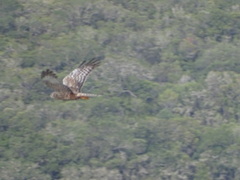
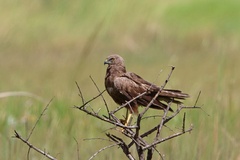
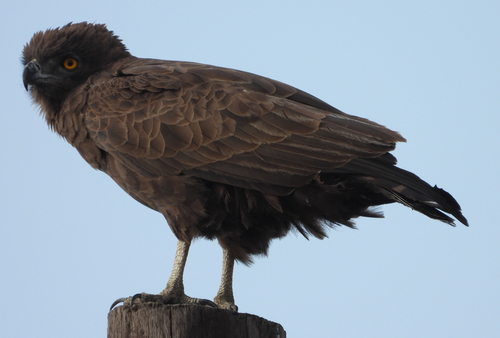
African Marsh-Harrier

African Marsh-Harrier

Circus ranivorus

Silhouette: Shyamal · PhyloPic

LCLeast ConcernNTVUENCR
Daily sighting probability <5% · Rare
at Queen Elizabeth National Park

In 3 days ~10% in a week ~20%

58 Verified sightings at Queen Elizabeth National Park From 2019 to 2026
1,704 In all 23 parks
March Best month
☀️ Diurnal When it's spotted

About the African Marsh-Harrier

The African marsh harrier (Circus ranivorus) is a bird of prey belonging to the harrier genus Circus. It is largely resident in wetland habitats in southern, central and eastern Africa from South Africa north to South Sudan.

African Marsh harrier females are larger than males and they are 44–47 centimetres (17–19 in) in length, with females being about 30% heavier than males (Simmons and Simmons 2000). Adults, (like the male bird right) have yellow eyes, but brown eyes when immature. Both sexes are mostly brown with pale streakings on the head, breast, forewing and rufous on the thighs and the belly. Adult males differ from females in that they have a pale grey wash to the dorsal secondaries and primaries. The female's are brown. The juvenile is dark brown and may have a pale breastband and pale markings on the head. The tail and flight feathers have dark barring at all ages, but this is rarely visible in the juvenile birds.

It resembles a small Eurasian marsh harrier but is slimmer and paler brown. It could be mistaken for an immature Montagu's harrier or pallid harrier, but the African marsh harrier can be readily distinguished from them by its lack of a white rump... Wikipedia →

Sounds

Call0:41

South Africa · 2018

© Lynette Rudman · XC433948 · CC BY-NC-SA 4.0

Global Distribution

Parks Where Found

# Park Country Daily sighting probability
1 West Coast National Park 🇿🇦 South Africa
~40%
2 Akagera National Park 🇷🇼 Rwanda
~10%
3 Chobe National Park 🇧🇼 Botswana
~10%
4 Moremi Game Reserve 🇧🇼 Botswana
~10%
5 iSimangaliso Wetland Park 🇿🇦 South Africa
~10%
6 Murchison Falls National Park 🇺🇬 Uganda
~10%
7 Arusha National Park 🇹🇿 Tanzania
~10%
8 Ngorongoro Conservation Area 🇹🇿 Tanzania
~10%
9 Lake Mburo National Park 🇺🇬 Uganda
<5%
10 Queen Elizabeth National Park 🇺🇬 Uganda
<5%
11 Garden Route National Park 🇿🇦 South Africa
<5%
12 Tarangire National Park 🇹🇿 Tanzania
<5%
13 Kidepo Valley National Park 🇺🇬 Uganda
<5%
14 Kafue National Park 🇿🇲 Zambia
<5%
15 Serengeti National Park 🇹🇿 Tanzania
<5%
16 Amboseli National Park 🇰🇪 Kenya
<5%
17 Addo Elephant National Park 🇿🇦 South Africa
<5%
18 De Hoop Nature Reserve 🇿🇦 South Africa
<5%
19 Virunga National Park 🇨🇩 Democratic Republic of the Congo
<5%
20 uMkhuze Game Reserve 🇿🇦 South Africa
<5%
21 Tsavo West National Park 🇰🇪 Kenya
<5%
22 Lake Nakuru National Park 🇰🇪 Kenya
<5%
23 Table Mountain National Park 🇿🇦 South Africa
<5%

Cities Where Found

# City Country Daily sighting probability
1 Kigali 🇷🇼 Rwanda
<5%
2 Kampala 🇺🇬 Uganda
<5%
3 Cape Town 🇿🇦 South Africa
<5%
4 Harare 🇿🇼 Zimbabwe
<5%

Before you go

What are the chances of seeing an African Marsh-Harrier in Queen Elizabeth National Park?

Rare

Under 5% of wildlife watchers report an African Marsh-Harrier sighting in Queen Elizabeth National Park on a given day, based on 58 verified sightings from GBIF citizen-science data from 2019 to 2026. It is the 238th most-seen of the 434 birds we can rate there. Over three days the chance rises to about 10%, and over a week to about 20%, if each day is a fresh chance.

When is the best time to see an African Marsh-Harrier in Queen Elizabeth National Park?

March

In that month about 30% of wildlife watchers report an African Marsh-Harrier in Queen Elizabeth National Park on a given day, against under 5% in May to November, the lowest months.

What time of day is best to see an African Marsh-Harrier?

Between 8 and 11 am

Across all the parks we cover, that three-hour window holds the most African Marsh-Harrier sightings with a recorded time, and about 9 in 10 of them come between 6 am and 6 pm: it is a daytime animal.

Is Queen Elizabeth National Park the best place to see an African Marsh-Harrier?

10th of 23

Of the 23 parks where we can rate African Marsh-Harrier sightings, Queen Elizabeth National Park ranks 10th at under 5%. The best odds are in West Coast National Park (South Africa, about 40%), Akagera National Park (Rwanda, about 10%) and Chobe National Park (Botswana, about 10%).

Where does the African Marsh-Harrier sighting chance come from?

GBIF citizen-science records

It is estimated from how often the African Marsh-Harrier is recorded against all the birds logged in Queen Elizabeth National Park (58 verified sightings from 2019 to 2026), calibrated against known sighting rates. Figures are rounded to the nearest 10% because citizen-science data supports honest approximations, not decimals, and months with records from fewer than five people show "—". How it works.

← Back to Queen Elizabeth National Park