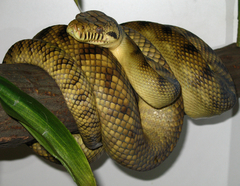
Amethyst Python

Amethyst Python

Simalia amethistina

Silhouette: SeismicShrimp · PhyloPic

LCLeast ConcernNTVUENCR
Daily sighting probability ~30% · Possible
at Raja Ampat

In 3 days ~60% in a week ~90%

20 Verified sightings at Raja Ampat From 2019 to 2026
20 In 1 park
May Best month
☀️🌙 Day & Night When it's spotted

About the Amethyst Python

The amethystine python (Simalia amethistina, formerly known as Morelia amethistina), also known as the scrub python or sanca permata in Indonesian, is a species of non-venomous snake in the family Pythonidae. The species is found in Indonesia and Papua New Guinea. Popular among reptile enthusiasts, and noted for its coloration and size, it is one of the largest snakes in the world, as measured either by length or weight, and is the largest native snake in Papua New Guinea. Until 2000, the larger Australian species S. kinghorni was generally considered a subspecies of S. amethistina, and this change of classification has still not been universally reflected in literature. Because of this issue, S. amethistina has often been described as the largest snake in Australia, but this is not accurate since under the current classification, this species does not occur in Australia.

Formerly, five subspecies of Morelia amethistina, including the nominate race, M. a. amethystina, were generally recognized. The Moluccan Islands (including Halmahera, Ternate and Tidore) are home to the former M. a. tracyae. The Tanimbar Islands are home to a smaller subspecies, the former M. a. nauta... Wikipedia →

Global Distribution

Parks Where Found

# Park Country Daily sighting probability
1 Raja Ampat 🇮🇩 Indonesia
~30%

More parks will be added in future updates.

Zoos & Centres Where Found

# Zoo / Centre Country
1 Moscow Zoo 🇷🇺 Russia In captivity
2 Pairi Daiza 🇧🇪 Belgium In captivity
3 Columbus Zoo and Aquarium 🇺🇸 United States In captivity
4 Kyiv Zoo 🇺🇦 Ukraine In captivity
5 Wrocław Zoological Garden 🇵🇱 Poland In captivity
6 Taronga Zoo 🇦🇺 Australia In captivity
7 Faunia 🇪🇸 Spain In captivity
8 Bali Bird Park 🇮🇩 Indonesia In captivity
9 Siam Serpentarium 🇹🇭 Thailand In captivity
10 Snake Farm of Queen Saovabha Memorial Institute 🇹🇭 Thailand In captivity
11 Africarium 🇵🇱 Poland In captivity
12 Cairns Aquarium 🇦🇺 Australia In captivity
13 Aquarium River of Zaragoza 🇪🇸 Spain In captivity
14 Bristol Zoo 🇬🇧 United Kingdom In captivity
15 Port Moresby Nature Park 🇵🇬 Papua New Guinea In captivity
16 terrarium ogrodu zoologicznego we Wrocławiu 🇵🇱 Poland In captivity
17 Vivarium de Meyrin 🇨🇭 Switzerland In captivity

Before you go

What are the chances of seeing an Amethyst Python in Raja Ampat?

Possible

About 30% of wildlife watchers report an Amethyst Python sighting in Raja Ampat on a given day, based on 20 verified sightings from GBIF citizen-science data from 2019 to 2026. It is the 13th most-seen of the 33 reptiles we can rate there. Over three days the chance rises to about 60%, and over a week to about 90%, if each day is a fresh chance.

When is the best time to see an Amethyst Python in Raja Ampat?

May

In that month about 50% of wildlife watchers report an Amethyst Python in Raja Ampat on a given day, against under 5% in June and December–February, the lowest months.

What time of day is best to see an Amethyst Python?

Between 7 and 10 pm

Across all the parks we cover, that three-hour window holds the most Amethyst Python sightings with a recorded time, and about 6 in 10 of them come between 6 pm and 6 am: it is seen both by day and at night.

Where else can you see an Amethyst Python?

Only Raja Ampat, in our data

Raja Ampat is the only park on Wallace's Line with enough records to rate Amethyst Python sightings: about 30% of wildlife watchers there report one on a given day.

Which relatives of the Amethyst Python live in Raja Ampat?

Same family: Pythonidae

The closest relatives of the Amethyst Python that you can see in Raja Ampat (family Pythonidae, Pythons) are Green Python (about 30%) and D’Albertis' Python (about 30%), with each one's daily chance of a sighting.

Where does the Amethyst Python sighting chance come from?

GBIF citizen-science records

It is estimated from how often the Amethyst Python is recorded against all the reptiles logged in Raja Ampat (20 verified sightings from 2019 to 2026), calibrated against known sighting rates. Figures are rounded to the nearest 10% because citizen-science data supports honest approximations, not decimals, and months with records from fewer than five people show "—". How it works.

← Back to Raja Ampat