D’Albertis' Python

D’Albertis' Python

Leiopython albertisii

Silhouette: SeismicShrimp · PhyloPic

LCLeast ConcernNTVUENCR
Daily sighting probability ~30% · Possible
at Raja Ampat

In 3 days ~60% in a week ~90%

17 Verified sightings at Raja Ampat From 2019 to 2026
17 In 1 park
February Best month
☀️🌙 Day & Night When it's spotted

About the D’Albertis' Python

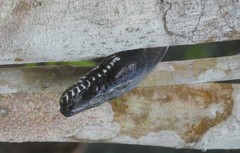
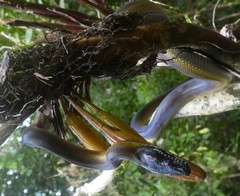
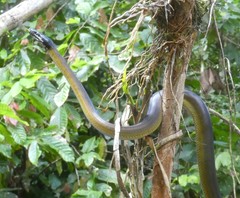
D'Albertis' python (Leiopython albertisii), also known commonly as D'Albert's water python or the northern white-lipped python, is a species of python, a non-venomous snake in the family Pythonidae. The species is endemic to New Guinea. There are no subspecies that are recognized as being valid.

L. albertisii is found in most of New Guinea below 1,200 m (3,900 ft), including the islands of Salawati and Biak, Normanby, Mussau and Emirau, as well as a few islands in the Torres Strait. The type locality given is "Kapaor in Nova Guinea boreali occidentali... et prope Andai ". The authors also stated localities for two additional specimens: "... un esemplare a Kapaor fra i Papua Onin..." and "... un secondo esemplare ad Andai presso Dorei..." (= Kapaur, Onin Peninsula and Andai, near Doreri, West Papua, Indonesia).

The specific name, albertisii, is in honor of Italian explorer Luigi D'Albertis.... Wikipedia →

Global Distribution

Parks Where Found

# Park Country Daily sighting probability
1 Raja Ampat 🇮🇩 Indonesia
~30%

More parks will be added in future updates.

Zoos & Centres Where Found

# Zoo / Centre Country
1 San Diego Zoo 🇺🇸 United States In captivity
2 Prague Zoo 🇨🇿 Czechia In captivity
3 Safari Madrid 🇪🇸 Spain In captivity
4 Shenzhen Safari Park 🇨🇳 China In captivity
5 Catoctin Wildlife Preserve and Zoo 🇺🇸 United States In captivity
6 Singapore Zoo 🇸🇬 Singapore In captivity
7 Reptile Gardens 🇺🇸 United States In captivity
8 St. Augustine Alligator Farm Zoological Park 🇺🇸 United States In captivity
9 Siam Serpentarium 🇹🇭 Thailand In captivity
10 Snake Farm of Queen Saovabha Memorial Institute 🇹🇭 Thailand In captivity
11 Rákosův pavilon 🇨🇿 Czechia In captivity
12 Velemlokárium 🇨🇿 Czechia In captivity
13 Vivarium de Meyrin 🇨🇭 Switzerland In captivity

Before you go

What are the chances of seeing a D’Albertis' Python in Raja Ampat?

Possible

About 30% of wildlife watchers report a D’Albertis' Python sighting in Raja Ampat on a given day, based on 17 verified sightings from GBIF citizen-science data from 2019 to 2026. It is the 16th most-seen of the 33 reptiles we can rate there. Over three days the chance rises to about 60%, and over a week to about 90%, if each day is a fresh chance.

When is the best time to see a D’Albertis' Python in Raja Ampat?

February and August

In those months about 40% of wildlife watchers report a D’Albertis' Python in Raja Ampat on a given day, against under 5% in June and October, the lowest months.

What time of day is best to see a D’Albertis' Python?

Between 9 pm and midnight

Across all the parks we cover, that three-hour window holds the most D’Albertis' Python sightings with a recorded time, and about 6 in 10 of them come between 6 pm and 6 am: it is seen both by day and at night.

Where else can you see a D’Albertis' Python?

Only Raja Ampat, in our data

Raja Ampat is the only park on Wallace's Line with enough records to rate D’Albertis' Python sightings: about 30% of wildlife watchers there report one on a given day.

Which relatives of the D’Albertis' Python live in Raja Ampat?

Same family: Pythonidae

The closest relatives of the D’Albertis' Python that you can see in Raja Ampat (family Pythonidae, Pythons) are Green Python (about 30%) and Amethyst Python (about 30%), with each one's daily chance of a sighting.

Where does the D’Albertis' Python sighting chance come from?

GBIF citizen-science records

It is estimated from how often the D’Albertis' Python is recorded against all the reptiles logged in Raja Ampat (17 verified sightings from 2019 to 2026), calibrated against known sighting rates. Figures are rounded to the nearest 10% because citizen-science data supports honest approximations, not decimals, and months with records from fewer than five people show "—". How it works.

← Back to Raja Ampat